
Common roof problems · 9 min read
The most common roof problems and how they are repaired
Roofs fail in a small number of ways, and nearly all of them start at an edge, a joint or a fixing. Here is each fault, how to spot it, and how a repair is normally carried out.
Roof trouble looks varied from inside the house. A brown ring on the ceiling, a drip in the loft, a cold bedroom, a gutter pouring over the front door in a downpour. Up on the roof the causes narrow down fast. Water gets in where one surface meets another, where a fixing has let go, or where the covering has simply worn through, and a surprising number of leaks trace back to the same dozen weak spots.
Knowing those spots helps in two ways. You can look for early signs from the garden or the loft before a stain appears, and you can judge whether a roofer's proposed repair matches the fault. A repair that suits the cause is quick and modest. A repair aimed at the wrong target is how people pay twice.
This guide goes through the problems in the order they usually show up, with the repair that normally follows each. Prices, where given, are national ranges from named guides, never a quote for your roof, and our roof repairs page explains how we work from survey to written quote.
Slipped, cracked and missing tiles or slates
Loose and broken covering is the fault that comes to mind first when roof repair is mentioned, and it is often the easiest to cure. After a gale you may find a tile on the lawn, or a bare patch where one has gone. Cracked tiles are quieter: a hairline split lets rain run through to the underlay, and the damage grows slowly.
The repair is to lift the surrounding tiles, remove the broken piece, check the batten under it and fit a matching replacement, secured with the clip or nail the tile type calls for. Matching matters. Old clay tiles vary in size and shade, and a mismatched patch stands out from the road for years, so a roofer may salvage tiles from a hidden slope to use on the visible one.
Why they slip in the first place
A single slipped slate may be bad luck. Several in a line suggest the fixings have weakened, and that is a different job, covered in our guide to nail sickness on slate and tile roofs. A tile standing higher than the ones beside it suggests a batten that has shifted or rotted away. Where a loft inspection shows daylight round a tile, the batten is the first thing to check.
Checkatrade's national table, last updated in June 2026, puts repair rates per square metre at £90 to £120 for concrete tile, £110 to £160 for clay and £150 to £220 for natural slate, before VAT. A few tiles replaced from a ladder is a small job, while a larger area that needs scaffold access costs a good deal more.
Ridges, hips and verges that have loosened
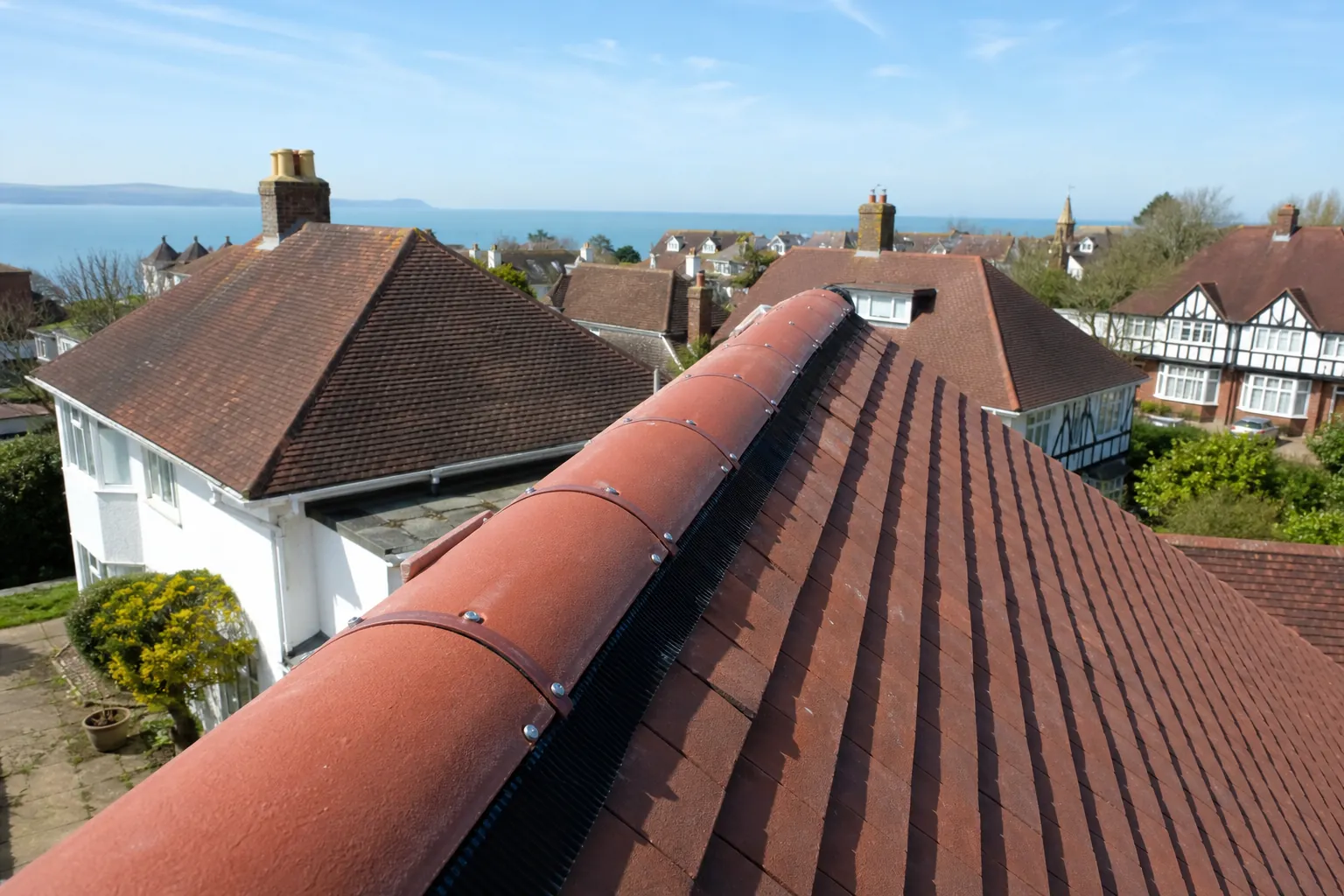
Three terms first. At the apex sits the ridge, a row of curved or angled capping tiles. Hips continue those cappings down the angled corners of a hipped roof. The verge is the side edge above a gable wall, where the final tiles project beyond the brickwork. These parts of a pitched roof take heavy punishment, because the wind lifts at them from several directions.
Signs of trouble are cracked mortar along the ridge, capping tiles sitting at an angle, mortar crumbs in the gutter and, at the verge, tiles that no longer bed neatly on the wall. Left alone, a loose capping eventually slides off and exposes the joint below it to rain, and a replacement then means a call-out in poor weather. Looking up from the garden after a gale is a cheap way to catch the problem early.
How a ridge or verge is repaired
The older approach re-bedded the cappings in mortar. BS 5534, revised in 2014, no longer trusts a bed of mortar alone with the capping tiles, so a sound repair adds a screw or clip to each. BS 8612:2018 sets out the tests for dry-fix kits that leave mortar out altogether. We fix ridges and verges mechanically as standard, and that is one of the details that divides a tidy roof from a tired one.
Checkatrade gives ridge tile repairs at £50 to £70 per metre, and a full dry ridge on a semi at around £800. Our ridge tile repairs page covers the work in more depth.
Flashings, valleys and chimney junctions
Wherever the covering stops at a wall, a stack or a higher slope, sheet metal bridges the gap. The flashing is the lead strip that makes that joint watertight. The valley is the internal angle between two slopes, and it drains a large area, so it works hard. Soakers are little folded lead sheets interleaved with the tile courses next to a wall.
Failed junctions cause some of the most stubborn leaks, because rain can run along a timber for some distance before it drips through, far from the spot where it entered. Cracked pointing along a flashing, a lifted edge, a split in the lead and a chimney that stains the wall below are all warning signs.
Repair options
A minor lift can be dressed back down, though it is worth asking why it lifted; if the cause was a poor fixing, the same edge will lift again. A split or perished flashing is better replaced in lead. Lead comes in numbered codes that grade its thickness: code 4 is the lightest listed by Royston Lead for flashings, with codes 5 and 6 specified for heavier duty. A slipping valley lining may be renewed, with the surrounding tiles lifted and relaid.
On chimneys, MyJobQuote (updated 22 September 2026) prices a patch to the lead at £150 to £250, and full replacement at £350 to £460 without scaffolding or £700 to £920 with it. The flaunching, the mortar bed that seats the chimney pots, should also be checked while the stack is accessible.
Lead flashing is one of the long-lived parts of a roof. MyJobQuote says it can last over 80 years, so a flashing that fails early usually points to a fixing or dressing fault. Our lead roofing and leadwork page explains the specifications.
Flat roof splits, blisters and ponding
With so little slope to shed water, a flat roof relies entirely on an unbroken covering. The common faults are splits, usually at seams and upstands, blisters where trapped moisture has lifted a felt layer, and water that stands in puddles for days after rain.
Felt, EPDM and GRP each have habits. Torch-on felt cracks and blisters as it ages. EPDM, a rubber membrane supplied as one large sheet, can fail at its joints or where it has been punctured. GRP, which is fibreglass and resin applied wet and left to harden in place, can craze or crack where the deck beneath moves. The Less guide, updated in March 2026, puts small flat roof repairs at £150 to £500 and gives felt 10 to 20 years, GRP 25 to 40 and EPDM 30 to 50.
Falls and the wet deck
Standing water is a design problem as well as a nuisance. BS 6229:2025, which replaced the 2018 edition in December 2025, keeps a minimum finished fall of 1:80, and roofers usually aim for about 1:40 at design stage to make sure it ends up draining. A roof that ponds will fail again after a patch. The deck underneath matters just as much: a soft, stained or spongy board tells you moisture has been reaching it over a long period, and such boards must be renewed before any new covering goes down.
A small split in sound felt or a punctured EPDM sheet is a reasonable repair. Ponding over a soft deck is usually a re-cover, and it is priced as one. Our flat roofing page sets out the options.
Gutters, fascias and where the water goes
A roof sheds its water into the gutters, so a gutter fault can look like a roof fault. Overflow staining on the wall, a green streak below a joint, and water cascading over the front of the gutter in rain are all signs of the system failing, and they can soak the fascia board and the rafter ends behind it.
Fascias are the long boards at the eaves that carry the gutters, while soffits line the underside of the overhang and are mostly out of sight from the garden. Either can rot when a leaking gutter wets it over several winters, and spotting the stain early saves a larger repair.
Typical gutter faults
A blocked gutter is the simplest case: leaves, moss washed from the roof and silt collect until the water has nowhere to go. A joint that has dried out leaks at the seam. Sagging gutters hold water because the fall has been lost, and brackets can rust or work loose. Manufacturer guidance, from Brett Martin, calls for a fall of about 1mm for every 600mm of gutter, with brackets no more than 900mm apart, and other makers give similar figures, so a gutter that sags is out of specification.
Clearing and refixing is a modest job. Replacing perished fascias, soffits and gutters costs more, and Checkatrade puts fascias and soffits at around £150 per linear metre. Our guttering, soffits and fascias page covers the work.
If a gutter spills only in heavy rain, suspect a blockage before blaming its size, and clear it first.
Condensation, moss and the slow problems
Not every roof problem leaks. Some quietly damage the house over years, and a few get mistaken for leaks.
Condensation in the loft
Damp timbers and a musty smell in the loft can come from moist household air rising into the cold space under the roof, with no hole in the covering at all. Ventilation at the eaves is how that moisture escapes. BS 5250 covers moisture management in buildings. Marley's advice, for a cold roof beneath a high-resistance underlay, is a 25mm ventilation gap along the eaves at pitches up to 15 degrees, and 10mm at steeper pitches. Blocked eaves, stuffed insulation and a missing vent all cause trouble. A roofer who sees damp without a matching leak should check ventilation before suggesting a repair.
Moss and lichen
Moss holds moisture against the covering and clogs gutters when it falls. A light growth is mainly cosmetic, whereas a thick mat is worth removing gently, and the gutters below should be cleared afterwards. Pressure washing can strip the surface of some tiles, so softer methods suit older coverings. Our roof cleaning and moss removal page covers the options.
Age and the slow failures
Underlay perishes, battens rot and the covering reaches the end of its service. Marley expects concrete tiles to give around 60 years, a figure it says is not a warranty, and well-kept slate can run past 100. Our companion guide on repair or replace helps when several of these faults appear together.
Questions
Roof problems: short answers
Can a roof leak with no tiles missing?
Yes. Water more often enters at a junction than through a gap in the covering. A split flashing, a failed valley lining, a cracked underlay behind a sound-looking tile or a blocked gutter can all let rain in. The stain on the ceiling is often some distance from the entry point, so the cause needs tracing on the roof.
Is a damp patch on the ceiling always a roof leak?
No. Condensation from a poorly ventilated loft, a leaking pipe or an overflowing gutter can produce the same mark. Watching when it appears helps: if it follows driving rain, suspect the roof; if it shows in cold, still weather, suspect moisture and ventilation. A survey separates the possibilities.
Which roof faults are safe to leave for a while?
Cosmetic moss, a hairline-cracked ridge mortar joint and a stable stain are usually not urgent, though each deserves a look. Active drips, loose cappings, slipping tiles and lifted flashings are better dealt with soon, because one more gale or heavy shower can make the eventual bill bigger.