
Nail sickness · 9 min read
Nail sickness on slate and tile roofs: signs and repair
A slate or tile roof can look intact for years after its fixings have started to fail. This guide explains what nail sickness is, how to recognise it early, and the three ways it is put right.
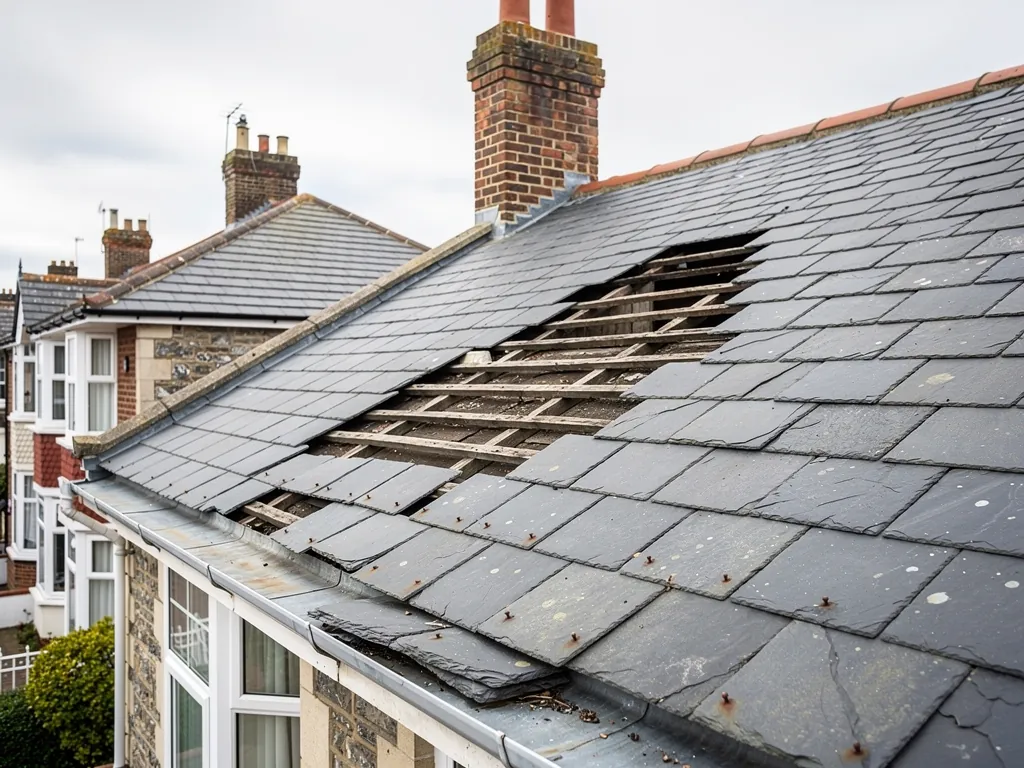
Slate is among the longest-lived roofing materials there is. On CORC's figures a well-maintained natural slate roof can see out a century and more. Yet slate roofs of far less age start dropping slates. The slate is usually fine. What gave up is the small piece of metal that held it.
Roofers call this nail sickness. A slate hangs from a nail driven through a hole near its head, into the batten beneath, and the slates in the course above overlap the nail so rain never touches it. The whole covering therefore depends on a few thousand small fixings that nobody can see. When they weaken, slates begin to slip, one here and another there, and a roof that looked sound starts to leak.
It matters because the repair you choose depends on how far it has gone. A few slipped slates call for a modest repair. A slope full of weak nails calls for something larger, and recognising the difference early saves a good deal of money. Tile roofs that rely on nailed tiles can suffer the same fault in a milder form.
What the term means and where the fault begins
Nail sickness is the loss of grip in the fixings that hold slates or nailed tiles to their battens. The nail may have rusted through, snapped at the head, worked loose in a softened batten or pulled out of a hole that has worn oversize. The slate beside it may be perfect. The fixing has simply stopped doing its job.
The fault usually begins out of sight. A nail sits in the dark gap between courses, exposed to condensation from the loft side and to whatever damp gets past the covering above it. Over decades that slow, hidden wetting weakens the metal. Timber battens can soften as well, particularly if the roof has been leaking in one spot for years, and a nail in rotten wood holds nothing.
Why one slate slips before another
Slipping tends to start at the places that work hardest: exposed edges, the lower courses where water collects and any slope that gets the full force of the weather. A slate that has dropped by a few millimetres is the first sign. It exposes a stripe of lighter, cleaner stone at the foot of the course above, which a roofer can see from the ground with a pair of binoculars.
The slates themselves are not to blame in nearly all cases. That is why a stripped-and-relaid slope can reuse the old slates, provided each one is sound and its holes are in good order. Where slates are thin, laminated or flaking, the problem is the slate, which is a different diagnosis and a different repair.
For a wider view of what goes wrong on a pitched covering, see our guide to the most common roof problems and how they are repaired.
Signs you can see from the garden and the loft
Nobody needs to go up a ladder to spot the early signs. They show from the ground or from inside the house, and noticing them makes the first call to a roofer far more useful.
From outside
Look for slates sitting lower than their neighbours, leaving a ragged line across the course. Look for a gap where a slate has gone altogether, slate chips caught in the gutter or lying on a porch roof, and an irregular pattern of dark and light stripes where some slates have slid. After a blustery spell, check the lawn and the path beneath the roof for fragments. A roof that has lost slates in several separate places is telling you something that a single repair will not fix.
From inside
In the loft, with a torch, check the underside of the covering. Daylight showing through a slate course, a wet or stained batten, rust streaks on nails and stray slate fragments lying on the insulation are all worth noting. Damp patches that follow rain, and ceilings that stain after a gale, point to slates that have shifted enough to let water past.
Photographs help. Take pictures of what you see, with a date, and send them across. When we survey, we photograph the roof ourselves so you can see what we found, and that record shows whether the problem is a few slates or a whole slope.
Slipping slates are not something to test by climbing onto the roof yourself. A roof ladder or tower is the proper way to reach them.
Why the nails fail: age, damp, movement and wind
No single cause explains every roof. Several act together, and the mix changes the repair.
Age comes first. Fixings are small, hidden and permanent, and over many decades some give out simply from years of service. The nail has no way of being replaced short of lifting the slate, so it is never inspected until a slate falls.
Dampness speeds it. Water that gets past the covering, or condensation forming on the underside of the roof, wets the nail and the batten around it. A roof with poor eaves ventilation will often show nail trouble early, so improving the airflow is part of a lasting repair. Our guide to common roof problems explains how ventilation is judged.
Movement and wind
Slates flex slightly each time the wind pulls at the roof. Marley points out that where the pitch is below 30 degrees, the side taking the wind can be pulled hard by suction, so a shallower slate roof gives its fixings more to do. Every gust asks the nails to resist a tiny pull, and over the years that loosens them in the batten.
Poor original work matters too. A slate nailed too high or too low, nails driven at an angle or hammered hard enough to crack the slate all store up trouble for later. Replacement of a few slates done badly in the past can leave a roof with weak spots where the new nails never gripped properly.
The practical point is that a roof which has begun to shed slates for any of these reasons will usually keep shedding them. The cause is spread across the covering, not confined to the places where slates have already come down.
Repair one: a tingle for the odd slate
When one or two slates have slipped and the rest are holding, the standard repair is a tingle. A tingle is a thin ribbon of lead or copper. One end is nailed to the batten in the gap below, and the other is folded up to catch the bottom edge of the new slate. Because the slate above covers the original nail position, a roofer cannot get a nail through the replacement, so the strip does the job of holding it from underneath.
The slipped slate is lifted out, the old fixing removed, and the replacement is slid into place and caught by the tingle. A small bend is dressed in the metal so the slate sits flat. Done neatly, the repair is hardly visible from the ground and takes little time.
Where this repair makes sense
A tingle is right for a few separate slips on a roof whose remaining slates are holding well. It is the repair of choice when the problem is a one-off, for example a slate knocked by a branch or a single nail that has failed. It is cheap, quick and keeps the original slate in place.
Where it stops making sense
It becomes false economy when slates keep slipping across the same slope. Each tingle repairs one slate and does nothing for the next one along. A roofer who patches the same area every winter is charging for the symptoms. Checkatrade puts a slate roofer's day rate at £280 to £360, and several return visits cost more than the work they avoid. Our guide on repairing or replacing a roof works through the sums.
One more point on tingles: they should not be used to hold a whole run of slates, because the metal strips are a stopgap and a long line of them is a sign that the slope needs renewing.
Repair two and three: relaying a slope or renewing the covering
When the fixings are failing across a whole slope, the sound answer is to strip the slope and fix the slates again. Done properly, nothing but the nails is replaced.
Strip and relay
The slates are removed course by course and stacked, the battens and underlay are checked, and anything rotten is renewed. The good slates are sorted from the damaged ones and fixed again on new nails, with matching slates added to cover breakages. For old slates the saving is real, since slate is the expensive part of the covering and reusing it keeps most of the value.
A relay also lets the roofer correct what was wrong before: the right headlap for the pitch, battens that are sound and spaced to suit the slate, and fixings that match the type. Cupa Pizarras states that the minimum pitch for natural slate is 20 degrees under BS 5534 for moderate exposure and a 500mm slate, that a hook fixing is not suitable on pitches under 25 degrees, and that a 500 by 300 slate at 20 degrees takes a headlap of 115mm in sheltered or moderate conditions. Those are the sort of details that a relay can put right.
Renewing the covering
Where the slates are also in poor condition, relaying them would be false economy and a new covering is the better choice. Checkatrade's slate guide (table dated September 2026) gives £160 to £210 per m² for a slate roof, while Spanish slate runs £95 to £125 per m². Which route suits you depends on what the survey finds.
Whichever way the slope is done, the new work should be fixed to the current standard. BS 5534:2014+A2:2018 is the code for slating and tiling, though BSI cautions that some of its recommendations may not suit old roofs finished in traditional or reclaimed slate, which leaves each roof to a roofer's judgement.
Tile roofs, costs and how we decide on your roof
Nail sickness is a slate word, but the same family of fault affects tiles that are held by nails. Wienerberger's guidance is that a nail or clip is wanted on every single-lap tile, which shows how much rests on the fixing and not on the weight of the tile alone. Where nails have rusted or the battens have decayed, tiles can slip in the same way, and the remedy follows the same logic: repair a handful, refix a slope or renew the covering.
What moves the cost
Checkatrade's repair table, last updated in June 2026, gives natural slate repairs at £150 to £220 per m², before VAT, and clay at £110 to £160. Those are typical national rates, not a quote. The final figure turns on how many slates are involved, whether the batten needs replacing, and above all access. Checkatrade's scaffolding table, updated in October 2026, gives about £875 monthly for an ordinary semi and £1,000 for a detached bungalow, and a scaffold can cost more than a minor repair.
Before comparing quotes, check each includes VAT and any scaffolding. If you live in a house with a slate roof that is a century or more old, ask what condition the battens are in, since they are as important as the slates.
How we decide
We go up and photograph the covering, then check how many fixings are weak by testing slates in the worst-affected areas. You get a plain verdict: tingle the odd slate, relay the slope or renew it. One written total follows the survey, and we keep the price fair.
Our slate roofing page covers the wider work, and the roof repairs page explains how we handle repairs.
Questions
Nail sickness: questions answered
Can nail sickness be cured by treating the nails?
No. A weakened fixing cannot be strengthened in place, because the nail is hidden beneath the course above. The cure is to refix the slate, either with a tingle for an isolated slip or by relaying the slope with new fixings. That is why the extent of the problem decides the repair.
How do I tell nail sickness from storm damage?
Storm damage tends to be sudden and clustered on the exposed side of the roof, with slates broken or blown clear. Nail sickness is gradual and scattered, with slates simply sliding down, often in dry weather. A survey shows whether the nails behind the fallen slates have failed, which is the surest way to tell.
Do I have to replace the slates as well as the nails?
Not necessarily. Sound slates can be reused on a relay, which is the main saving over a new covering. If the slates are laminating or flaking, relaying them wastes money and a new covering is the better choice. The survey photographs show which case you have.