
Repairs and the regulations · 10 min read
Do roof repairs need Building Regulations approval?
Small repairs seldom need approval. The answer shifts with the share of the building you disturb, what goes back on the roof, and whether the house is listed or in a protected area.
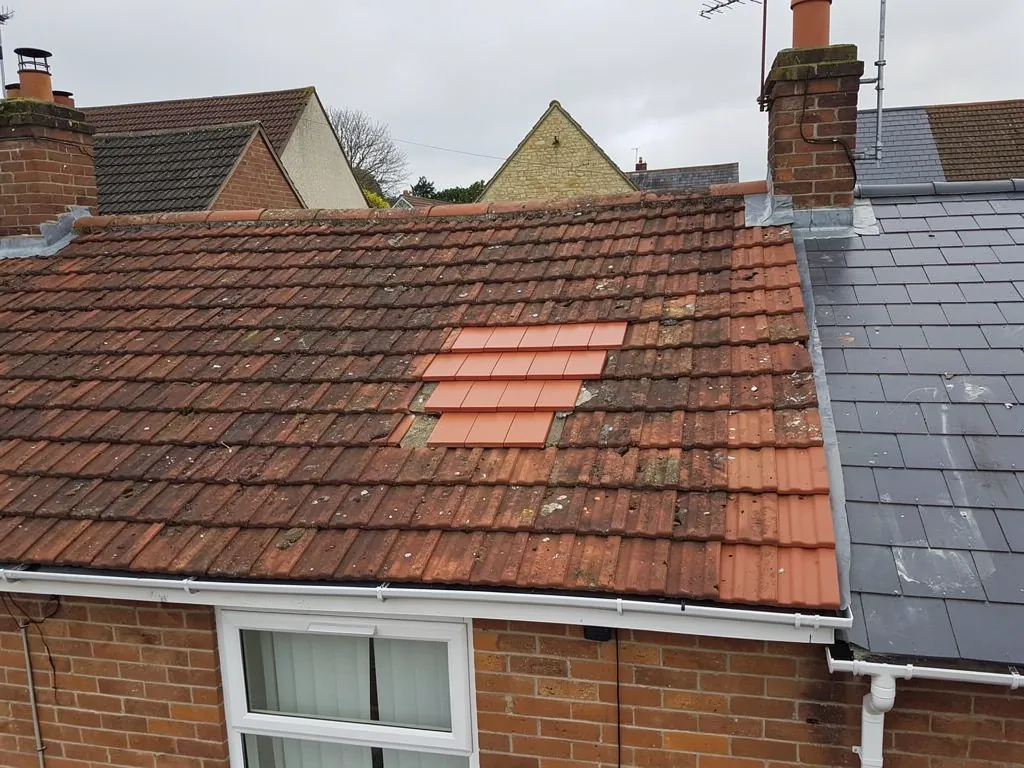
Fit a few replacement tiles and nobody expects paperwork. Strip half a roof and relay it, and the position is different. Between those two jobs lies a grey patch where owners, landlords and roofers each assume somebody else has checked, and the question tends to surface only when a buyer's solicitor asks for the certificate, by which point the roof is long finished and the person who did it may be hard to find.
This guide explains how the rules work for repairs in England, drawing on the Planning Portal, the government's Approved Documents and the councils around Bognor Regis. It deals with the test for an application, heavier coverings, Part L insulation, chimneys and conservatory roofs, and the separate matter of planning permission.
Treat it as a guide and not a ruling. Your council's building control team, or a registered building control approver, can rule on a specific job, and we explain consent to every customer before work begins.
The two-part test for a plain repair
Building Regulations reach roof work in England, yet not every job needs an application. The Planning Portal sets two limits and both must hold. Normally no application is wanted while under 25 per cent of the total building envelope is disturbed and the work also stays under 50 per cent of the roof. That envelope is the shell of the whole house, meaning its walls, floor, roof, windows and doors.
Because the first figure belongs to the whole building and the second to the roof alone, they are easy to blur into one rule, and a version of the rule that mentions a single percentage of the roof is wrong. A small bungalow might have half its roof renewed and still sit inside the envelope limit, so the roof share cannot be read by itself.
What the test means on site
Swapping a dozen tiles, refixing a ridge, redressing a flashing or patching a leak in a flat roof all fall comfortably inside both limits. A repair is also simple to defend because the existing covering, its fixings and its insulation stay as they were.
The Planning Portal adds triggers that bring an application back whatever the percentages: structural alterations, a new covering whose fire rating falls short of the old one, and extra weight of 15 per cent or more. The next sections take those one at a time. Our guide on whether it is cheaper to repair or replace a roof shows how the thresholds feed into the choice between a patch and a bigger job.
Where Arun District Council reads it more strictly
Local guidance can sound firmer than the national thresholds, and Bognor Regis sits in Arun District. Arun's pages on building control name the replacement of roof coverings, pitched and flat, among alterations it expects to approve. At first glance that appears to contradict the Planning Portal. It need not.
The Portal says when an application is not normally needed. The council describes the sort of work its team handles and invites you to ask. The two meet at one point: a minor repair is usually outside the regime, a re-roof often falls inside it, and the council or your roofer can tell you which side your own job lies on.
Who can give a ruling
One route is the council's own team, which has separate pages for applications and for inspections. It says plainly that it cannot take inspection requests on the day itself, so allow time if work is already under way. The other is a registered building control approver, a private body under a registration scheme that has run since April 2024. Arun asks owners whose approver has lost its licence from the Building Safety Regulator to contact the council.
The practical step is to ask before the work starts. A short email giving the address, the covering and a description of the job usually settles it, and a written reply is worth filing with the house papers. Inside the South Downs National Park, building control stays with the district council even though the Park Authority handles much of the planning.
If a job is notifiable, we talk you through consent and lodge the notification ourselves.
When a heavier or different covering changes things
A repair puts back what came off, so weight and fire behaviour stay unchanged. The picture alters when a repair turns into a change of material, such as concrete interlocking tiles where a slate slope used to be, or the reverse.
Two of the Portal's triggers bite when the material changes. If the new covering would behave differently when exposed to fire, that counts. So does one that adds 15 per cent or more to the weight carried by the roof. Approved Document A describes a significant change in loading as one above 15 per cent and calls the strengthening it demands a material alteration. The two documents disagree on whether exactly 15 per cent counts, so treat roughly 15 per cent heavier as the point at which a structural check and building control come in.
Why weight matters on an older frame
A frame sized for light tiles may have no spare capacity. If the new tile is far heavier or lighter, the Portal says to get an engineer or surveyor to look at the structure before you start. Lighter is not automatically safer, since a lighter covering can be lifted more easily by wind suction and the fixings need rethinking.
Arun's appraisal of the Aldwick Road conservation area, along the seafront, records that original slate was frequently swapped for concrete interlocking tiles, which it says detract from the street scene, and asks owners to restore the original roofing. A swap of that sort is a change of covering, not a repair, so the weight check and building control apply and planning may as well.
If your repair is like for like, none of this arises. If anyone suggests changing the covering, ask them to explain the effect on weight and paperwork before you agree.
Part L: insulation when a roof is renewed
Part L of the Building Regulations deals with saving fuel and power. It touches repairs only when the work counts as renovating a thermal element such as a roof or flat roof deck. Approved Document L (Volume 1, 2021 edition with the 2023 amendments) treats laying a fresh waterproof membrane across a flat roof as renovation and sets two thresholds. The first limit: renovate more than 50 per cent of one element's surface and that element is upgraded. The second: renovate more than 25 per cent of the external envelope and it counts as a major renovation.
A flat roof re-covered from edge to edge reaches the 50 per cent mark for that element, so the insulation comes under review. A pitched roof where a few slates are replaced does not.
Which edition applies
The 2026 edition of the document takes effect on 24 March 2027 for ordinary building work. Until then the 2021 text governs, and the renovation triggers are the same in both. If a job lands near the changeover, building control can say which one applies.
Roof windows and rooflights
Fitting a new roof window or rooflight brings limiting U-values: a roof window is limited to 1.4 W/m²K (or Band B) and a rooflight to 2.2. The roof element itself is limited to 0.15 where it is new or replaced. Our skylights and roof windows page covers the planning side of adding one.
None of this argues against a straightforward repair. It explains why re-covering a flat roof is treated as a different job from sealing a split, and why a quote for the former can include insulation.
Chimneys, conservatory roofs and fragile sheets
A few jobs near a repair carry rules of their own, and each is easy to mistake for upkeep.
Chimney stacks and chimney breasts
Repointing a stack, renewing the flaunching (the mortar cap that seats the pots) or replacing the lead tray around it all count as repair. Taking out a chimney breast does not. The Planning Portal says approval will always apply, since a breast forms part of the building's structure, and on a party wall a party wall notice is needed too. Our chimney repairs page covers the repair side.
Conservatory roofs
A solid conservatory roof counts as a new roof, and the Planning Portal expects sound structure, good energy performance and proper ventilation. Exchanging a polycarbonate roof for a solid one is therefore not a repair in the regulatory sense, even though the frame stays. The conservatory roof replacement page goes into it.
Asbestos cement on older outbuildings
Garage and outbuilding roofs of an older vintage may be asbestos cement. That falls under health and safety rules, not building control. The Health and Safety Executive tells owners to assume asbestos may be in anything built or refurbished before 2000. Taking whole asbestos cement sheets off with care is non-licensed, but heavy breakage makes the job notifiable to the HSE. These sheets can give way underfoot, so keep off them.
Planning permission, listed buildings and protected land
Building Regulations and planning are separate systems. A repair can clear one and still meet the other, though it seldom does.
On planning, the Town and Country Planning Act 1990 (section 55) does not treat as development any works that leave the outward appearance of a building materially as it was. Like-for-like re-roofing falls within that, so permission is not usually needed. Two caveats apply: a listed building, and an Article 4 direction removing permitted development rights. Arun's two directions deal with shared-house use and with the Craigweil House area of Aldwick, and neither takes away roof rights. Other councils differ: Havant and Portsmouth have directions on roof alterations facing the street in certain conservation areas, so ask before changing a covering there.
Listed buildings
Listed building consent is needed for alterations that change what makes a listed building special. The South Downs National Park Authority states that day-to-day maintenance and small matching repairs carried out where they stand fall outside it. That gives a workable line: swapping a few matching slates is maintenance, while a different material is not. If unsure, ask the conservation officer first. Our guide to roof repairs in a conservation area shows what changes there.
The Downs and the harbour
Where the Park lies in Arun, Horsham, Adur or Worthing, the Authority itself decides planning; where it lies in Chichester or East Hampshire, the district council receives the application for it. Chichester Harbour National Landscape, the name it took in 2023, was designated in 1964 and renamed in 2023.
Wildlife law shields bats as well as active nests, and a roofer who finds either stops and asks before going on.
A practical checklist before the work starts
Most of these questions can be answered in ten minutes if asked in order. The sequence suits owners, landlords and anyone buying a house with recent roof work.
Before the repair
Decide whether the job restores what was there. If so, and a small part of the roof is involved, the Portal limits are nowhere near and no application is wanted. If the material changes, the area is large or a thermal element is renovated, put the question to building control. For a listed house, or one inside a conservation area, check planning too. Have your roofer describe the work in writing so the question you send is precise.
During the work
Where an application exists, building control may inspect at set stages, and Arun asks for advance notice of a completion inspection. Keep dated photographs of the roof before, during and after. They show what was done to the structure and insulation once everything is closed up again.
After the work
File any certificate with the written quote and the pictures. Solicitors acting on a later sale often ask to see them, and having them ready saves time.
If a roofer says no consent is needed and you are unsure, ask for that in writing and put the question to your council.
For the work itself, our roof repairs page lists the jobs we take on.
Questions
Repairs and consent: quick answers
Do I tell building control if I only replace some roof tiles?
Not normally. The Planning Portal's limits are under 25 per cent of the total building envelope and under 50 per cent of the roof, and a handful of tiles sits far below both. Arun District Council lists re-covering roofs among work it deals with, so for anything beyond a repair, ask its building control team.
Does a flat roof repair trigger a Part L insulation upgrade?
A small patch does not. Part L classes a fresh waterproof membrane over a whole flat roof as renovation, and an element is upgraded once more than 50 per cent of its surface is renovated. A full re-cover is therefore judged differently from a repair, and building control can confirm what applies.
Is listed building consent needed to mend a listed roof?
Minor like-for-like repairs generally are not, according to the South Downs National Park Authority, but work changing the look or fabric that gives a listed building its status does. Matching slates or tiles fixed in place is maintenance; a change of material is not. Ask the conservation officer if there is any doubt.