
Roof replacement costs · 9 min read
How much does a roof replacement cost in the UK?
National guides put a new roof anywhere from a few thousand pounds to the high teens. Here are the typical UK ranges, the factors that shift a bill, and the points to check on any quote.
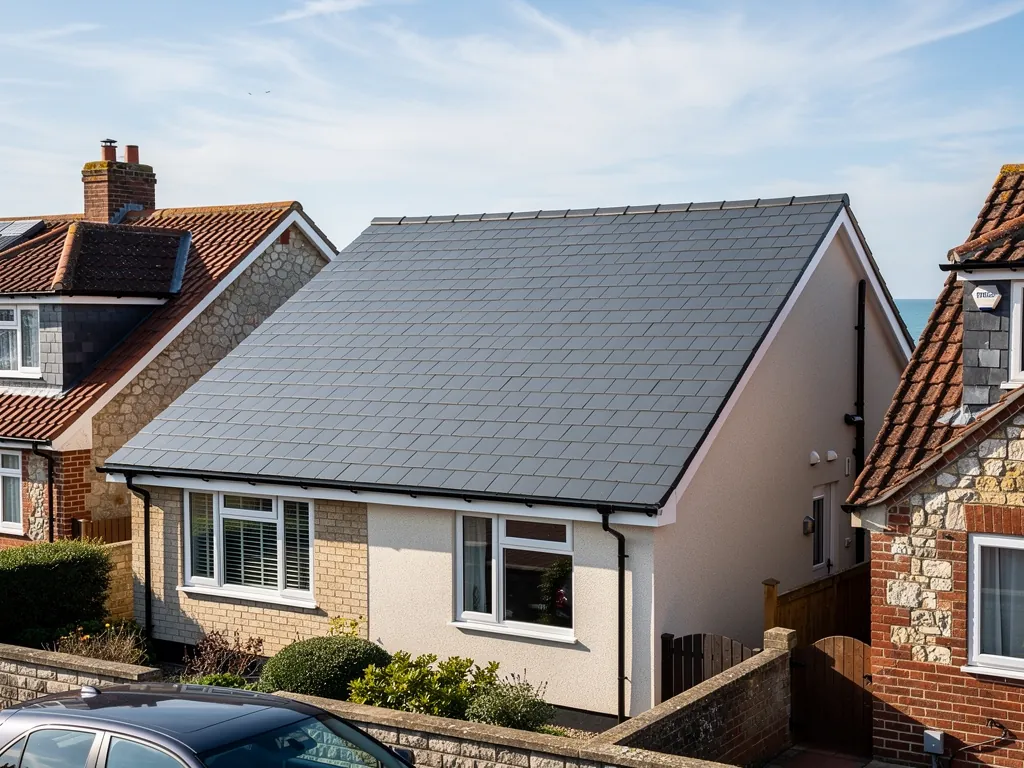
A new roof is among the largest bills a homeowner meets, and a reliable number is hard to find. Search around and you will land on averages, ranges spanning £15,000 and prices that appear to leave out half the job. The trouble is that a roof is several things at once: it is a covering, a structure beneath it, a way of getting access and a dozen small details, and each one can swing the total.
The figures that follow come from national cost guides, each with its date. They describe ordinary houses across the UK, and none is a quote for yours. Some include VAT and some do not, so we flag which. Comparing two numbers with different tax treatment is the quickest route to misjudging a price.
We move from the headline averages to roof shape, covering, scaffolding, tax and insulation. Use it as background for the real decision, which rests on a survey of your own roof, with pictures and one total price in writing.
Headline averages for a new roof
Checkatrade's roof replacement guide, updated in October 2026, puts the UK average at around £8,000, with most replacements between £4,000 and £19,000. The spread is wide because it mixes a small flat roof with a large detached house. Those headline figures carry no VAT label, so put the same question to any number you are given.
The width of that band shows how much depends on size and difficulty, and the hip and gable rows below show where ordinary houses tend to land.
Checkatrade adds one reference point: around £12,000 for a three-bedroom semi. A smaller house should come in under that, and a larger one, or one with several roof planes, over it.
Why no single number can be right
Two roofs on one street can differ by thousands. One has a simple pair of slopes and a clear drive. The other has a hip, two valleys, a stack, a dormer and a footpath in front. Area matters, but the count of edges, joints and awkward details matters almost as much, since each is slow, skilled work. Our guide to why roofing quotes vary digs into the reasons.
If you are comparing prices, ask what each one was based on: the area, the shape, the covering and the way the roof would be reached.
How the shape of the roof moves the price
The outline of a roof counts as much as its area. Checkatrade's replacement table, headed with VAT added on top and last updated in October 2026, gives these typical totals:
| Roof type | Typical cost (+VAT) |
|---|---|
| Gable roof | £7,000 to £16,250 |
| Hip roof | £9,250 to £18,000 |
| Flat roof | £2,800 to £7,500 |
A gable roof is a pair of slopes that stop at vertical end walls, so there are few angles to deal with. A hip roof falls away on all four sides. The sloping corners are the hips, and each adds a line of capping, a run of angled cuts and more labour, which is why the hip row begins and ends higher than the gable row.
Flat roofs come lowest on the list because they carry the least material and no pitched structure, but they are far from simple. The membrane, the edge trims and the falls that carry water to an outlet are where flat roofs fail, and they are where the skill lies.
So when someone quotes a figure, ask which kind of roof it was for. A price for a plain gable tells you little about a hipped bungalow with a chimney and two dormers. The survey is where that difference is found and written down.
Tile, slate or flat: what the covering does to the bill
The material sets the base rate, and it also sets how long the roof can be expected to last. Checkatrade's slate guide, in a table dated September 2026, gives natural slate at £160 to £210 per square metre, averaging £184, with imported Spanish slate at £95 to £125. For concrete and clay on a new roof, the guides we use give totals by house and roof shape rather than a per-metre rate, so the shape table above is the better guide.
Lifespan belongs in the sum. Marley expects concrete tiles to last around 60 years, stressing that this is not a guarantee. CORC puts well-maintained slate at 100 years and more. For flat roofs, Less gives torch-on felt 10 to 20 years, GRP 25 to 40 and EPDM 30 to 50. A covering that costs more today and lasts twice as long can be the lower-cost roof over the life of the house.
Keeping the look of the street
On a period house or in a conservation area, the question is often what will be expected, not what costs least. In its Aldwick Road conservation area notes, Arun says the original slate has often lost out to modern concrete interlocking tiles, a change it counts as a blemish on the street. Before changing a covering in a conservation area or on a listed building, check with the council's planning team.
A change of material can affect weight and appearance as well as price. Our guide to changing your roof covering covers the checks that go with it.
What scaffolding adds to a new roof
Almost every re-roof calls for scaffolding, because roofers must strip, carry and lay heavy materials on a slope with a safe edge. Checkatrade puts scaffolding for a roof replacement at £700 to £1,300. Its separate hire table, dated October 2026, gives around £875 a month for a semi, £800 for a terrace, £1,000 for a detached bungalow and £1,200 for a detached house.
If poles stand over a public footpath, section 169 of the Highways Act 1980 requires a licence, granted by the highway authority. Fees and waits differ by county: West Sussex County Council quotes £266 for a month and 10 working days of lead time, while Hampshire County Council quotes £211.90 for the opening fortnight and ten clear days. Portsmouth falls under its own city council.
Is it in the price?
When two quotes differ by a thousand pounds or more, access is a prime suspect. One may carry scaffolding and its licence while another expects you to arrange it separately or adds it after booking. Ask directly, and ask whether VAT is inside the figure too.
Access can also cost less than feared. A bungalow with a clear drive may need only a simple scaffold, and on a bigger job the hire is spread across more work. Our guide to scaffolding for roof replacement explains what to expect and how long it stays.
Labour, VAT and what the averages leave out
Labour makes up a large share of a re-roof, and day rates give you one way to sense-check a total. Checkatrade shows roofers at around £35 to £45 an hour or £280 to £360 a day, and slate roofers at the same £280 to £360 a day. A job taking a crew several days carries that cost whatever the material.
Tax comes next. VAT at the standard 20 per cent applies to a re-roof. Checkatrade's shape table is headed with VAT added on top, so a £9,250 hip roof at the bottom of its range becomes £11,100 with tax. The headline average has no label, so do not assume it is inclusive. Ask each roofer to say in writing whether the sum includes it.
Insulation can follow its own rules. HMRC's VAT Notice 708/6 (31 January 2024) zero-rates qualifying insulation installed between 1 May 2023 and 31 March 2027, then drops back to 5 per cent. Roof and loft insulation features in it, yet the rate depends on whether the work counts as one supply or two, so the quote explains the position for your house.
What no average includes
National figures cannot allow for rotten timbers found when the old covering comes off, a stack that needs rebuilding or a loft room needing extra work. Those turn up on the day, which is why the survey looks hard at the structure first.
Building control, insulation and the weight of a new covering
A new roof is also building work with rules attached. The Planning Portal sets the usual limits: below 25 per cent of the building envelope and below 50 per cent of the roof, no building control application is normally needed. Arun's own page for applications names re-roofing among the alterations it deals with, so it pays to ask the council, or a registered building control approver, before the work is booked.
Insulation affects comfort as well as cost. Approved Document L 2021 treats renovating over 50 per cent of a roof surface as the point where insulation should be improved if feasible, and the 2026 edition, effective from 24 March 2027, keeps the same triggers. Until then the 2021 values apply to new elements.
Weight is a separate check. The Planning Portal adds a weight test: approval is needed once a new covering adds 15 per cent or more to what the old one weighed, and it recommends a structural engineer or surveyor check before work begins. Where the work is notifiable, the notification is ours to handle and we explain it before you agree anything.
Planning permission is a different matter. Replacing like with like does not usually need it, though listed buildings and some Article 4 areas carry extra rules. Our guide to re-roofing and Building Regulations goes case by case.
Repair or replace, grants and the written quote
With the size of the bill in mind, the first question is whether you need a new roof at all. A repair that fixes the fault is the smaller job, and where one will hold, that is what you hear from us. Once repairs pile up or the covering is giving way across the slope, the sum shifts. Our guide on whether it is cheaper to repair or replace a roof works through it.
Help with the cost is a common hope. No national scheme we have seen covers re-roofing a house. Ofgem's ECO4 stops on 31 December 2026, the Great British Insulation Scheme closed with 31 March 2026, and what remains targets loft and wall insulation or heating. Arun District Council can say what local support exists, and gov.uk is where to confirm any scheme.
What the quote should contain
After the survey you should have pictures of your own roof, a plain verdict and a written quote. Ours is one total, and we price the work fairly. Compare it with others on what each covers: scaffolding, VAT, the named covering, waste taken away and who deals with any Building Regulations notification.
The quote should also explain what happens if the timbers prove worse than expected, so day three holds no shock. Our roof replacement and new roofs page describes the job from survey to handover.
Questions
Roof replacement cost questions
Is the UK average cost for a new roof with or without VAT?
That depends on the guide. Checkatrade's headline average of around £8,000 carries no VAT label, while its roof shape table is headed with VAT added on top. A re-roof is standard-rated at 20 per cent, so ask any roofer to state whether their price includes it.
Can I get a government grant to pay for a new roof?
Unlikely. Current schemes pay for insulation and heating and not a new covering, ECO4 closes on 31 December 2026 and the insulation scheme that followed it has already closed. If money is tight, Arun District Council can tell you what local help exists, and gov.uk lists live schemes.
Does a new roof cost less in some seasons?
We would not promise it, because no national guide we use gives a seasonal price difference. What changes through the year is the weather available for the work and how quickly scaffolding can be arranged. Ask for the quote to state the timing, and weigh urgency against the condition of the roof.