
Conservation roof windows · 9 min read
Roof windows in conservation areas and on listed buildings
What changes for a roof window when the house stands in a conservation area, inside the South Downs or on the heritage list, and which council office to ask.
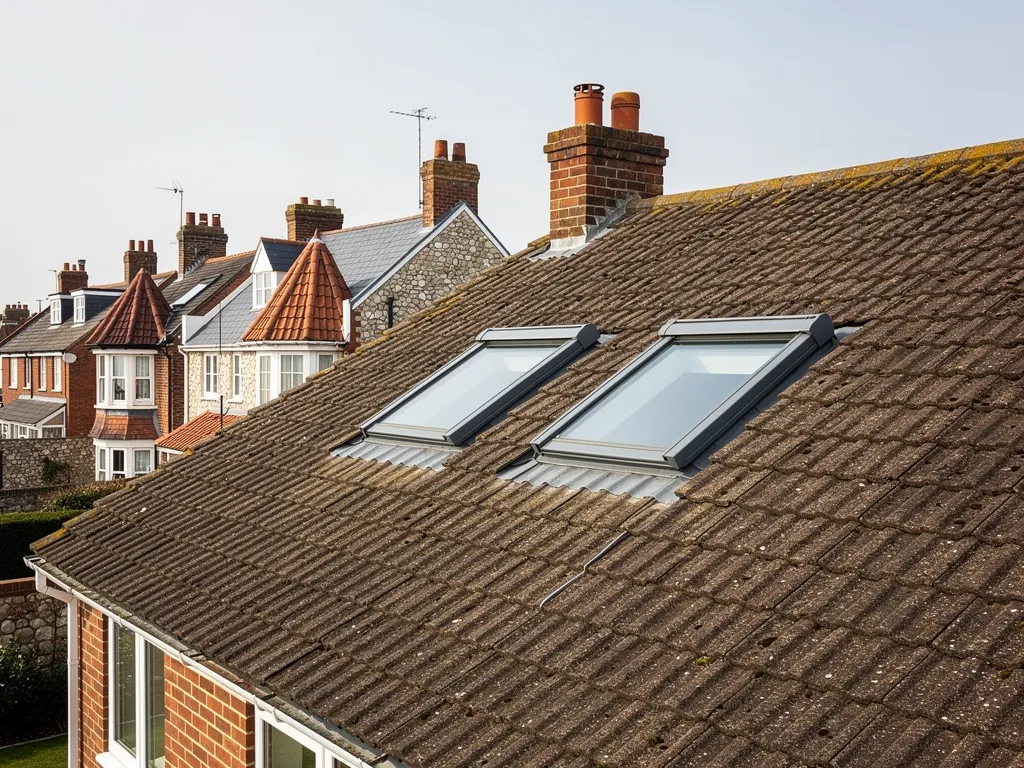
A conservation area does not forbid roof windows. That surprises people, because the name suggests a freeze. The real position is narrower and more useful. Some rules carry on exactly as before, a few are switched off, and a listed building follows a different path altogether. Which of the three describes your roof decides whether you can simply get on with it or must ask first.
Around Bognor Regis the question comes up more than you might expect. The Steyne and Waterloo Square, Aldwick Road, the station area, Hotham Park, Felpham village and Craigweil House are all conservation areas, and listed houses and churches are scattered across Chichester, Arundel and the downs. Further out, the South Downs and the Chichester Harbour National Landscape add layers of their own.
The sections below set out the rules in the order you would meet them, with the office to ask at each step. They describe the law as it stands. A short conversation with the planning team before you order any glazing is still the safest move, and it costs nothing.
What a conservation area does and does not remove
Fitting a window into a house roof slope comes under Class C of the General Permitted Development Order, the rule that lets owners make modest alterations to a roof without applying for planning permission. Class C carries no exclusion for conservation areas, the South Downs or a National Landscape. The right can therefore survive in all of those places, unless something specific strips it out.
Two things can. One is listing: if the house is on the national heritage list, listed building consent is needed as well. The other is an Article 4 direction, a council order withdrawing chosen permitted development rights across a named area. Without either, the ordinary Class C conditions apply as they would in any street.
Those conditions are the familiar ones. The unit may stand out at most 0.15 metres from the old slope, and it must also stay below the ridge or other high point of the roof as originally built. Those two limits are what keep a permitted window looking like part of the slope. A window in a slope that forms a side elevation must have obscure glass, and must be fixed shut unless the part that opens sits higher than 1.7 metres over the floor inside. Obscure glass is needed in every case, whatever the height.
Flats are outside the arrangement altogether, because a flat or a block containing flats is not a dwellinghouse in the order's terms. A flat owner applies for permission wherever the building stands. Our guide to skylight planning permission covers the ordinary case outside protected areas, so here we concentrate on what the protection adds.
How Article 4 directions reach roof windows
An Article 4 direction is made by the local planning authority, and it bites only on the area and the classes of work it names. Two directions can look the same on a council map and remove entirely different rights, so you read the one that covers your own street, not the one next door.
In Arun the picture is straightforward. The directions we found leave roofs alone. One deals with shared-house conversions in parts of Littlehampton and in the Marine and Hotham wards of Bognor. A second, covering the Craigweil House area of Aldwick, is about fencing off grass verges and paving front gardens. Neither touches the right to a roof window. For the remaining Bognor conservation areas no direction turned up, though the council's management plan says it will consider using them.
Next-door councils do use them on roofs
Further along the coast the power has been used on roofs. Havant's direction for Langstone covers changes to the roof of any house facing the highway, and names the insertion of roof light windows as its example. Portsmouth has directions across parts of Old Portsmouth and Southsea that remove the right to recover the roof of a main elevation facing a road. Adur has them for Old Shoreham and Kingston Buci, covering roof alterations and rooflights on the street frontage.
A pattern runs through those examples. Where a direction bites on roofs, it usually aims at the slope facing the street and leaves the back alone. For the Chichester district we cannot say what any direction covers, so for a roof in Chichester, Bosham or Itchenor, ask the council before you start.
Listed buildings: consent comes first
A listed building is governed by different law. Section 7 of the Planning (Listed Buildings and Conservation Areas) Act 1990 forbids altering a listed building in any way that affects its special character, unless the work has been properly authorised. A new opening in a historic roof slope almost always counts, so listed building consent is the starting point and permitted development does not stand in for it.
Plain repair is treated differently. The South Downs National Park Authority says regular upkeep, and small repairs that simply match what is there, do not need listed building consent. A roof window is new fabric, so it falls outside that wording. Anything that puts in something that never existed needs the council's view first.
Churches and chapels
Churches in worship use follow separate tracks. Anglican churches work through the faculty system, and several other denominations run an approval process of their own. Quakers, Unitarians and other faiths have no such exemption, so they approach the council like any owner. When the Churches Conservation Trust takes over a closed church, the usual listed controls apply again. A scheduled monument, which can include a churchyard feature, needs its own consent, and that decision sits with the Secretary of State and not with the council.
Whatever the building, the first call for a listed roof is the conservation officer at your local planning authority, before a builder or a window supplier is involved. In Arun the address is conservation.officer@arun.gov.uk. Expect to be asked for drawings, a photograph of the slope and a short note explaining why the window is wanted and where it will sit.
Bognor and Aldwick: what the council says about roofs
Arun's conservation guidance is specific about roof materials, and it shows what the council looks for. For The Steyne and Waterloo Square, a conservation area designated in August 1979 and extended in July 1994, it asks owners to return roofs re-covered in something out of keeping to their first material, slate or plain clay. It also treats the chimneys as important features of the skyline.
For Aldwick Road, designated in July 1994, the council notes that concrete interlocking tile has often replaced the slate, a change it says spoils the buildings and the look of the street. Its stated aim is to restore the original roofing. The area is described as imposing Victorian and Edwardian terraces, mainly stucco, slate and flint.
None of this is a rule against roof windows. It does show how the council reads a roof: as a continuous run of slate and chimneys seen along a street. One unit on the rear slope, out of view, is a different proposition from a single window in the middle of a front slope on a regular terrace, where the eye reads every tile course and every chimney from the pavement opposite.
Craigweil House in Aldwick was designated in April 2009. In the council's own words, the traditional construction there is stock brick made nearby, topped with roofs of plain clay tile. Felpham village, designated in February 1985, is described as having flint, brick and orange or red clay tile. If your house is in one of these areas, the tone and texture of the covering around the opening will matter as much as the glass.
The South Downs and the Harbour: who decides
Inside the South Downs National Park, who decides depends on which council area you are in. Where the Park overlaps Arun, Adur and Worthing, or Horsham, the Park Authority itself takes the planning decisions. Along the Chichester, East Hampshire and Winchester edges, the district council takes in applications and acts for the Authority. Throughout the Park, building control stays with the district or borough council.
Arun adds that any conservation area lying inside the Park belongs to the Authority, so a village conservation area up on the downs is dealt with by the Authority and not by the district.
Chichester Harbour National Landscape
Protection began on 4 February 1964, and in 2023 the title was changed to National Landscape. The order itself still uses the older wording. The old term is still the legal wording in the order. For roof windows the practical effect resembles a conservation area: Class C is not removed by the designation alone, but dormers are, because Class B is unavailable on land of this kind.
A house may sit under more than one of these labels, which is common around Bosham and Emsworth. The safest course is to write to the council, say what you propose and where, and ask which route applies. A short email with a photograph of the slope and a sketch of the position usually brings a clear answer without delay, and the reply is worth keeping on file for the building control stage. If the answer is that an application is needed, ask what drawings and notes the council wants, so the first submission is complete.
Choosing and fitting windows that suit a protected roof
Where no consent is required, a thoughtful choice still keeps the roof looking right and the neighbours content. A unit bedded flush with the slope looks quieter than one perched on a raised frame. A dark frame tends to fade into slate. The flashing should be dressed to suit the covering, in lead on slate or plain tile, so the junction reads as part of the roof and not as an afterthought.
The position matters as well. A neat pair of windows in the rear slope, lined up with the openings below, looks planned. A lone window in the middle of a front slope looks like an accident. We photograph the roof before and during the work, so the finished job can be compared with the original.
Part L still applies
Protection does not excuse you from the energy rules. A new roof window in an existing house still has to reach a U-value of 1.4, or Band B on the rating scale, under Approved Document L. Ask your building control body how that works out for your house, and mention the protected status when you do.
For a conversion, our guide to roof windows for loft conversions covers size, position and escape. Our skylights and roof windows page explains the work we do. Before any opening is cut we photograph the slope, give you a plain verdict on the roof, and then write up a single total.
Questions
Conservation roof window questions
Do I need planning permission for a roof window in Aldwick Road?
The conservation area does not remove Class C on its own, and no Article 4 direction is recorded for it. An ordinary unlisted house can often use the right, inside the size and side-slope limits. Ask Arun District Council's planning team, because the detail of your house decides.
Can I put a rooflight into a listed building?
Almost never without listed building consent. A new opening in an old roof alters the building, and the law demands authorisation for changes that affect its character. Speak to the conservation officer before you buy anything, and expect to supply drawings and a statement of what is proposed.
Is a rear-slope roof window easier to get approved?
Usually, since directions that bite on roofs tend to cover the slope facing the highway, and councils in conservation areas care most about what shows from the street. The other Class C conditions still apply, while a listed house needs consent whichever slope is chosen.