
Re-slating · 9 min read
Re-slating a roof: strip, sort, reuse and re-cover
A slate roof re-covered from the rafters up: what the strip reveals, which slates are worth reusing, what goes in fresh underneath and what sets the final figure.
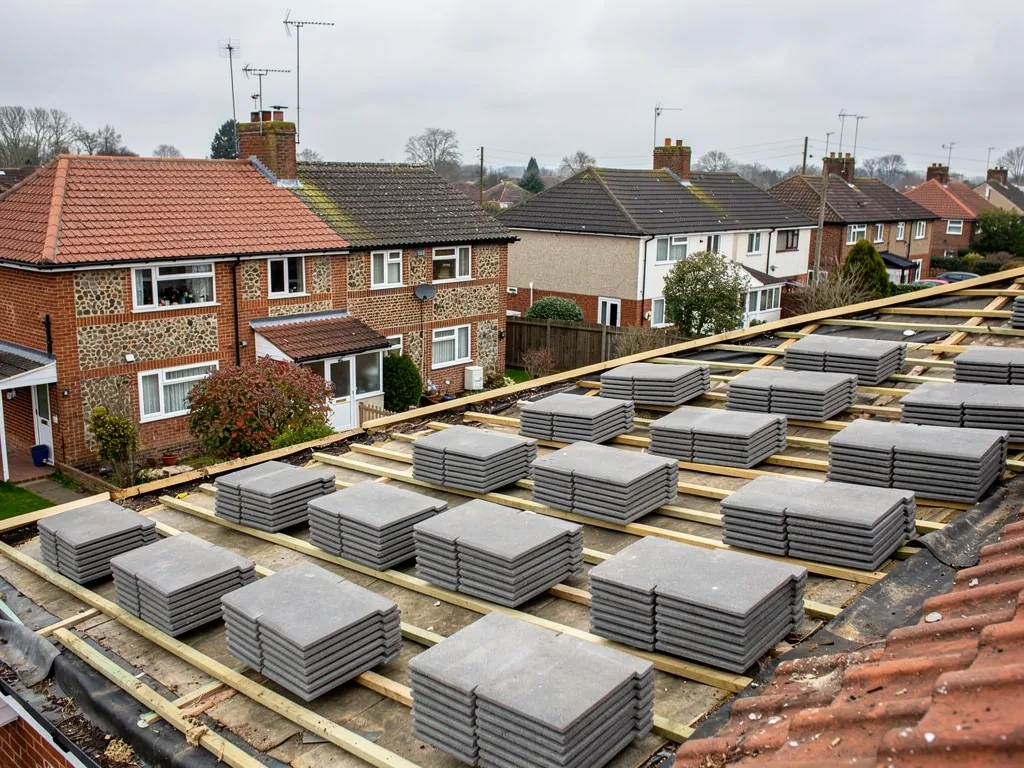
Re-slating sounds like one task. On site it is four: strip the slope, sort the slates, rebuild the layers beneath them and lay the stone back. Most of the judgement, and most of the money, sits in the middle two.
The slates themselves are rarely what brings a roof to this point. Checkatrade's cost guide describes natural slate lasting beyond a century. What gives way first is the hardware beneath: nails that have corroded, timber battens that have rotted and an underlay that has dried out. Once those fail, slates slide faster than anyone can patch them, and lifting the whole slope becomes the cheaper course than another round of call-outs.
Here the job is followed in the order it happens. We explain why a slope is opened before we promise anything about reuse, how the slates are graded, what is replaced as a matter of course, and where weight and approval come in. You get a survey first, then a quote in writing that names a single price for everything.
When a slate roof needs stripping rather than patching
The question that matters is not the age of the slates but how many are on the move. A few slipped slates on a big slope are a repair. Slates dropping across the same slope winter after winter are a pattern, and the pattern usually points at the fixings. We cover that failure in our guide to the signs a slate roof is failing, which is worth reading before you decide anything.
We begin from the ground, then from a ladder where it is safe, and take photographs as we go. The verdict has three possible forms. Repair it, if the trouble sits in one place and everything around it is sound. Patch it, if the roof has some years left and only needs to be made watertight for now. Re-slate it, if fixings and battens across a whole slope are beyond dependable repair. A full re-cover is never our recommendation when a repair will hold.
What tips the balance
Three things push a roof towards stripping. Repairs begin chasing each other from one corner of the slope to the next. The underlay is visibly perishing when seen from inside the loft. Or the slates are sound, yet the labour of lifting them again and again has started to add up, and one proper relay would be better value.
The sums back this up. Checkatrade's repair table, last updated in June 2026, shows natural slate repairs at £150 to £220 per m² before VAT, while its slate guide, with a table dated September 2026, shows £160 to £210 per m² for a new natural slate roof. Read them as mid-market national guides, never as your own quote. They do show how repeated patching over a large area can creep towards the cost of doing the whole slope once.
The strip: what comes off and what it shows
Work begins at the top. The ridge is the crest where two slopes meet, and its capping comes off first, along with any hip cappings; a hip is an outward corner running down the roof. Slates are then lifted course by course and stacked by hand. Nobody throws them down, because a dropped slate is a broken slate.
The strip is when the roof tells you what the survey could only suspect. Beneath the slates sit battens and, on many older roofs, felt or boarding. On some there is nothing but the stone: the slates have been the only barrier between the loft and the weather for generations, and wind-driven rain has been finding every joint.
With the slope bare we look at:
- the battens, for rot, splits and the old nail holes left by earlier refixing
- the rafters, for staining or softness, particularly near valleys and the eaves
- any sarking, meaning boards laid over the rafters beneath the slates
- the lead at chimneys, party walls and valleys, and whether it can be kept
- the wall plate and eaves, where water collects first when a gutter has overflowed
A bare slope is also the moment to photograph timbers and lead, so you see what was under your slates before it is covered again. Where timber has to be replaced, you get the picture and the reason, and the written quote deals with it rather than leaving it as a surprise.
Scaffold goes up before any slate moves, because a ladder is the wrong tool for a job of this size. The slope is opened in sections that can be closed up and sheeted down whatever the weather does next, with the rooms below protected.
Sorting slates: what goes back on the roof
This stage decides whether a re-slate is a moderate job or a major one. Each slate that comes down is looked over, tapped and put in one of three stacks: good for reuse, sound but the wrong size for the finished layout, and cracked, laminating or holed through the nail.
A sound slate rings when tapped; a damaged one sounds dull. Slates that peel into layers have usually finished for good, and slate flaking has its own causes. A slate with a widened nail hole can sometimes be holed again higher up, but only where it is long enough to keep its headlap, the overlap that stops water creeping up under the slate above.
Reuse, new or reclaimed
On a roof of any age a good number of slates may be fit to return, but never a guaranteed number. We count the sound ones before we price the supply of new, because a figure worked out with the slates in your hand beats a guess from a ladder. Where the old ones fall short, matching needs care: same size, thickness, colour and texture, or the new patch shows from the street for years. Reclaimed slates from a similar roof are one source, and new slates of the same origin are another.
Welsh, Spanish and Brazilian slate differ in price and look. Checkatrade gives Spanish slate at £95 to £125 per m², against £160 to £210 for natural slate generally, so the choice moves the total a long way. Whatever is chosen, the sorted stacks are shown to you before the new slates are ordered, so you can see how many you are paying to replace and why.
One more point on the old ones: a slope relaid with its own slates keeps its character, and on a terrace that matters. Mixed colours and uneven edges are part of what makes an old roof look like it belongs.
Underlay, battens and the layout before a slate goes on
Under the new slates, everything is fresh unless it plainly passes inspection. Battens are replaced unless they are sound and the right gauge for the slate. A breathable underlay is laid over the rafters first, catching any water that gets past the stone and stopping wind from lifting slates from beneath. Older roofs may have had no such layer, which makes this the largest quiet improvement in the whole job, and a modest line in the bill next to the slates.
Roof-space ventilation belongs to the same plan. An underlay that cannot breathe, or a loft with no air path from eaves to ridge, traps moisture. Marley's guidance sets eaves ventilation by underlay type and roof pitch, and BS 5250:2021, the code for managing moisture in buildings, sits behind it. On site we look at the eaves, along the ridge and at any loft insulation pressed up against the felt.
Setting out the courses
Before a single slate is fixed, the slope is set out on the battens. The gauge comes from the slate length and the headlap, and the cut slates at the eaves, the verge and the valleys are planned so the courses finish evenly. The verge is the roof's edge at a gable. Many old roofs have diminishing courses, with slates shrinking in size towards the ridge, and a re-slate keeps that pattern so the roof still reads correctly from the street.
Pitch is checked here too. Cupa Pizarras reads BS 5534:2014+A2:2018 as setting a 20 degree floor on natural slate (a 500 mm slate in moderate exposure), and keeps hooks off any slope under 25 degrees. A shallow roof may therefore need a different answer from a steep one, and our answer on the minimum pitch for a slate roof sets out the figures.
Laying slates, then the ridge, hips and lead
With battens in place, slates go on from the eaves upward, each course lapping the one below. Two nails hold each slate, set so it lies flat and the next course hides the nail heads. Where nailing is impossible, such as at some cut edges, a small clip or tingle takes over. We describe that repair fully in our answer on what a slate tingle is.
Fixing details change from building to building. Wienerberger names location, altitude and local wind exposure as the things that set them, and Marley notes that on pitches under 30 degrees the windward slope can face strong suction. So we agree the nailing with the survey of your building, not a fixed rule. BSI also cautions that a few old roofs, redone in traditional or reclaimed material, sit awkwardly with what the standard recommends, which is why an old roof calls for judgement and not a checklist.
Ridge, hips, valleys and flashings
Ridges and hips finish the slopes. Since the 2014 revision of BS 5534, mortar by itself stopped being trusted to hold the capping pieces; each one is fixed mechanically as well.
Lead is the second finish. Flashings are the lead dressings that close the gap between roof and wall or chimney stack, while soakers are little folded pieces slipped under each course along an abutment to pass water over the joint. Lead comes in numbered codes: Royston Lead's brochure marks code 3 as suitable for soakers alone, with code 4 the thinnest it lists for flashings. Sound lead can outlive the first set of slates, so we keep it and dress it again where we can. Where it has split, it is replaced with the right code for its position.
Weight, approval and what the bill depends on
Re-covering falls under the Building Regulations, though not always as people expect. On the Planning Portal's test, an application is not normally required when under 25 per cent of the total building envelope is affected and under 50 per cent of the roof. A covering with a different fire performance, or one at least 15 per cent heavier, changes that. Arun District Council's building control pages count replacing roof coverings as approvable work, so for a full re-slate ask the council or your registered building control approver before the scaffold goes up. We explain what applies and deal with the building control notification when your job needs one, as set out in our guide to re-slating and the Building Regulations.
Weight is about change, not the stone itself. Should the new covering be markedly different in weight from the old, the Planning Portal sends you to a structural engineer or surveyor.
What moves the price
A re-slate gets one total price in writing. The things that push it up or down:
- the area of the slope and its shape, since hips, valleys and dormers add hours
- how many of your own slates can go back, and the cost of matching any that cannot
- the timber found once the slope is open
- lead, and whether it is reused or replaced
- access, including scaffold and, where it overhangs the pavement, a highway licence arranged by the scaffold contractor
Checkatrade puts slate roofers at £280 to £360 per day, with VAT added on top. For the national figures side by side, see our guide to what a new slate roof costs; the work we do is set out on our slate roofing page.
Questions
Questions about re-slating
Can the slates from my own roof go back on?
Often a good number can, because slate outlasts the fixings that hold it. Every slate is checked once it is off, and cracked, flaking or over-holed ones are set aside. The count of sound slates decides how many new or reclaimed ones are needed, and the strip settles the final count, which the written quote then reflects.
Will I have to move out while the slope is stripped?
Normally not. The slope is opened in sections that can be closed up, and rooms below are protected. The real disturbance is noise and dust in the loft. If the loft holds stored belongings or is a bedroom, clear it first, and we will talk through timing with you before the scaffold arrives.
Is re-slating always cheaper than a different covering?
Not always. Checkatrade gives natural slate at £160 to £210 per m² and Spanish slate at £95 to £125, so the covering you choose moves the figure a long way. Reusing your own sound slates saves on supply, though stripping, sorting and labour still count. Ask each roofer what their price includes.