
Slate fixings · 9 min read
Nails or hooks: how slates are fixed
Every slate on your roof is held by something small, and the choice between a nail and a hook is made by pitch, exposure and the state of the roof, not by habit or by which is quicker.
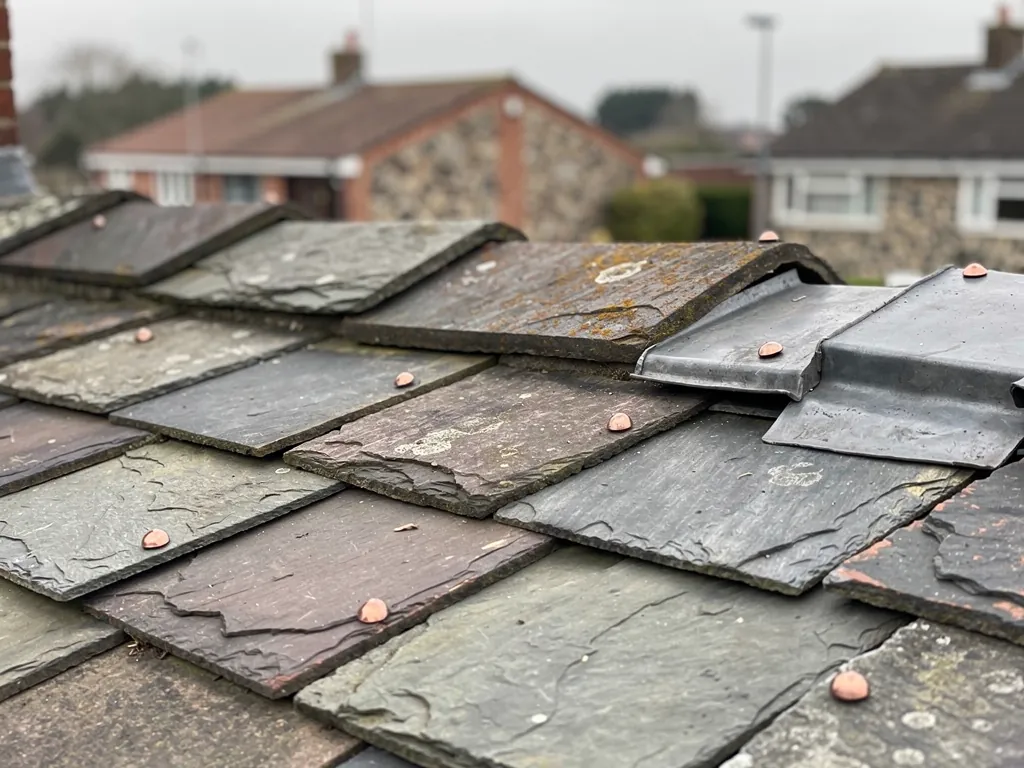
Slate is heavy, brittle and slippery, and the only thing keeping a slate on a batten is its fixing. Roofers have two main ways of providing one. The traditional way is a nail driven through a hole in the slate into the batten behind. The other is a hook, a metal fixing that holds the slate without a nail passing through the stone.
Both are in use today, and both have a place. Online arguments tend to ask which is better in the abstract, and that is the wrong question. The useful one is which suits this roof: its steepness, the wind and rain it takes, the age of the slates, and the size of the job, from one corner to a whole slope.
This guide sets out how each fixing works, the pitch limit manufacturers put on hooks, what the British Standard asks for, and how those points play out on the low, open bungalow roofs and tall seafront terraces around Bognor. It also covers what to ask a roofer who proposes one or the other. A written quote follows our survey, and the fixing is named in it.
What a nail fixing and a hook fixing actually do
A nailed slate has two holes, punched near the upper end, and a nail through each into the batten. The course above covers the heads. The slate is held at its top and relies on its own weight and the overlap to stay flat. Nailing is the method most old roofs were built with, which is why the repair question comes up so often on older houses.
A hooked slate is held differently. The fixing grips the slate near its lower edge, so the slate is secured at a point further down its length than a nail would reach. Depending on the system, the hook is attached to the batten, and the slate sits in it rather than hanging from a nail. The details differ between manufacturers, and the maker's instructions govern how each system is fitted. A roofer who has fitted both knows that a fixing which suits one slate size or one slope can be wrong for the next.
Why there is more than one way
The two methods spread load differently. A nail hole puts a gap in a thin slab of stone, which is one reason makers developed alternatives. A hook avoids that gap. Against that, it holds the slate in a different place and works within limits that makers set, the pitch limit being the best known.
Neither is a shortcut. Marley's guidance on BS 5534 makes the point that the standard is a method of calculating a fixing specification, covering batten selection, fixing methods and wind uplift, and that it also applies to normal re-roofing and repairs. In other words, the fixing is worked out for the roof, not picked from a menu.
The pitch limit on hooks
The most useful single rule in this subject is a pitch rule. Cupa Pizarras, a slate maker, advises that below 25 degrees of pitch a hook fixing is not the right choice. That is the manufacturer's guidance. It sits beside the figure the same maker gives from BS 5534, where 20 degrees is the lowest pitch for natural slate on a moderate exposure site with a 500 mm slate.
So there is a band of low-pitch roofs, from 20 up to 25 degrees, where slate may be used but hooks may not. On those slopes a nail fixing is the answer. Above 25 degrees, either method can be considered, and the next questions are exposure and the slate itself.
Pitch also controls the overlap. In the same Cupa table for sheltered or moderate sites, a 500 mm by 300 mm slate needs a headlap of 115 mm at 20 degrees, 105 mm at 22.5, 95 mm at 25, 80 mm at 30, 60 mm at 40 and 55 mm from 45 to 75 degrees. A lower pitch needs more lap, because water has less incentive to run off and more chance of being pushed up the slope.
Measuring the pitch before choosing
Guessing the pitch from the ground is unreliable, and a bungalow roof that looks steep can be well under 30 degrees. We measure on the roof or from the loft rafters, note it on the survey and let it settle the fixing question. If the figure falls near the 25 degree line, the safer choice is nails, and the written quote says so.
Our answer on the minimum pitch for a slate roof sets out the lower limits in more depth.
Wind, rain and the exposure of your site
Pitch is the first filter. Exposure is the second. A slate roof on a sheltered street does not face the same forces as one on the seafront or open ground, and fixing specifications reflect that. Wienerberger's guidance lists geographic location and altitude, along with local wind exposure, among the things that set a specification, and says the only reliable way to know what is needed is a fixing calculation for the site.
Marley's wind guidance adds that where the pitch is below 30 degrees, the slope facing the wind can meet strong suction, which engineers also call negative pressure. Suction is the pull that tries to lift slates off a roof. It is one more reason low roofs, such as those on bungalows, get a careful look at the fixing.
Cupa sorts the UK into four driven-rain categories: sheltered, moderate, severe and very severe. Its rule of thumb that anywhere within 30 miles of a west-facing coast counts as severe is about west-facing coasts, and Bognor does not get a category from it. Which category applies to your address is a matter for the specification, not for assumption.
What this means near the coast
We do not quote wind speeds or label your street. What we do is look at the roof: how open it is, how tall the building stands, which way the slope faces, and whether gales have already shifted slates. Slates that have already gone in earlier gales tell you something real about the fixings, whatever any map says.
Where a specification calls for extra security, it is usually in the form of more fixings or a bigger headlap, and either is described in the survey notes.
Old slates, new slates and reuse
Fixing choice depends partly on the slate itself. New natural slate comes pre-holed or can be holed on site. Old slate on an older roof already has its holes, and those holes tell a story. Slates with enlarged or cracked holes, from nails that have rusted or worked, cannot be reliably re-nailed in the same places.
This is where a relay shows its value. When we strip a slope, each reused slate is checked. A slate with sound holes goes back on a fresh nail. A slate with a damaged hole can sometimes be re-holed a little further along, if the length allows, or held by a method that no longer leans on the damaged hole. Slates that are cracked or flaking are set aside, and replaced with reclaimed or new ones.
What BS 5534 says about old work
The BSI entry for BS 5534:2014+A2:2018 carries a caution that its advice may not fit some old roofs being re-slated, above all where reclaimed or traditional slates go back on. Put plainly, a roof of thin, uneven, hand-split slates cannot always be handled like a roof of uniform modern slate, and judgement about what the existing slates and battens can take is part of the job.
For the same reason, we will tell you when your roof is better repaired than relaid. If the covering is sound and only a few fixings have failed, the lightest job that holds is a local repair, and our guide to Victorian and Edwardian slate roofs explains how those jobs are judged on older houses.
Repairs: tingles, hooks and mixed fixings
A single slipped slate in the middle of a nailed roof cannot be re-nailed, because the nail holes are hidden under the course above. The usual answer is a tingle, a short tab of soft metal, lead or copper, screwed or nailed into the batten and bent up around the slate's lower edge. It works as a one-off hook, and trades recognise it for odd slates.
Some repairers use a proprietary slate hook or clip for the same job. The principle is the same. The trade-off is that every fix of this kind is a patch on a roof whose original nails are ageing, so how many you can sensibly use depends on how many slates are loose.
A mixed roof, with nailed original slates and a scatter of repair fixings, is normal on an older house and is not a fault in itself. It becomes a warning sign when the repairs are frequent and the loose slates are widespread, pointing to nails failing across the slope.
When to move from repair to relay
As a rule, a handful of tingles is fine. Dozens in a season suggest the roof needs a relay, with the slope stripped and the slates laid again on new fixings. Our slate roof repair guide explains how we separate the two.
Photographs help. When we survey, we photograph slipped and loose slates, the fixings where visible and the underside from the loft, and you get the pictures with the written quote. That shows you why we recommend patching, relaying or a fresh covering, and lets you decide.
Cost, labour and what to ask your roofer
National cost guides do not price nails against hooks. What they do give is the context. Checkatrade's slate guide, whose table was refreshed in September 2026, puts a new slate roof at £160 to £210 per square metre, Spanish slate at £95 to £125, and slate roofers at £280 to £360 a day, working in pairs more often than not. Checkatrade's separate roof repair table, dated June 2026, gives natural slate repairs at £150 to £220 per square metre. Both exclude VAT, which goes on at 20 per cent. Treat them as typical national figures that say little about one particular roof.
Fixing choice moves cost mainly through time. Slate is laid one piece at a time whichever fixing is used, and the written quote reflects the survey and the job, as one total. Access matters as much as the fixing, so check whether any price you are given includes scaffolding.
Questions worth asking
- What is the pitch, and was it measured on the roof?
- Which fixing is proposed, and what does the maker say about it at that pitch?
- How many fixings does each slate get, and is any extra security planned for exposed slopes?
- If slates are reused, how will damaged holes be dealt with?
- Are the battens being checked or replaced?
A roofer who can answer those is working from your roof. One who claims hooks or nails always win is working from habit. Our slate roofing page covers the wider service, and the answer on minimum pitch is linked above for readers who want the pitch limits in full.
Questions
Slate fixing queries
Can I use slate hooks on a low-pitched bungalow roof?
Usually not. The slate maker Cupa Pizarras steers away from hooks on pitches below 25 degrees, and some bungalow roofs sit close to that line. Nails are the normal answer on low slopes. Get the pitch measured on the roof first, since the ground gives a poor view of it.
Are nailed slates stronger than hooked slates?
Neither wins on every roof. A nail holds a slate at its head, while a hook avoids a nail hole in the stone. Strength depends on pitch, exposure, the batten and how the fixing is fitted, which is why BS 5534 works from a specification for the site instead of a favourite.
Do slates need re-fixing after storm damage?
Only the ones that moved. After a gale, check for slipped or cracked slates from the ground, and have a roofer look at the fixings around any gap. If slates keep slipping across a slope, the original nails may be failing, and a relay can be cheaper than repeated repairs.