
Slate repairs · 9 min read
Slate roof repairs: slipped slates, tingles and broken slates
What a slate roof repair involves, from refixing a single slipped slate with a tingle to mending the lead around a stack, and where a patch stops being sensible.
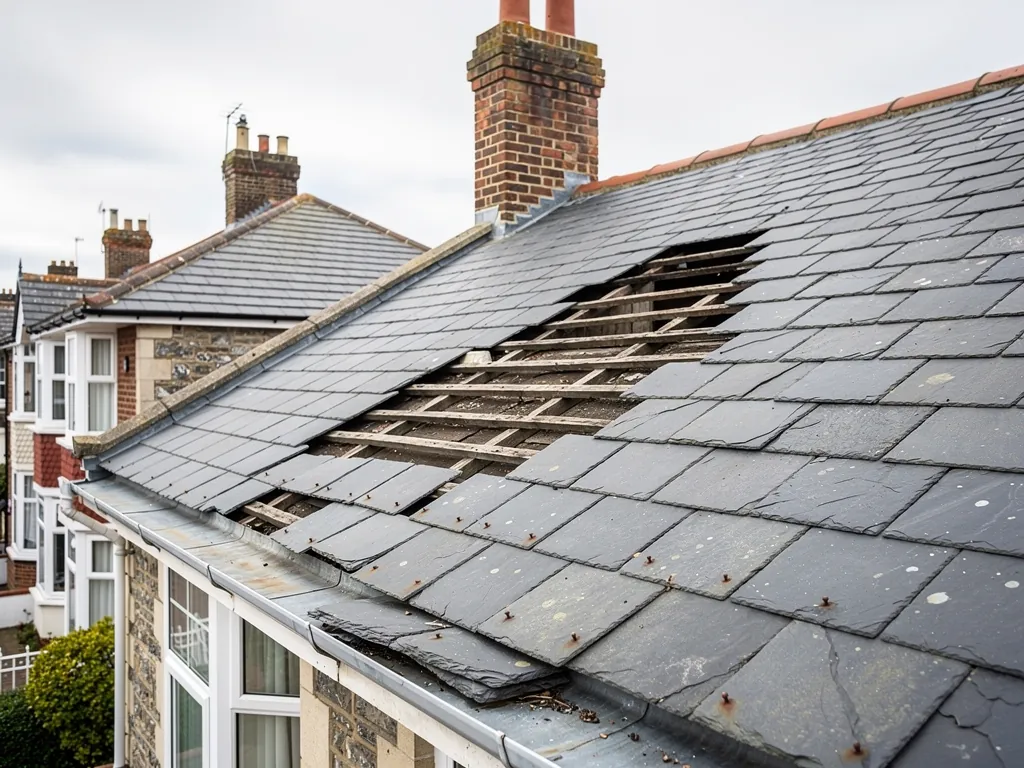
A slate roof can lose a slate on a quiet afternoon and show nothing indoors for months. When the problem finally appears, as a brown mark on a bedroom ceiling or a dripping loft timber, the slate that caused it may be one of several that have been working loose for a while.
The good news about slate is that it repairs well. The stone is durable and the joints are made to be opened: a slate can be lifted, replaced or held in place without disturbing the roof around it, provided whoever does the job knows how the covering was put together. The weak points are almost always small metal parts. Nails, clips, lead dressings and the occasional ridge fitting give way long before the stone does.
This guide covers the repairs we are asked about most on slate: slipped slates, tingles, broken and flaking slates, lead and ridge faults, and the matter of reaching the roof safely. It also gives typical UK prices, so you can see what a fair repair costs before anyone comes out.
Slipped slates: why they move and what holds them
A natural slate is held by two nails driven through holes near its head, and the course above covers the nail heads. Nothing else is fastening it down. When a nail loosens, rusts through or loses its grip in an aged batten, the slate drops a little, and the next gale or hard frost drops it further. A slipped slate shows as one that has dropped below the rest of its row, with a gap of bare underlay above it.
One slipped slate is rarely the whole story. If the nails on that course are all of one age, others are likely failing too, so a sensible roofer checks the neighbouring slates before offering to fix just the one. We describe how that wider failure works in our answer on why slates slip and how they are refixed.
Refixing, not just pushing back
Pushing a slipped slate back up and hoping is not a repair. It has to be held. If the slate is whole and the nail holes are intact, a roofer can slide it up and fix it with a tingle, or fit a fresh slate and tingle in its place. The tingle supplies the grip that the nails no longer give.
Where many slates are slipping across a slope, the question changes. A repair that replaces a few slates and leaves forty rotten nails above them buys little. At that point the honest advice is to talk about relaying the slope, and the re-slating guide shows what that involves. Our verdict always comes with photographs of the slates in question, so you can judge whether we are describing a single fault or a tired roof.
It also helps to know that slipped slates are often found in the loft before the roof: look for slivers of daylight at the eaves, or slates lying in the gutter.
Tingles: the repair that sits where nails cannot
The tingle is the small, plain fix that makes most slate repairs possible. It is a narrow ribbon of lead or copper, fastened to the batten beneath the gap and folded up round the foot of the new slate, which stops that slate sliding out again. Nail holes in a slate sit near its head and are covered by the slates above, so a replacement cannot simply be nailed in; the tingle works around that.
It is a recognised, long-used repair, and when it is made well it is barely visible from the ground. Good tingles are cut to size with a clean bend and are sited just below the edge of the slate, so water runs over them and off. Badly made ones are loose strips of lead that lift in the wind or stand proud of the roof line.
Where a tingle is the wrong answer
Tingles are for individual slates. They are not a substitute for fixing a whole run of failing nails, and a roof covered in them is a roof telling you something. Each one adds a small stub of metal to the roof, and the more there are, the harder the slope becomes to repair neatly. If you can count tingles from the street, it is time to talk about what is happening to the battens and nails beneath.
Some slate roofs use hooks as their original fixing, and these carry limits of their own. Cupa Pizarras keeps hooks off any slope below 25 degrees, so a repair that would bring hooks onto a shallow pitch needs a second look. Our answers on the slate tingle and on how a single cracked slate is replaced give the detail.
Cracked, broken and flaking slates
Slates break for plain reasons. Someone has stepped on them. A branch has dropped or a chimney pot has shifted. A frozen film of water inside a slate has split it along its grain. Whatever the cause, a cracked slate lets water run straight through to the underlay, and the underlay is only the second line of defence.
Replacing one means lifting the slates above to free its nails, cutting or drawing the old nails out with a slate ripper (a flat tool with hooks that slides up under the slate and snags the nail), sliding a new slate into the gap and holding it with a tingle. The job is quick for a skilled roofer and awkward for anyone else, because the slates around it can crack if they are lifted carelessly.
Slates that flake in layers
A different problem shows when slates start to peel, with thin sheets lifting from the surface and dust on the lead below. Slate is formed in layers, and some stone is more prone to splitting along them as it weathers. A few flaking slates can be replaced. A whole roof of them cannot be repaired, because new ones next to old will start to fail where the old ones leave off, and the roof needs to be lifted and relaid with sound stone.
Replacement slates also have to match. Size, thickness, colour and finish all show from the street, and a bright new slate among old grey ones draws the eye for years. Reclaimed slates are often the neatest way to match an older roof, though they take time to find. If you are replacing slates because the original has gone, our slate roofing page explains how we work out which slate suits a roof.
Do not walk on slates to inspect them. Slate breaks under foot, and a fall from a roof is far more serious than any leak.
Lead, ridges and the details around the slates
On many slate roofs the slates are sound while the metalwork around them has failed. Lead flashings close the joint between roof and masonry, and lead soakers lie beneath the slates beside them. Lead splits, lifts or is pulled by the wind, and a chimney is the commonest place for it to go. MyJobQuote, in a guide last updated on 22 September 2026, puts a patch on chimney lead between £150 and £250.
Thicker lead gets a higher code. Of the grades listed by Royston Lead, code 3 is for soakers only, while codes 4 and 5 are named for flashings. A good repair uses the right code for the position and dresses the lead tightly into the joint, not smeared over it with sealant.
Ridge and hip fittings
The ridge runs along the very top of the roof. On a slate roof it may carry clay cappings, lead or a slate ridge, and cappings loosen when the bedding under them weathers. After the 2014 revision of BS 5534, a mortar bed on its own is not taken as enough for ridge and hip pieces, which now get a mechanical fixing too. Checkatrade quotes £50 to £70 per metre for ridge tile repairs, with the same range for lead flashing repairs, both excluding VAT.
Gutters belong in the picture too. One that is blocked or sagging keeps the lowest courses wet, and a slate roof can seem to be failing when the drainage is really at fault. The gutters get checked on every survey.
A small amount of lead work on a slate roof can transform its performance, so it is worth asking whether a leak is coming from the slates at all. Our guide to finding a roof leak shows how the path of water can mislead.
Reaching the roof: ladders, towers and scaffold
Access decides more of a repair bill than many people expect. A slipped slate low on a bungalow may need only a ladder plus a roof ladder, which spreads your weight over the slates. The same slate on a three-storey terrace, above a pavement, can call for a tower or full scaffold, and the cost of getting to it can exceed the repair itself.
Checkatrade's scaffolding table of October 2026 lists a detached bungalow at about £1,000 a month, a terrace at £800, a two-storey semi at £875 and a detached house at £1,200, with a chimney scaffold near £660 a week. Those are national typical figures, useful for scale only. They also show why scaffolded repairs are worth bundling: with the poles already up, the slates, lead and gutters can all be seen to together.
Poles on the pavement mean a licence
Section 169 of the Highways Act 1980 requires a licence whenever scaffolding obstructs the road or footway. In West Sussex the county council asks for 10 working days' notice and charges £266 for a month. If the repair can wait, allow for that notice period in your plans.
Not every slate repair needs a scaffold, and not every roof can be repaired safely without one. The height, the pitch, what sits below and the need to protect people passing all decide it. Our guide to scaffolding for a roof repair sets out when each method suits.
What a slate repair costs, and when to stop patching
On natural slate, Checkatrade's June 2026 repair table runs from £150 to £220 per m², and it leaves out VAT, which is 20 per cent at the standard rate. The same guide shows slate roofers at £280 to £360 a day. Treat both as national yardsticks and not as your bill. Very small jobs tend to hit a minimum charge, as the trip, the set-up and the clearing away cost the same however few slates are involved.
What moves a slate repair up or down is mostly access, the number of slates involved, whether lead needs work, and how hard it is to match the existing stone. Our written quote gives one total, and it follows the survey. Our national roof repair costs guide breaks the market down by material.
Repair, patch or replace
The verdict comes ahead of the price. Repair it, when the trouble is in one spot and the slope around it is sound. Patch it, when the roof has years of life but needs to be made watertight now. Replace the covering, when fixings are failing across the slope and the repairs are chasing each other. A repair that lasts is cheaper than a succession of small ones, and a roofer who recommends a new roof where a repair would hold is selling you something you do not need.
A small repair does not trigger a Building Regulations application. According to the Planning Portal, one is not usually required if under 25 per cent of the total building envelope and under 50 per cent of the roof is affected. If your roof is listed or in a conservation area, ask your council about consent before work starts.
If a gale did the damage, the insurer hears first, then the roof is made safe, and every photograph and receipt is kept.
Questions
Slate repair questions
Can a single slipped slate be fixed without scaffolding?
Often, yes. If the slate is low on the roof and the building is not tall, a ladder and a roof ladder are enough. Higher up, or above a pavement, a tower or scaffold may be needed. The height, the pitch and what is below decide it, and we say which applies when we survey.
Do replacement slates look different from the old ones?
They can, at first. A new slate is usually brighter than weathered stone around it, and size and texture also matter. Reclaimed slates of the same type often match best. We show the options before ordering, because a mismatch on a visible slope is the part of a repair that stays obvious longest.
How do I know if the leak is from the slates or the lead?
Water can travel a long way along timber before it appears indoors, so the stain is rarely under the fault. Slates, flashings, a blocked gutter or a ridge can all be the source. A survey of the outside and the loft is what separates them, and photographs show you what was found.