
Victorian slate · 9 min read
Victorian and Edwardian slate roofs: what fails and how it is repaired
A slate roof laid in the 1800s or early 1900s can have decades left in it, yet the parts around the slate tend to wear out first. This guide follows the usual order of failure and the fix for each.
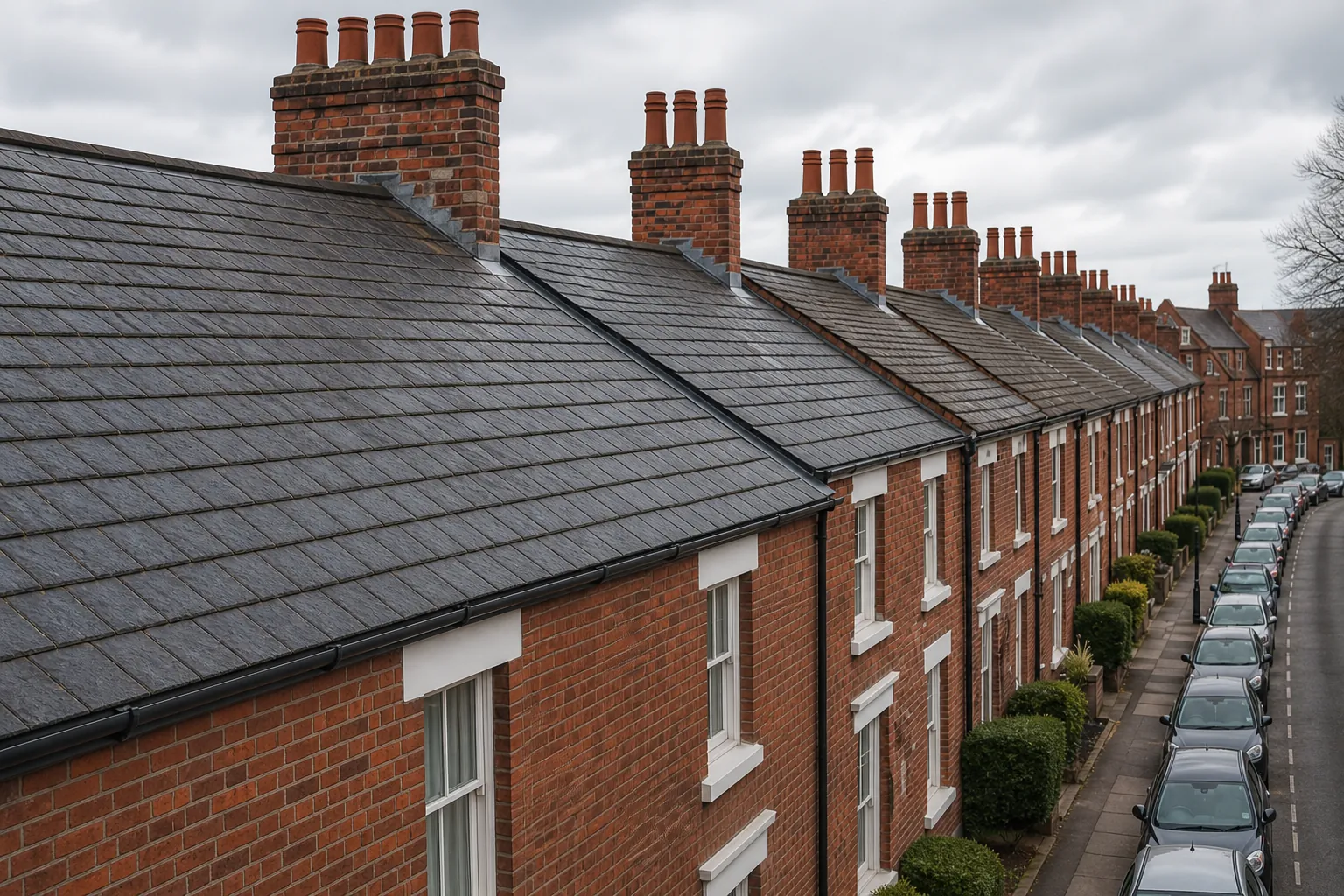
From the pavement, an old terrace roof looks much as it did when the street went up. Climb a ladder and the picture changes. The slates are frequently fine. What has given up is the hardware around them: the nails, the lead at the chimney, the channels between roofs, the mortar under the ridge.
That matters because a few slipped slates are rarely the real fault. They are the visible end of a fixing that has run out of life, and chasing them one at a time can end up dearer than curing the cause once.
Below, the faults come in the order they tend to appear: how the roof was made, why slates drop, where leadwork lets water in, what the top of a tall stack adds, and the point where a repair stops being enough. The last section covers what the rules say if your house stands in a Bognor conservation area. Figures are typical national ranges from named guides, so they give scale only. The survey comes first and our written price follows, one sum for the job, and our slate roofing page covers the service itself.
How a roof of this age was put together
Most Victorian and Edwardian slate roofs share one basic pattern. Battens, which are thin timber strips running across the rafters, carry the slates. Each slate is nailed through two holes near its top, and the course above hides the nail heads. The length of each slate that stays covered by the course two rows above is called the headlap, and it stops rain being driven up under the slate. Cupa Pizarras tabulates it: a 500 mm by 300 mm slate at 20 degrees in sheltered or moderate conditions needs 115 mm, while on slopes from 45 to 75 degrees the same slate needs only 55 mm. Steeper roofs shed water faster, so they need less overlap.
Where an old roof has no modern underlay, the membrane that sits between slate and rafters, stripping the slope gives the roofer the chance to add a breathable one before the slates go back, a second line of defence against wind-blown rain.
Why construction shapes the repair
Since each slate hangs by two nails and its own weight, nothing fails suddenly. A slate creeps down a little, then a little more, until the gap it covered shows. Reading that pattern helps. Slipped slates spread across a whole slope suggest ageing fixings everywhere. Slipped slates bunched in one place point to something local: a blocked gutter, an overhanging branch, a cracked flashing.
The stone itself can be very long-lived. CORC puts well-maintained slate at a hundred years or longer, and Checkatrade says much the same of stone slate. Those figures describe the rock. They say nothing about how long a nail will hold, which is why a sound-looking roof can still be failing underneath.
Slipped slates and the nails behind them
The most frequent complaint on an old slate roof is the slate that has slid a few centimetres below its row. It seems minor. Beneath it, the nail has usually rusted through or worked free of the batten, and the slate is held by little more than friction.
One slipped slate is a quick job. The roofer lifts out the old slate and fixes a tingle, a small hook of lead or copper that is secured to the batten and bent upwards to cradle the bottom edge of the replacement, whose own holes sit beyond reach under the row above. For odd slates it is the accepted method, and it does the job.
When dozens are dropping across a slope, tingles stop making sense. Each is a small plaster over a fixing that is tired everywhere, and the roof will keep shedding slates after each gale. The cheaper route across several years is then to strip the slope, inspect the battens and relay the good slates on new fixings. Our guide to nails or hooks explains how the new fixing is chosen.
Flaking and cracked slates
Some slates fail from the inside. Thin layers of stone lift at the exposed edge and peel, so the slate gets thinner until it snaps. A handful among sound neighbours are swapped one by one. If flaking is widespread, the stone itself is close to worn out and no fixing will cure that.
Walking across an old slate roof cracks slates, so a survey is done from a roof ladder and the edges wherever possible. Cracks that appear after somebody else has been over the roof are common, and a photograph of the underside tells you whether a crack is old or new.
Valleys, flashings and soakers
On a terrace, many leaks start in the lead rather than the slate. Three terms are worth knowing. A valley is the sunken line where two slopes come together and carry rainwater off. A flashing is metal sheet that seals the joint between roof and wall or chimney. A soaker is a small L-shaped piece of lead, woven in between slates at an abutment, so water cannot slip behind the flashing above.
Lead comes in numbered codes that follow its thickness. Royston Lead's brochure marks code 3 as suitable for soakers only, lists code 4 as the thinnest it recommends for flashings, and lists codes 5 and 6 for flashings, dormers and gutters. A light code on a flashing that moves with every hot day and frosty night is a common reason a repair does not last.
Good lead is long-lived. MyJobQuote puts the life of lead flashing above 80 years. Old lead still cracks where it has been folded back and forth, and it splits along creases. A flashing dressed too shallow into the wall, or sealed with a skim of mortar, lets rain run behind it.
Channels buried in the roof
Terraced houses often have a parapet gutter or a box gutter, a lined channel set between two roofs or behind a low wall. It is a notorious place for leaks, because one blockage turns it into a pond. The lining may be lead or old bitumen. Clearing it twice a year is cheap, and a failure here can look like a slipped slate when seen from the ceiling below.
On a survey we photograph every valley and abutment from above. The photos go to you alongside the quote, which lets you judge the lead for yourself.
Stacks, ridges and verges on a tall terrace
The top and the edges come next. A terrace stack rises well above the slope, shares walls with neighbours and takes the full force of the weather. The flaunching, the mortar crown that sets the pots and throws off rain, cracks and drops out. The brickwork loses its pointing. The flashings loosen. Water then reaches the breast inside, and a stained bedroom wall is often the first warning.
Along the summit runs the ridge capping, and hips cap the sloping corners of a hipped end. On old roofs this capping is usually bedded in mortar. Since the 2014 revision of BS 5534, mortar alone stopped being treated as a sufficient hold for ridge and hip capping, and each piece now also gets a screw or clip. BSI itself notes the standard can be a poor fit for re-slating older roofs built from traditional or reclaimed slate, so an experienced slater uses judgement here, not a checklist.
At a gable end the slope finishes in a verge. In the middle of a terrace it hides in the party wall, but end houses and villas have slates cut and pointed against a wall or board. Cracked mortar there gives gusts a way in beneath the end slates.
What height does to the bill
Access changes the price of everything. Checkatrade's scaffolding table of October 2026 gives about £800 a month for a terrace, £875 for a semi, £1,200 for a detached house and around £660 a week for a chimney scaffold. When poles and boards stand over the footway, a licence from the county council is needed. West Sussex asks for at least 10 working days and charges £266 for a month.
Repair, relay or strip: reaching a verdict
The owner's usual question is repair or replace. With slate there is a middle option, the relay. The roofer strips a slope, keeps the sound slates, and lays them back on fresh battens with new fixings and underlay. It reuses stone that is still good and renews only what has failed.
As a rule of thumb: repair suits a roof with a few slipped or cracked slates and fixings that are still sound. Relaying suits slates in good order on tired nails or battens. A new covering is the answer when the stone itself is flaking. We give that verdict before any price, with photographs, and put forward the lightest repair that will hold. A relay also lets us renew lead and add underlay while the slope is open, which costs less than doing those jobs separately later.
What national guides put on it
Checkatrade's repair table, last updated in June 2026, puts natural slate repairs at £150 to £220 per square metre before VAT. Its slate roof guide gives £160 to £210 per square metre for a new slate roof, Spanish slate at £95 to £125, and slate roofers at £280 to £360 a day, commonly working as a pair. VAT at 20 per cent goes on where figures leave it out.
Matching moves the number. Reclaimed slates that match in size and tone take time to track down, and an old slope often ends up part salvaged, part new. For the common jobs, see slate roof repair.
Whoever quotes, check that VAT and scaffold are in the total, and ask what happens to your old slates.
Conservation areas and holding on to the slate
Many of Bognor's Victorian and Edwardian buildings stand in conservation areas. The council's appraisal of the Aldwick Road area, a conservation area since July 1994, describes grand terraces from the early nineteenth century to the Edwardian era, with stucco, slate and flint dominating. It records that concrete interlocking tiles frequently replaced the slate, says the swap harms how the houses and the seafront streets read, and lists putting back the original covering as the remedy. The Steyne and Waterloo Square conservation area dates from August 1979, with an extension in July 1994, and the guidance there steers owners towards natural slate or plain clay.
Where a street has lost its slate, a repair is a chance to move back towards the original look, though cost and consent decide whether that suits you. Like-for-like repairs are not usually treated as development under section 55 of the Town and Country Planning Act 1990. Swapping the covering is another matter, and a listed building also needs consent before anything touching its special character is altered. Raise it with the planning officers at Arun first.
Building Regulations on a re-slate
Planning Portal guidance names two limits for skipping a building control application, namely under 25 per cent of the building envelope and under 50 per cent of the roof affected. Arun lists re-covering among the work it wants approval for, so let the council's building control team or your roofer confirm your own case. Roosting bats and nesting birds enjoy legal protection, and that affects when and how a roof is opened.
Our guide to slate in a conservation area goes further into consent.
Questions
Old slate roof queries
Is it worth repairing a 120-year-old slate roof?
Often yes, if the slates are sound. Slate can outlive its fixings by decades, so renewing nails, battens and lead under a good covering usually beats replacing the lot. A photograph of the slates and their underside shows whether the stone or only the fixing has reached its limit.
Why do slates slip after a gale on an old terrace?
A gale tests every fixing at the same moment. Where nails have rusted or worked loose from the batten, a slate that has hung by friction for years finally drops. Slips in one spot suggest a local cause, while slips across a slope point to ageing nails.
Can I replace Victorian slate with concrete tiles?
Sometimes, but not freely. Concrete is heavier, which can call for a structural check, and building control comes in if the weight rises by roughly 15 per cent or more. In a conservation area or on a listed building a change of covering may need consent, so speak to the council first.