
Foam types · 9 min read
Open-cell vs closed-cell spray foam
Spray foam comes in two broad types, open-cell and closed-cell. This guide explains how they differ in plain terms and why the type matters when a roof needs inspecting or the foam taken off.
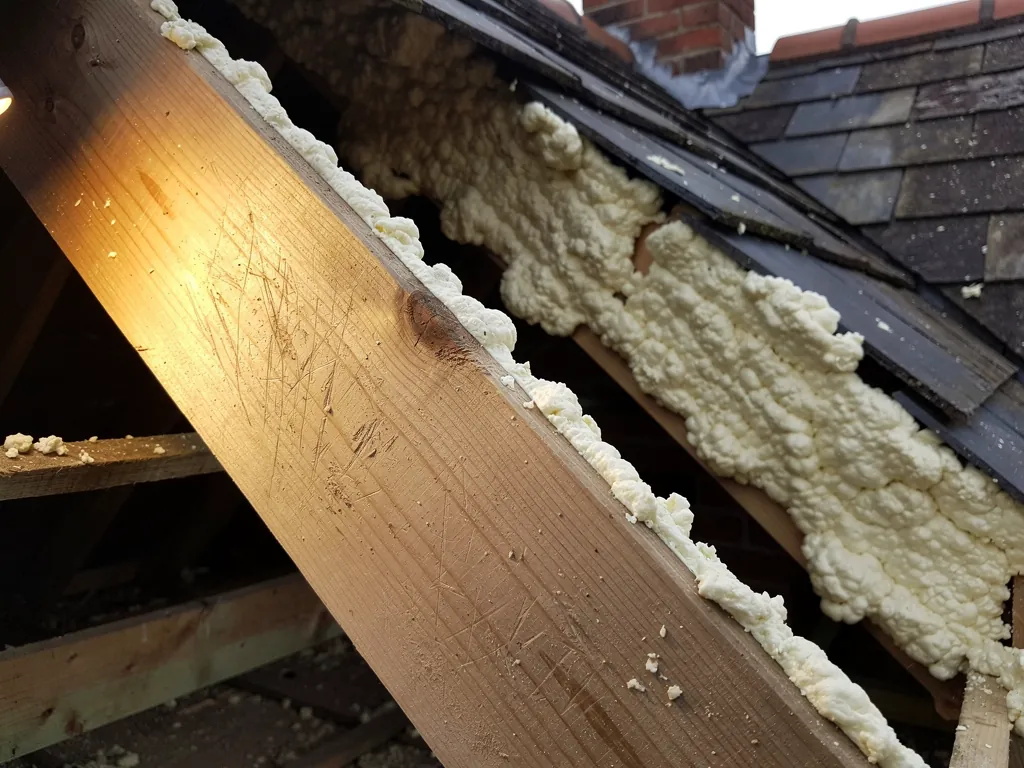
Ask three installers what they put in your loft and you may get three different answers, or a brand name that tells you nothing. Underneath the brand names there are two broad families of polyurethane spray foam, called open-cell and closed-cell. People often assume the difference is only about how well each insulates. For a roof, it matters in other ways too: how the foam behaves if water reaches it, how it grips the timber and the underlay, and how it comes away when someone needs to get at the structure.
Official guidance says little about the two types, so we keep to what it supports. The RICS consumer guide from March 2023 says there are different types of foam with different performance properties, and the Energy Saving Trust comments on open-cell foam when foam meets a leaking roof. Beyond that, we describe the two types in general terms and tell you where only a look at your own roof will settle the matter.
None of this is a recommendation to remove or to keep foam. That decision comes from a survey. For the work itself, when it is needed, start with our spray foam insulation removal page.
Why the type of foam matters on a roof
In a wall or a floor, foam is mostly a question of thermal performance. On a roof it carries extra jobs and extra risks, because the roof is the part of the house that keeps rain out, and the foam is sprayed against the layers that do it. A foam that lets a little moisture pass behaves differently from one that stops it, and a foam that is soft behaves differently from one that sets hard.
RICS puts the first point simply: there are different types of spray foam, with different performance properties, and once applied they are not easily reversible. That second half is the part owners underestimate. Choosing a type is close to a one-way decision, and it was usually made by an installer in an afternoon rather than by the owner after a long comparison.
Types are one factor among several
The type is only one thing that decides how a foamed roof fares. The state of the roof before it was sprayed counts, as do how the ventilation was handled, what underlay lies beneath the tiles and whether the old insulation was left in the loft. RICS says there is no one size fits all guidance and that manufacturers each publish their own technical literature and installation guides.
So an open-cell roof can be sound and a closed-cell roof can be troubled, or the other way round. The label tells you where to start looking, and nothing more. A good installer will have recorded the product and the thickness sprayed, and a good surveyor will ask for both before forming a view.
The two types in plain terms
Manufacturers generally describe open-cell foam as the lighter, softer product. Its tiny cells are not sealed, so it feels spongy to the touch, it expands a great deal when sprayed and it lets some water vapour through. Closed-cell foam is generally described as denser and firmer. Its cells are sealed, it sets into a rigid layer and it is more resistant to vapour passing through. Those are descriptions of the product family, not measurements of the foam in your loft.
Each has uses. The reason for naming them here is the difference in behaviour when a roof is already doing something wrong. A softer foam that breathes a little is less likely to hold moisture against the structure than a rigid, sealed layer. A rigid layer is more likely to stay put, and it will also hold a roof together in ways nobody planned.
What a roofer can see from the loft hatch
Press a thumb gently into a patch of foam that you can reach. Open-cell typically gives and springs back slowly. Closed-cell typically feels hard and may crack rather than dent. Colour is not a reliable guide, as pigments and ageing change it. Crumbling, yellowing or shrinkage away from the rafters are worth photographing whatever the type, as they hint at a roof that is no longer behaving as intended.
Do not cut into the foam yourself to see the rafters. The timbers may be wet, the underlay may be damaged, and the foam may be doing a structural job you cannot see. If you need to know, have the loft inspected. A short visit with a torch, a moisture meter and a camera tells a roofer a great deal that a hatch glance cannot, and you keep the photographs.
What the Energy Saving Trust says about leaks
The clearest line between the two types in published advice concerns leaks. The Energy Saving Trust, in advice last updated on 8 May 2026, says that spraying foam onto a roof that is leaking, without fixing the leak, is not something it recommends. It then adds that an open-cell foam carries a far smaller risk of the same trouble.
Read that carefully. It does not say open-cell foam is safe on a leaking roof. It says the risk is lower than with the alternative, and the first instruction is still to repair the leak, which also means finding where the water comes in. Foam makes leaks harder to trace, so that search is best done before any spraying. Water that gets behind a closed, rigid layer has little chance to escape or to be seen. Water behind a softer, breathable layer may at least dry out or show through.
This links back to what RICS calls hidden problems, which is the roof leak you cannot see until the timber is rotten. Whatever the foam type, a leak behind foam is easiest to deal with when it is found early, so a loft check after a gale or a long wet spell is cheap protection.
Why a sold-as-a-fix roof is a special case
Some owners were offered foam as a way to stop a leak or to hold slipping tiles in place. RICS treats that separately from insulation, noting that such roofs are often already past economic repair. If that is your story, the type of foam hardly matters: the roof needs a proper survey. Our guide to spray foam sold as a fix for a leaking roof covers it.
Moisture, ventilation and the underlay beneath
Whichever type is in the loft, the questions RICS asks are the same. Was the roof free of defects and damp when it was sprayed? How is ventilation to the roof structure controlled, as the manufacturer requires? Did the old ceiling-level insulation need to come out to control condensation risk? Are vapour control layers needed?
The guide also says that some products must not be applied to waterproof roof underlays such as bitumen sarking felts or unventilated plastic sheets, because those layers do not let water vapour through, and that some must not touch the underlay at all and need a dedicated ventilation channel behind the foam. Underlay is the sheet that sits under the tiles and above the rafters. Which products can sit against it is a matter for each manufacturer's literature, and the type of foam is part of the answer.
Condensation does not care about the label
Foam seals the gaps that let a ventilated loft shed moisture. Open-cell or closed-cell, the foam turns a cold roof into a warm roof, in RICS terms, and a warm roof needs a plan for moisture. A softer product may let vapour travel into the timbers and then sit there if the plan is missing, while a rigid sealed one may push the moisture to the cold side. In both cases the outcome depends on what was designed, and on whether anyone kept the calculations.
Our guide to spray foam, condensation and roof ventilation goes through the signs of trapped moisture, and a roofer can take moisture readings of exposed timber when a section of foam is opened.
How the type affects removal
Removal is where the type becomes concrete. The foam has to be separated from the timber, the battens and the underlay without damaging them. How hard that is depends on how firm the foam has set, how well it has stuck and what it was sprayed against. We confirm the method on site after looking, because the roof tells us more than the label does.
RICS cautions that taking foam off may harm the structure it is stuck to. That is why a survey comes first, why a section is often opened to see what is underneath, and why the removal is planned rather than rushed. Owners who hear that foam will come off easily, or in a few hours regardless of the roof, are right to question it.
Who should do it, and what to expect
The work needs access to the underside of the roof and a way of dealing with the waste. Dust and fragments are a nuisance in a loft, so the waste is bagged and carried out, and the house and garden are left clear. Where a covering has to be lifted to get at the foam, the tiles or slates are sorted, reused where sound and replaced where not.
Whether the roof then needs repair, a new underlay or fresh insulation depends on what the timbers show once they are exposed. You get our verdict before any price, with photographs, and the quote that follows the survey is a single written total. Our guide to how spray foam is removed from a roof walks through the stages.
Finding out which foam you have
The most reliable evidence is paper. RICS lists the documents an installer should hand over: the installation contract, the calculations, a note of the works to the roof, any warranty and any independent test certificate, for example a BBA or Kiwa certificate. Those should name the product, and the manufacturer's data sheet will say whether it is open-cell or closed-cell. If you are buying a home, ask the seller for them.
When the papers are missing, look at the clues. Check the loft for a label or sticker from the installer, an old invoice in the house, or a mention in the survey you had when you bought. Tell the surveyor or roofer what you have found. The type can then be established from a sample or from the way the foam behaves when a small area is opened.
What to do next
Do not choose between leaving it and removing it until you know three things: which type it is, what condition the roof timbers are in and what your lender and insurer say. A survey answers the middle one. Our answer on how to tell if your loft has spray foam helps if you are not yet sure it is foam at all.
We photograph the roof space, give a plain recommendation to keep, part-remove or fully remove, and propose only as much work as the problem needs. Some foamed roofs are best left alone, and a roof that is sound under the foam, with papers to match, may need nothing at all.
Questions
Foam type queries
Is open-cell foam always safer for a roof than closed-cell?
No. The Energy Saving Trust says the risk of spraying onto a leaking roof should be much lower with open-cell foam, but it still does not recommend doing it. Both types change a cold roof into a warm roof, and both need ventilation and moisture control planned by someone who has surveyed the roof.
Can I tell which type I have without opening up the roof?
Sometimes. The installer's paperwork and the manufacturer's data sheet are the surest guides, and a gentle press on an exposed patch can suggest whether the foam is soft or hard. A roofer can confirm the type when the loft is inspected, so you are not relying on a guess.
Does the foam type change what lenders think?
Nothing published says lenders treat the two types differently. What is on record is that foam can affect a valuation and that, as of November 2024, some lenders declined such homes. Ask your lender directly and keep the installer's papers, which name the product.