
Removal process · 10 min read
How spray foam is removed from a roof
How spray foam comes off a roof depends on what it is stuck to. This guide follows a removal from the first loft survey to the cleared site, and says what changes the method.
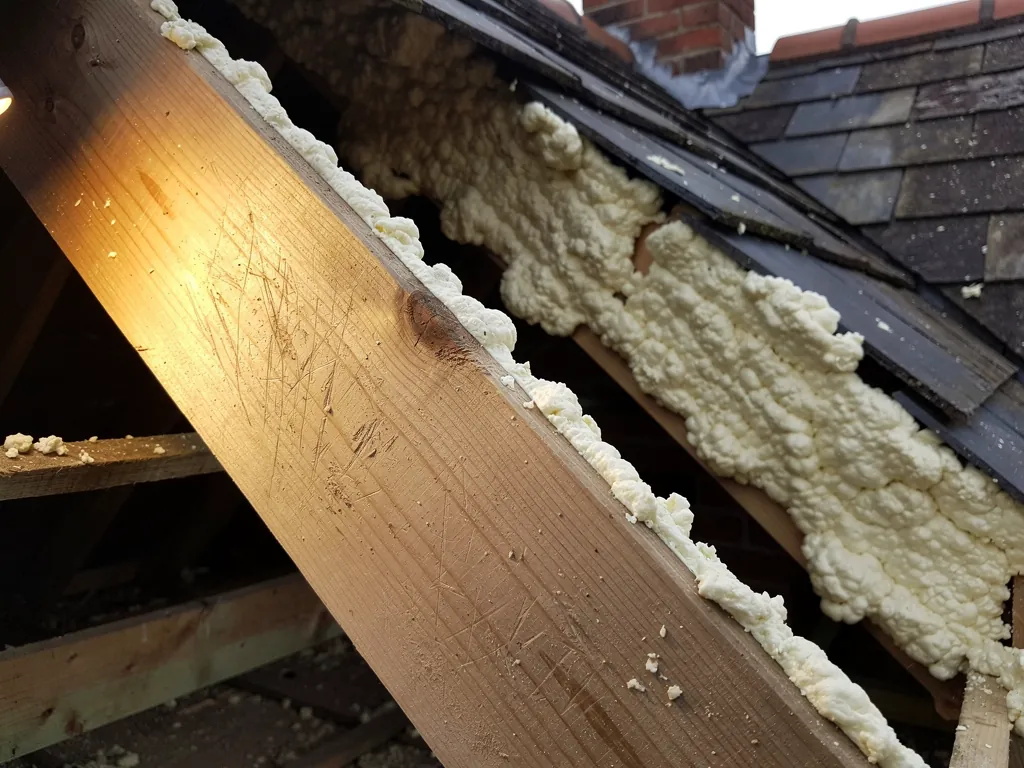
Spray foam is applied as a wet mix that swells and sets hard against whatever it touches. That is the whole difficulty. A foam skin that cured against clean, bare rafters comes away one way. A skin that crept through gaps and glued the underlay to the timber comes away another, and sometimes the roof covering has to come off to reach it.
So there is no single method, only a short list of them, and the job is choosing between them. The choice rests on three things you can see from the loft: what the foam is stuck to, how thick it lies, and what condition the wood underneath is in. Nobody can know the third until some of the foam has gone, which is why a removal is run in a set order, with a pause to look at the timber before the rest is committed.
This guide walks through that order. It covers the survey, the two main routes, how foam type changes the work, what is done once the timber shows, and the finishing and clear-up. It sits under our spray foam insulation removal service, which explains what we do on a job.
The survey that decides the method
Nothing is scraped until the loft has been looked at properly. We go up with a torch and a camera and work along the roof slope by slope, noting where the foam is thick, where it is thin and where it has been sprayed over something it should not have covered, such as cables, a cold water tank or the edge of a bathroom extract duct.
Three questions get answered in the loft. The first is what the foam is touching: bare rafters, roofing felt, or the back of the tiles themselves. The second is whether the foam is open-cell or closed-cell, which you can often tell by pressing a thumbnail into a spare patch. The third is whether any daylight, damp staining or loose underlay shows at the edges of the foam, because those mark the places where trouble is most likely to be hiding.
Why the photographs matter
Every survey is photographed, because the pictures become the reference for the rest of the job. A buyer's surveyor or a lender may later want to see what the rafters looked like once the foam was off, and a dated set of before and after photographs answers that better than a description. Our survey photographs come with the written quote, which is one total price fixed after the survey.
The survey also settles what you are not going to do. Where a section of foam is sound, dry and sitting on bare timber, the plan may be to open it up in places and probe the wood rather than remove all of it. That decision is taken at the survey, along with a plain statement of whether full removal is the only way to leave you a roof that can be inspected. Our guide to the spray foam survey covers what an inspector looks for.
Removal from the loft side
When the foam sits on bare rafters and the roof covering is sound, the work can usually be done from inside, with the tiles left in place. This is the quieter and tidier route, and it is the first one we look at.
We cut and scrape the foam off by hand, a section at a time. Open-cell foam is soft and tends to pull away in lumps, while closed-cell foam is hard and may need to be cut with a blade and scraped off the wood in layers. Power tools can scar timber, so on rafters the work leans towards hand tools and patience. Dust and offcuts are bagged as they come off, and a vacuum with fine filtration runs alongside, since cured foam breaks into small particles that drift through a loft quickly.
Protecting the rest of the house
The ceiling below is covered, the hatch is sealed with sheeting and the route down the stairs is laid with protection. Anything stored in the loft is lifted out first, because foam dust gets into boxes and fabric. The people doing the work wear breathing protection and disposable overalls, and the loft is ventilated while they are in it.
Even when everything goes to plan, a thin film of foam can stay stuck to the face of the wood. A roofer will take it back as far as is sensible without cutting into the timber, and will tell you where a residue remains. A surface trace on a dry, sound rafter is a different matter from a pocket of foam wedged between two boards that has been holding moisture against them.
The honest limit of this route is access. Where the foam reaches into the eaves, where the roof space is tight or where the rafters are boxed in by a loft conversion, the loft side may not reach everything, and the covering has to be lifted from above.
Lifting the covering when foam has stuck to the felt
Foam that has crept through the gaps in the underlay, or that was sprayed against the back of tiles or slates, cannot be separated from inside without tearing something. In that case the roof is stripped in sections from above, the foam is taken off with the tiles out of the way, and the covering is relaid or renewed.
The work is planned slope by slope so that the house is never left open to the weather. A section is lifted, the foam and the stuck underlay are removed, the timber is checked, new underlay is dressed in and the tiles or slates go back before the next section is started. On a hot day the plan changes little, but in a forecast of driving rain the job waits, because a half-stripped roof is a worse risk than a foamed one.
What happens to the tiles and slates
Sound tiles and slates are stacked and reused where they are in good order. Foam on the back of a tile does not always release cleanly, so a proportion may be damaged in the lift, and the survey allows for that by saying whether matching replacements are easy to find. Handmade clay tiles and older natural slate are harder to match than modern concrete, and that affects both the method and the total price.
Scaffold and access
A full strip generally needs scaffolding, since tiles are carried down and waste is carried away. A scaffold that obstructs the pavement needs a licence from the council that runs the road, so the start date has to leave time for it. The route is more disruptive and more costly than working from the loft, which is why it is chosen only when the survey shows the foam cannot be taken off from inside. The guide on removing foam without stripping the roof sets out when the loft route is enough.
How the type of foam changes the work
Open-cell and closed-cell foam behave differently under a scraper, and the difference shows up in how long a job takes and how much clean-up it leaves.
Open-cell foam is the softer of the two. It has a spongy, crumbly texture and tends to lift off wood in pieces. It also holds moisture more readily than a closed surface would, which is part of why damp is looked for behind it. The Energy Saving Trust, in its loft insulation advice last updated on 8 May 2026, advises against spraying foam onto a leaking roof, and adds that open-cell foam makes that risk far smaller.
Closed-cell foam is denser and harder. It grips timber and felt hard, and it is the type that tends to need cutting in layers rather than pulling off. It also tends to be the type that sits thickest in older, hurried installations, so a large area of it can mean a long job.
What the foam type does not change
The order of work stays the same whichever foam you have. The survey comes first, the foam comes off in sections, and the timber is checked once the first run of rafters is clear. What changes is the labour. A hard, thick skin on a long slope takes longer than a thin soft one on a short one, and this is why a removal is priced only once the roof has been seen.
If you are not sure which foam you have, photographs of the foam from the hatch are often enough for us to give a first view on method before a visit.
Checking the timber once it shows
The reason many owners want foam removed is the part they cannot see, so the moment the rafters come clear is the most important one in the job. The roofer checks the exposed wood slowly and on purpose.
The check is simple. The surface is looked at for dark staining, white or grey mould bloom and any change in the grain. A probe, usually a bradawl or a thin screwdriver, is pressed into the timber at several points. Sound wood resists the point and gives a hard, dry feel. Softened wood lets the point sink, and may crumble. Nail heads and the area around the eaves get extra attention, since that is where water most often collects.
If timber has been affected
The RICS consumer guide, dated March 2023, warns of dampness, such as uncontrolled condensation, where insulation has been fitted wrongly. A rafter that has stayed damp under foam can be anything from stained to soft. Stained but hard timber is usually left, with the cause of the damp dealt with. Soft timber is cut back to sound wood. Where a rafter has lost real strength, a new length is fixed alongside it, which is called sistering, or the whole member is replaced.
Every finding is photographed, and the repair plan is shown to you before the work goes ahead, with the cost covered by the written quote. Our guide to whether spray foam damages roof timbers goes through what the damage looks like.
The RICS guide also notes that removing spray foam could potentially damage the existing structure, so this stage is slow by design.
Felt, air paths and a roof that can look after itself
With the foam gone and the timber checked, the roof has to be put back into a state where it can look after itself. That means the underlay, the air paths and whatever insulation goes in next.
Roofing felt that has been torn, glued to foam or left brittle is replaced. Where the covering is still on and only a patch of underlay is damaged, a repair strip can sometimes be fitted from inside. Where a wider area is affected, the underlay is renewed during the strip described earlier.
Reopening the air paths
Roof ventilation lets damp air out and keeps the timber dry. Foam that fills the eaves can shut off the gaps that let air through. Once it is removed, those paths are checked and reopened: tray vents or a cleared soffit at the eaves, and vents or a breathable underlay at the ridge. Marley publishes eaves ventilation figures for cold roofs that vary with the type of underlay, and the right answer depends on the pitch and the construction, so it is checked on site rather than assumed.
Insulating again afterwards
A roof usually loses its insulation along with the foam, so what replaces it is decided before the job ends. The usual alternative is mineral wool quilt laid at ceiling level, leaving the roof space cold and ventilated. Your building control body can say what it expects to see.
Last of all, the loft is vacuumed and the bagged debris leaves with us. If the removal is part of a sale or a remortgage, keep the survey report and the before and after photographs, since together they show a roof structure that has been exposed, checked and put right.
Questions
Spray foam removal process questions
Can I scrape spray foam off the rafters myself?
You can try, but it is slow, messy and easy to get wrong. Cured foam sheds fine particles, rafters can be scarred by the wrong tool, and you will not know how to read what the timber underneath is telling you. The check for softness and staining is the part worth paying for, so have a roofer look at it before you start.
Does the roof have to come off to remove spray foam?
Not always. If the foam is on bare rafters and the covering is sound, it can often be taken off from the loft with the tiles left alone. If it has stuck to the felt or to the back of the tiles, the covering has to be lifted in sections. The loft survey is how that is decided.
What happens to the foam once it has been taken off?
It is bagged in the loft and carried out, then removed from site by us. The loft is then vacuumed so that fine foam dust is not left behind on the joists or in the eaves.