
Timber damage · 9 min read
Does spray foam damage roof timbers?
Foam does not rot wood by itself. Trapped moisture does, and foam can hide it. Here is how damage develops under a foamed roof, how it is found, and what is done about it.
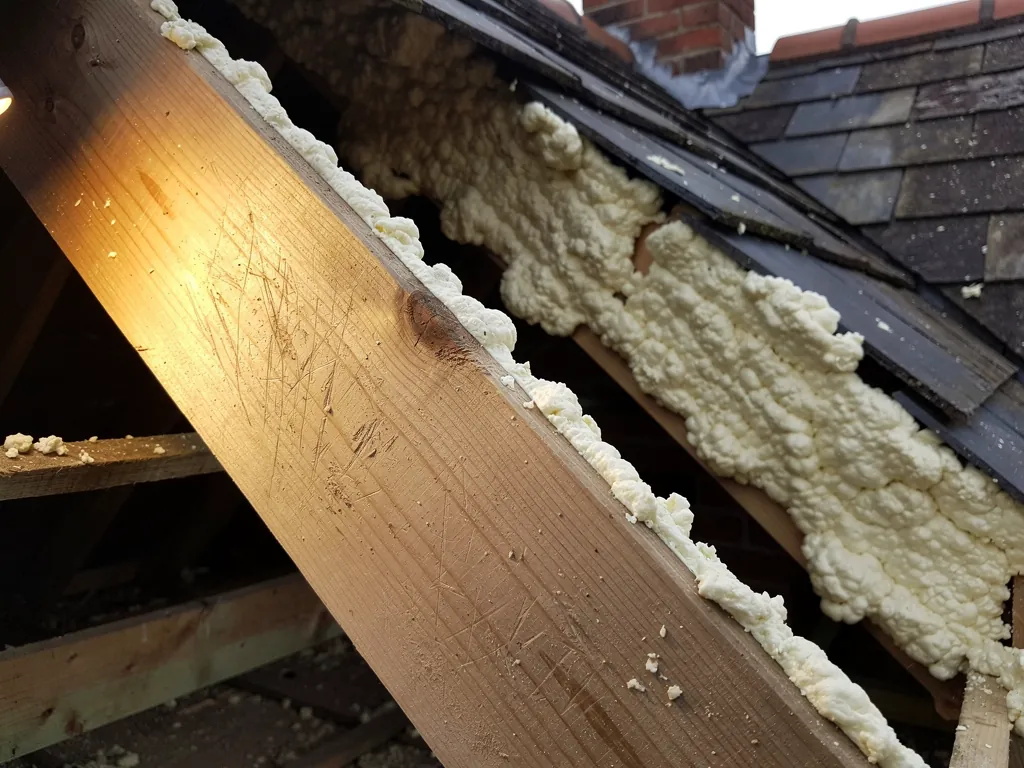
It is the question that sits behind most spray foam worries: has the foam done something to the rafters? The reply that serves you best is a conditional one. Dry timber under a dry roof can sit under foam without harm. Timber that gets wet, and stays wet because nothing can dry it out, is another matter, and foam makes that second case easier to arrive at and harder to spot.
So the useful thing to know is not whether foam is good or bad for wood but how water gets in, where it goes and what stops it leaving. Once that is clear, the signs to look for and the checks that matter follow naturally.
Below we cover how moisture ends up under foam, what damaged timber looks like, why it cannot be judged from below, how a roofer checks it and what the repair looks like. It forms part of our spray foam insulation removal work, where the survey is the first step. No figure is offered for how often damage is found, because the answer varies from roof to roof and a loft has to be looked at to know.
Why foam is not the cause but can be the cover
Wood rots when it holds moisture for long enough. A normal pitched roof has several ways of shedding that moisture before harm is done. Air moves through the eaves and out at the ridge. The underlay lets some vapour pass. The timber, which is sheltered from the weather, dries when the weather turns warm and dry.
Spray foam changes that arrangement. It sticks to the timber and the underside of the covering, sealing the gaps that once let air through, and it leaves the rafters sandwiched between foam on one side and underlay or tiles on the other. If moisture reaches the wood, it has fewer routes out.
What the guidance says
The RICS consumer guide, dated March 2023, warns of dampness, with uncontrolled condensation as an example, where insulation has been fitted wrongly. The wording matters: it speaks of faulty installation, not of foam in every case. It also describes the surveying problem, which is that foam can make timber difficult to inspect.
The Energy Saving Trust, in its advice last updated on 8 May 2026, goes further on one specific case. Its guidance is not to spray foam onto a roof that is already letting water in, and it expects the danger to be lower where the foam is the open-cell kind. Put those together and a picture forms. Foam over a sound, dry roof is a lower concern than foam over a roof that was already admitting water, and the type of foam matters too.
None of this proves that your roof is damaged. It tells you where to look, which is for water, and why a loft with foam on it deserves a proper check rather than a glance.
How moisture gets under the foam
Water reaches roof timber from three directions, and foam can sit in front of any of them.
The first is a leak from above. A slipped tile, a cracked slate, a failed flashing or a split in the underlay lets rain run onto the timber. In an open loft that water usually announces itself with a ceiling stain or a drip, and gets fixed. With foam in the way the water can run along the face of a rafter without ever reaching the room below, so nobody knows.
The second is condensation from inside. Warm, damp household air rises into the roof space, finds a cold surface and turns to droplets. The surface in question is often the underlay or the tile backs, and if foam stops air moving, moisture can sit there. Our answer on spray foam and condensation goes into this mechanism.
Nail holes and gaps at the edges
The third is slower and quieter. Roofing nails pass through felt and batten into the rafter, and every hole is a possible path for damp. Where the roof meets a gable, a chimney or a dormer, small gaps open as buildings move over time. Foam sprayed across all of those leaves nothing visible to flag them.
Coastal weather adds to the exposure. Gales and driving rain test the covering from the sea side, and a roof that has taken several winters of that may have small defects that were harmless when the loft was open and become important when foam covers them. A foamed roof is not a failing roof by default. It is a roof where small faults lose their early warning, which is why the check is worth doing.
What damaged timber looks like
When a rafter has suffered, it usually tells you in ways a roofer recognises. The signs vary with the type of decay, and not every sign is present at once.
The earliest one is staining. A rafter that has been repeatedly wet goes dark, often in a tide-mark pattern that follows the line along which water ran. Alongside it you may see mould growth, which appears as grey, green or black patches, or white bloom on the wood or on the back of the foam.
Then come changes in the wood itself. Softened timber loses its grain. It feels spongy under a thumbnail or crumbles to a damp powder. In some cases the wood cracks across the grain into small blocks, and a fine web of white strands may spread over the surface. Those are the marks of fungal decay, and they ask for a proper look at how far the problem has gone and what is feeding it.
Signs at the edges
Rusting nails and fixings near the foam are another clue. Where metal has corroded, moisture has been present, and the surrounding timber deserves a closer look. Daylight visible between foam and tiles is a hint of gaps in the covering, and foam that has pulled away from the timber suggests it has been wet or has moved.
It helps to keep this in proportion. A dark rafter is not necessarily a rotten one. Old staining from a leak mended years ago is common in lofts of every age, whether foamed or not. What matters is whether the wood is still sound when it is probed, and whether the moisture that caused the mark is still present. Only a physical check can answer both, and photographs of what is found are kept so the record is clear.
Why you cannot judge it from below
Looking at the foam from the loft floor tells you what the foam looks like. It tells you very little about the wood underneath, and the reasons are mechanical, not a matter of opinion.
The foam is a continuous skin. It is typically opaque, and it coats the rafter on its inner faces and often along the sides. A rafter might be soft along its upper face, the one against the underlay, and show nothing at all from beneath. A lump of foam gives no clue about what sits behind it.
A surveyor's moisture meter, an instrument that reads electrical resistance through a surface, can sometimes give an indication through a thin layer, but readings through foam are open to doubt. The meter is a pointer, not a verdict, and a reading that looks fine on one rafter says little about the next.
What a buyer's surveyor can do
A surveyor working in a loft can look, photograph and report what is visible. They cannot cut foam away from a house they do not own. That is why survey reports on foamed roofs so often say the structure could not be inspected, and why a buyer's lender may then ask for a specialist opinion. Our guide to the spray foam survey sets out what is looked at and where its limits lie.
The same RICS guide cautions that taking foam out may harm the structure beneath. That is a reason to plan any opening-up carefully rather than a reason to leave things unseen. A small, controlled opening at a sensible spot, made by hand, usually tells you far more than a dozen readings taken through the foam, and the opening can be made good afterwards.
How a roofer checks the timber
A proper check has a few parts, and it begins before anything is cut.
We look first at the roof from outside and from the loft, noting any missing or slipped coverings, failed flashings, and signs of water at the ceiling below. Evidence of past leaks tells us where to open up first. We also look at the eaves and ridge, since poor ventilation there points to likely condensation.
Then comes the opening. A section of foam, normally a patch at a few chosen spots, is cut back by hand to expose bare wood. The rafter is looked at for staining, mould and decay, and a probe is pushed into it. A sound rafter resists and feels dry and firm. A damaged one gives way. The probing is repeated along the length and at the ends where the timber sits on the wall plate, since that is where water tends to gather.
Choosing where to open up
Spots are chosen on the evidence: below valleys and chimneys, near the eaves, beside any ceiling stain and along the slope that takes the worst of the weather. If the first openings show sound, dry wood, the plan can be to leave the rest in place. If they show trouble, more of the foam comes off until the extent is known.
Photographs are taken at every opening, with a note of its position, so that the record can be passed to a buyer, a lender or another surveyor. The written quote then follows, as one total price, set by the extent of the work the survey showed. Our spray foam removal process guide follows the work through from there.
Putting damaged timber right
If the check turns up damage, the first question is what caused it, because replacing wood while the water still arrives only starts the clock again. The cause is dealt with before anything else: a failed flashing renewed, torn underlay replaced, a slipped tile refixed, ventilation reopened.
The timber is then dealt with according to its condition. Stained but hard wood is left, once dry. Surface mould on sound timber can be cleaned. Where wood has gone soft, it is cut back to firm material, and decayed sections are replaced with new treated timber. A rafter that has lost real strength is either strengthened by fixing a new length alongside it, known as sistering, or replaced altogether.
Structural advice
Rafters carry the roof, so where a number are badly affected, or where damage reaches the wall plate or the ridge board, it is sensible to take advice from a structural engineer. When a job reaches that point you are told, rather than being given a guess at a repair that has to carry load.
What follows for the roof
Once timbers are sound, the roof is made ready to stay that way: the underlay renewed where torn, the eaves and ridge vents cleared, and the loft insulated again with a method that lets the roof breathe. Your building control body can confirm what it expects for any structural work.
A foamed roof can also come through a check with sound timber. When that is the finding, you hold a written record that it was looked at and found dry and firm, and that has value of its own when the house is sold or remortgaged. If the check is the thing you are after, ask for it in the survey.
Questions
Roof timber and spray foam questions
Can spray foam cause wet rot in rafters?
It can contribute where moisture is present, because the foam can stop timber drying out. The foam is not the source of the water. A leak, or condensation that cannot escape, is. Rafters under foam on a dry, sound roof may be perfectly healthy, which is why they need checking and not assuming.
How would I know if my roof timbers are damaged under foam?
Look for ceiling stains, a musty smell in the loft, rusting nails and daylight at the edges. None is proof, and timber can be damaged with none of them showing. The reliable answer comes from opening the foam in selected places and probing the wood, which a roofer can do on a survey visit.
Is damaged timber always a reason to remove all the foam?
No. Where the damage is limited and the cause is fixed, the affected sections may be cut out and repaired and the rest left in place. Where it is widespread, or the roof cannot be checked, full removal gives the clearest result. The survey photographs show which case you have.