
Roofers in Elmer
Thatch, coastguard cottages and beach chalets
Elmer's roofs run from a thatched flint cottage on Elmer Road and early Victorian coastguard cottages to the lightweight chalets and bungalows of the 1920s seafront estates.

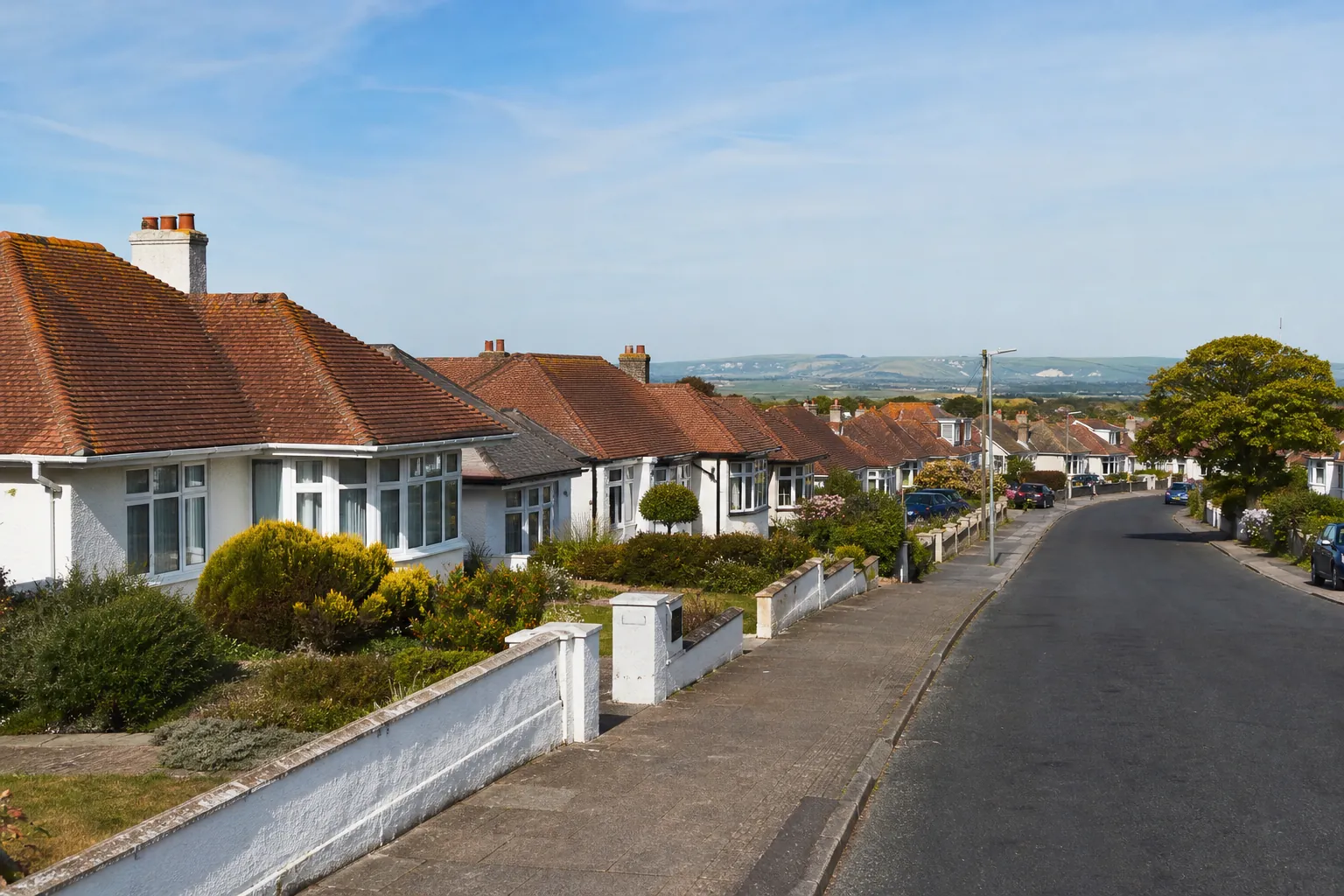
Elmer roofs
From High Kettle to Elmer Beach
-
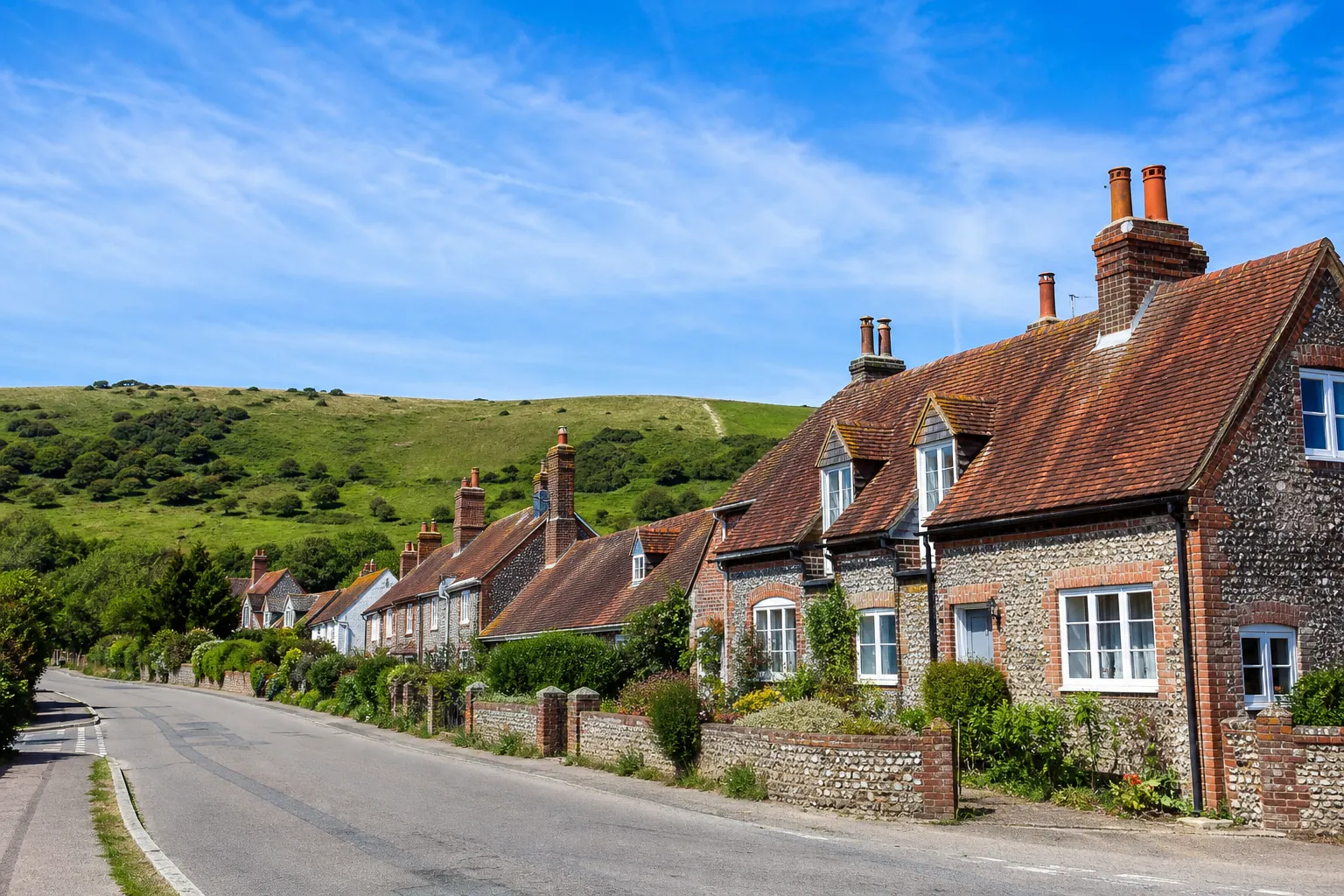
High Kettle on Elmer Road
High Kettle is a late 17th- or early 18th-century cottage of flint with brick dressings and thatch. A roof joined to walls like these asks for lead that follows the flint and brick.
-
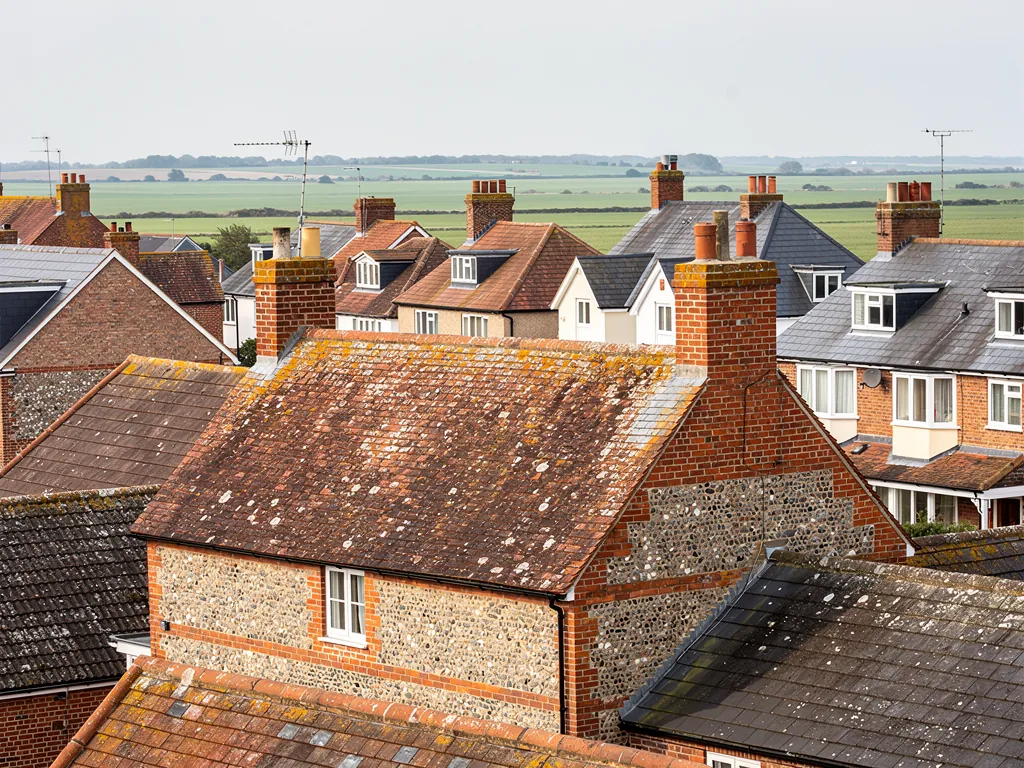
Coastguard cottages and a beach estate
Coastguard cottages had been newly built at Elmer by 1841, and the small Elmer Beach estate was laid out from about 1923. Two eras sit a century apart, each with its own roof problems.
-
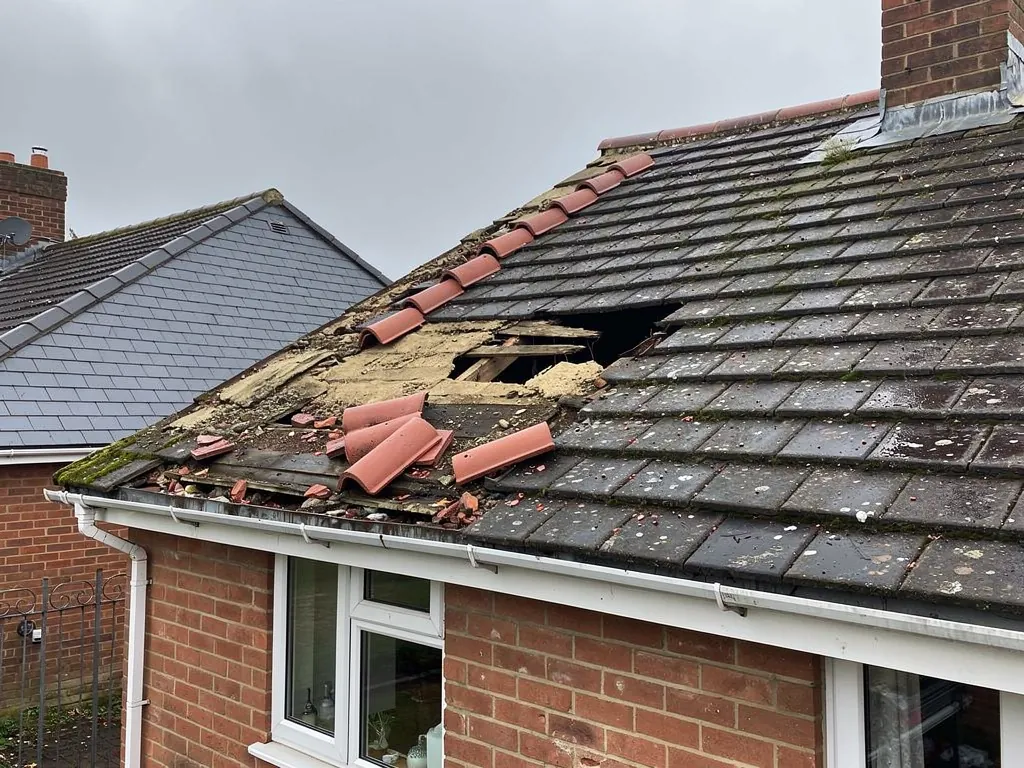
Chalets built to be light
The Victoria County History records interwar estate housing of ephemeral construction, with asbestos walls at Elmer and old railway carriages used often there. Light buildings like these deserve a careful survey.
Map of Elmer, 3.8 road miles east of Bognor Regis, with the nearest towns we also cover.
Elmer's seafront estates and the ground beneath
- Council
- Arun District Council
- County
- West Sussex County Council
- Conservation area
- None named for Elmer or Middleton among Arun's 29
- Article 4
- No direction found for Elmer on Arun's conservation areas page
- Ground
- Brickearth with coastal alluvium at Elmer
- Distance
- 3.8 road miles east of Bognor Regis, about 10 minutes by car
Elmer notes
Thatch, coastguard cottages and Elmer Beach
Elmer packs thatch, an 1841 coastguard row and interwar seafront estates into one small place, and each asks something different of a roofer.
Chapter 1: High Kettle, flint and thatch on Elmer Road2623
Sheet 01 / 03High Kettle, named in the Victoria County History, is a cottage in Elmer Road that began in the late 17th or early 18th century and is built of flint with brick dressings and thatch. Brick dressings are the brickwork around corners, windows and doors, where flint alone would be hard to shape. The same history says coastguard cottages were newly built at Elmer by 1841. Between them, those two entries cover the village's early roofs: one cottage under thatch, and a row built for a government service on the shore. A roof of that age is read as it stands today, not from the history.
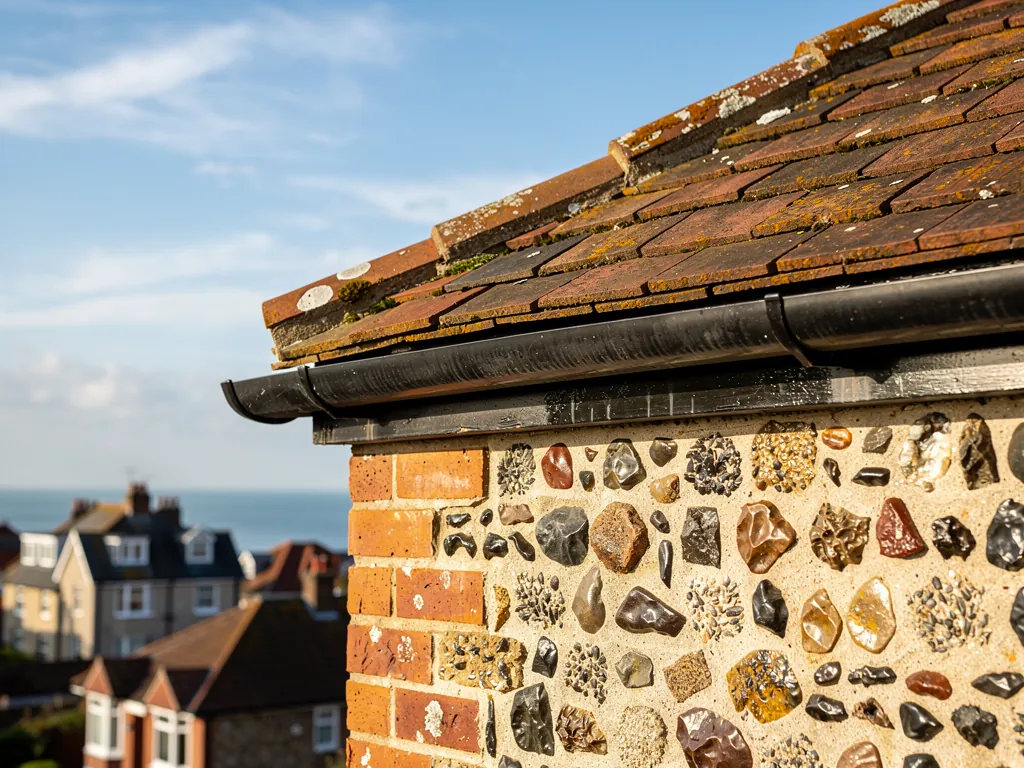
Beside a thatched Elmer cottage
- Flue lined and swept
- Fire plan for any hot work
- Flashing cut to flint and brick
- Shared gutter agreed with neighbours
1.1 Brick, flint and the roof that meets them
Where a tiled roof meets flint and brick, the junction is the weak point. Flint is uneven and brick is not, so a flashing that suits one may sit badly against the other. A good lead flashing is cut to follow the wall, tucked into a raked-out joint and sealed, and it is wedged along its upper edge. Brick can be pointed tighter than the flint beside it, so a crack near the roofline is worth noting before the lead goes on. Our lead roofing and leadwork page shows the types of flashing and where lead gets used.
1.2 A row of 1841 coastguard cottages
Any terrace raises the same questions that row would. A terrace shares its roof line, and often a party wall and a chimney stack, so water getting in at one house can show up in the next. A repair on a row calls for a word with the neighbours, a shared plan for scaffold and a check on whose gutter is whose. Slipped slates or tiles at the ridge are usually the first sign, and a roof inspection finds the cause. If the row was re-roofed in stages, the slopes may be different ages, and the joins between them deserve the most attention.
1.3 A dry roof beside a living fire
Thatch changes the rules for everyone nearby. Before a flame or a hot tool comes out, we look at the flue, the stack and the gap between the thatch and the work. A torch-on felt joint or a soldered flashing needs a fire plan beside straw, or a cold-applied alternative. If a chimney has not been swept or lined recently, that comes first. The stack work itself comes after that check.
Chapter 2: Railway carriages and asbestos walls at Elmer2745
Sheet 02 / 03The small Elmer Beach estate was laid out from about 1923, and the Victoria County History describes how some of the interwar estate housing around it was of more ephemeral construction, with asbestos walls, for instance, on the Southdean estate and at Elmer. It adds that frequent use was made of old railway carriages, especially at Elmer. That is history, and we are not saying any particular house contains asbestos. Whether anything of that kind survives behind later brick or render is something a survey settles, not a map. A building of that kind may have been extended or re-roofed since.
Two kinds of asbestos on an old roof
Asbestos cement sheet
Non-licensed work when carefully removed unbroken, notifiable if substantially damaged.
Insulating board
Hard to tell from lookalikes, and mostly licensed work for a specialist firm.
2.1 Why a light 1920s building needs a survey
A lightweight building has little spare strength, and a roof laid over a timber carriage body or thin-walled chalet can be asked to do more than it was built for. The first look is at the structure under the covering: sagging, damp timber and rusted fixings tell more than the surface does. Where fixings have rusted away, a covering may be held by little more than its own weight, and photographs of the underside, the timbers and the wall plate show the true condition. Anything heavier than the old covering is a structural question, and the Planning Portal advises taking a structural engineer's or surveyor's view before work begins.
2.2 Asbestos cement sheets, step by step
The HSE's rule of thumb is to suppose that asbestos is present in any property constructed or refurbished prior to 2000. Sheets of asbestos cement lifted off whole and handled with care count as non-licensed work, and the HSE counts weathered sheeting that is not otherwise badly damaged as part of that. If the sheet is substantially damaged or breaks up, the job becomes notifiable non-licensed work, and notice goes to the regulator before it starts. In the HSE's words an asbestos cement roof is always fragile, so nobody should step on one, and heavy fragments are carried down by hand rather than thrown or sent down a chute.
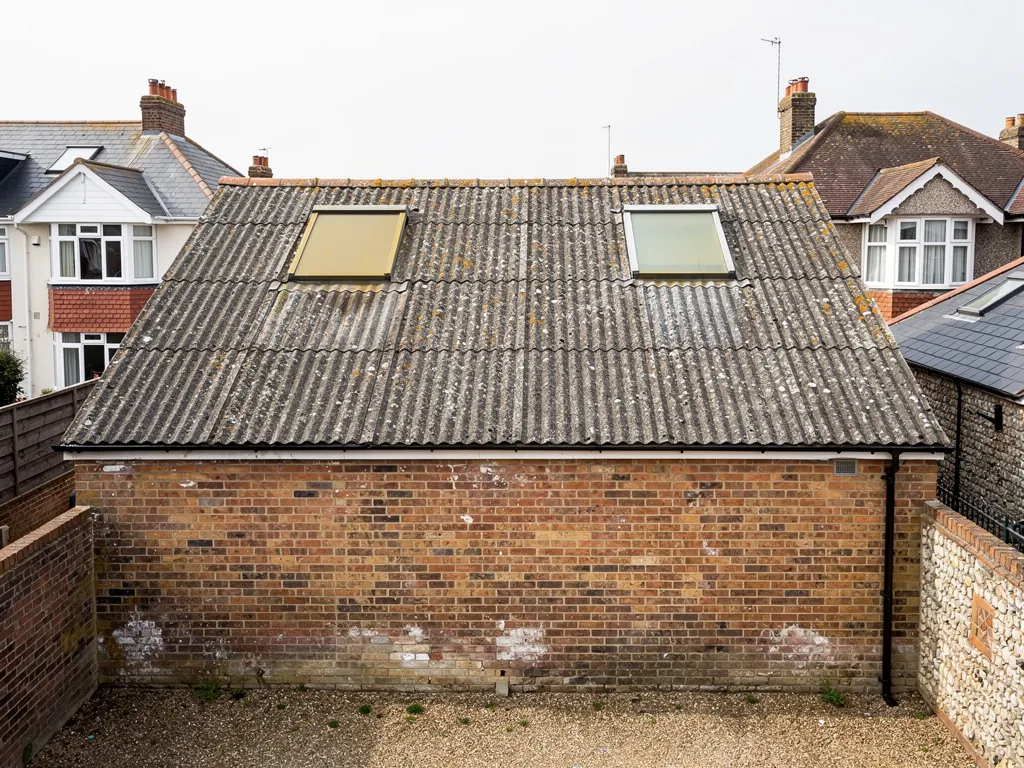
2.3 Boards, soffits and the waste trail
Asbestos insulating board is a different material. It is difficult to tell from lookalikes, and removing it is mostly licensed work, so a specialist firm takes that part. Household asbestos waste needs a consignment note, which the contractor completes as the waste producer, and the carrier should hold a waste carrier registration. Ask to see both. For the sheets themselves, HSE guidance is to double-wrap and label the waste and to use a lockable skip, so ask where it will go. Our roof inspections and surveys page describes how we record what is up there.
Chapter 3: Elmer Sands, the sea bank and low roofs2379
Sheet 03 / 03At Elmer a sea bank put up before 1931 was destroyed in that year, flooding much of the Elmer Sands estate, and the Victoria County History says spring tides with south-westerly gales still caused occasional flooding in the 1970s and later. That is history, not a current hazard rating, and we do not give any road a flood score. It does explain why a low seafront estate takes its weather seriously, and why the drainage on its roofs matters as much as the covering. With so little standing between a low roof and the weather, trouble tends to appear along the edges first.
Weather and history
Elmer's flooding history is a record of the past. It tells you where the sea reached, not how a given roof will behave.
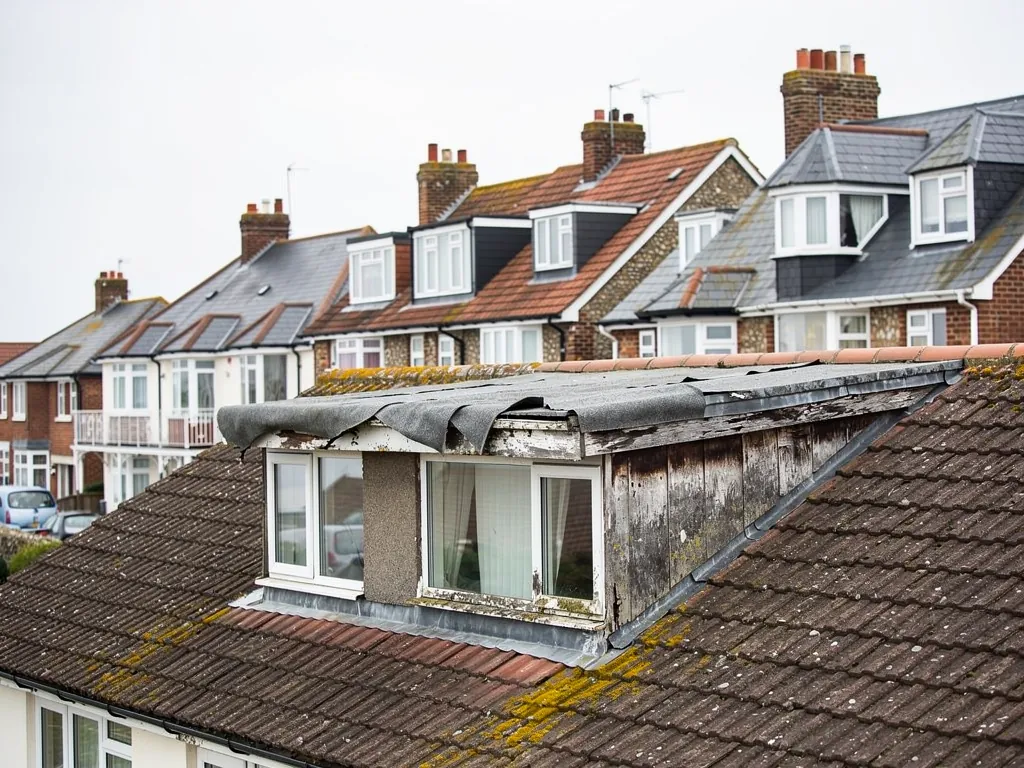
3.1 Gutters and downpipes in heavy rain
Gutter makers give falls from roughly 1:600 to 1:350 depending on the system, and Brett Martin says brackets should be no more than 900 mm apart. A sagging run holds water, spills over the fascia and soaks the wall. Leaves and moss in the outlets do the same job in a few weeks. A full gutter in a downpour is often mistaken for a leaking roof. Brackets also need sound fascia boards behind them, so renewing a gutter alone can fail within a season if the rafter ends are rotten.
3.2 Low pitches and wind suction
Marley's wind guidance says the windward slope of a roof pitched below 30 degrees may face severe negative pressure. Chalets and bungalows with shallow slopes therefore need every tile or slate fixed to the manufacturer's data sheet, and each product has its own minimum pitch, which is on its data sheet, such as 35 degrees for Marley concrete plain tiles and 20 degrees for natural slate under BS 5534. The first job is to measure the pitch, because the answer decides which coverings are allowed at all, and an old chalet roof that was fitted with the wrong product is a common reason for a repair that keeps failing. If the pitch is too shallow for the covering you want, a flat-roof system is often the better answer than forcing a tile onto it.
3.3 Flat roofs on beach chalets
Small flat roofs on chalets and garages fail at edges, outlets and upstands. Less gives £150 to £500 as a typical range for small flat roof repairs, in a guide updated in March 2026. What your roof needs depends on the deck, the falls and what the survey finds, and the written quote follows from that. Approved Document L classes the stripping and renewal of a flat roof's waterproof layer as renovation, and renovating more than 50 per cent of the roof element means upgrading its insulation. Our flat roofing page describes the coverings.
What we can do for Elmer roofs
Frequently asked questions
Questions from Elmer Road to the beach estate
Is it safe to carry out lead and tile repairs beside a thatched roof on Elmer Road?
Yes, with a plan. We look at the flue first, keep scaffolding clear of the straw, and either use a cold-applied method or put a fire watch on any hot work. The lead flashings are cut to follow the flint and brick. The thatch stays a thatcher's job, and we agree boundaries with the neighbours before the work starts. If the cottage is listed, we read its entry and ask Arun before touching the roof edge.
Could an old Elmer chalet have asbestos in its roof or walls?
Possibly, because the history records asbestos walls on some interwar estate housing at Elmer, but that does not mean any one house has it. The HSE suggests presuming asbestos in older property until it has been tested. A survey and, where needed, sampling by a specialist settles the question before anyone cuts, drills or removes anything, and it tells you what the waste route will be.
Why do low-pitched roofs near the Elmer seafront need extra care in a gale?
Marley notes that on roofs pitched below 30 degrees the windward slope is open to severe suction. Shallow chalet and bungalow roofs therefore depend on every tile, slate and ridge being fixed to the maker's data sheet. We check how the covering is held, not only how it looks, and recommend mechanical fixing to BS 5534 where it is missing, with photographs so you can see exactly which tiles or ridge sections are loose.
What do small flat-roof repairs cost on an Elmer chalet?
Less gives £150 to £500 as a typical UK range for small flat-roof repairs, in a guide updated in March 2026. The real figure depends on the deck, the outlets, the edges and access, and a rotten deck changes the job, because the deck has to be replaced before any new covering can go down. We survey first, photograph each fault, and then the quote arrives in writing as a single total, so a repair and a replacement can be compared fairly.
Nearby areas
Get a quote
Tell us about your roof
Describe what's happening and we'll call you back.
Loading the enquiry form. You can also call 01243 252373.