
Asbestos cement roofs · 9 min read
Asbestos cement roofs on industrial units
Large cement sheets that have kept the rain off a unit for a long time may contain asbestos. This guide explains how the HSE sorts the work, when overlaying beats removal, and how the waste must leave site.
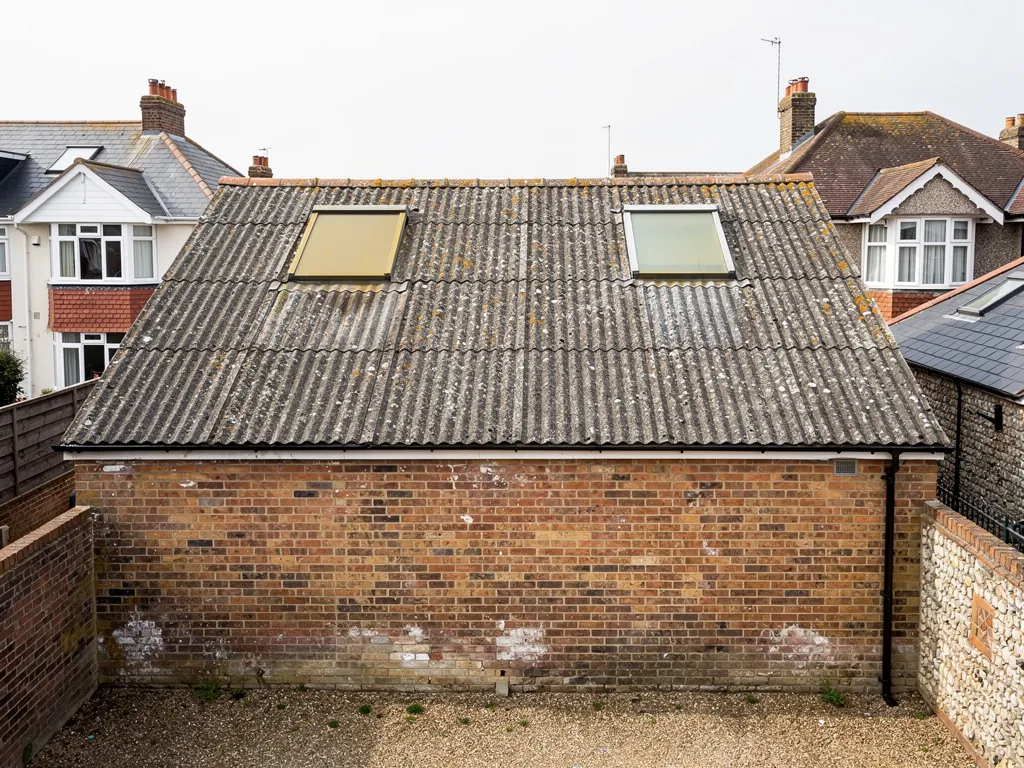
Corrugated cement sheeting covers a great many warehouses, workshops, farm buildings and trade units. It is also the roof type that raises the most questions when an owner finally asks what it will take to replace it.
The Health and Safety Executive gives a blunt rule of thumb for older premises: where the construction or a refurbishment dates from before 2000, assume asbestos is present somewhere in the building. Asbestos cement is the most familiar form on a roof, and it is the form this guide deals with. The fibres are locked inside the cement, and the danger arrives when the sheet is broken, drilled, scrubbed or crushed and the fibres escape. Pressure washing a mossy roof or walking across it with a bucket are exactly the activities that cause that, which is why the first rule is not to treat an old cement roof as an ordinary one.
Two things follow. The roof needs a decision, not a guess, and the decision has more than one possible answer. Some roofs can be left, some can be covered over, and some have to come off. This guide goes through each route, the HSE categories that govern the work, and the questions to put to any contractor before a price is agreed.
How to tell whether a unit roof is asbestos cement
You cannot reliably tell by eye. Large corrugated sheets, fixed to steel or timber purlins with bolts and hooks, are the usual picture, and a weathered grey surface with lichen or moss is typical of old cement sheeting. Newer sheets in a similar profile can look much the same from the ground. The HSE admits that even experts struggle to separate some asbestos products from lookalikes, and the safe habit is never to guess about an old board or sheet.
That is why the pre-2000 rule exists. If the building dates from before then, or was refurbished before then, the sensible position is to assume the material contains asbestos until a test says it does not. Taking a sample for analysis is itself work that the HSE places in the non-licensed category, but it still needs care, because scraping a sheet can release fibres. It is a job for someone trained.
Building records and the register
Start with paperwork. Original drawings, previous survey reports, a maintenance file and any asbestos register held by the building's owner or manager may already answer the question. If you took the building on a lease, ask the landlord for the register before you ask a roofer to climb up.
Why the roof is dangerous in two ways
Asbestos cement roofs carry a second hazard that has nothing to do with fibres. In its task sheet for removing cement sheets, the HSE warns that this type of roof is always fragile and cannot bear weight. A person who steps on a sheet may go through it. Our guide to fragile roofs and rooflights covers how access is planned, and every asbestos cement job begins with that plan.
Rooflights set into these roofs are usually the weakest points, which is why they matter so much during any work.
Licensed, notifiable and non-licensed: how the HSE sorts the work
The HSE divides work on asbestos materials into three groups, and a roof can move from one to another depending on its condition and what you do to it.
Non-licensed work
Cement products such as roof sheeting and rainwater goods sit in the non-licensed group in the HSE's list, so long as the material is handled with care and comes off in one piece. The same page adds that weathered cement is covered, provided it is not otherwise badly damaged. Weathering alone, in other words, does not push a roof into a higher category.
Notifiable non-licensed work
Where sheeting has been badly damaged or already broken into pieces, the HSE moves the work into the notifiable non-licensed group. The HSE wants notice before the work starts and sets no minimum notice period. The employer must also designate the work area, arrange medical examinations and keep registers of the work, which are health records, for 40 years. The task sheet for removing sheets makes the same point: if the material starts to break up creating significant dust, the job becomes notifiable.
Licensed work
The HSE reserves higher-risk work with asbestos for firms that hold its licence for it. Removing asbestos insulating board is in most cases licensed work, and so are materials such as lagging and sprayed coatings. The HSE task sheet for cement sheeting says it does not fit where other asbestos materials are present, such as lagging, limpet or insulating board, and that a specialist authorised for that kind of work should deal with those. A roof with asbestos cement sheets and a lined, sprayed or boarded ceiling beneath it may be two separate jobs with two separate sets of rules.
The practical message for an owner is that the condition of the sheets decides the category. Condition is judged first, the category follows, and the method comes last.
Overlay, encapsulate or remove: the three routes
When an asbestos cement roof starts to leak, owners often assume the only answer is a strip-out. That is not always so. The HSE task sheet asks the question itself: can you overlay the sheets with non-asbestos material instead of removing them? If so, it says to attach the new material to the existing purlins and avoid drilling through the old sheets.
Overlay
An overlay is a new roof laid above the old one, usually in insulated composite panels or profiled metal. It keeps the asbestos undisturbed, avoids a skip of waste and keeps the building dry during the work. Because the old sheets stay where they are, nobody has to cut bolts, lower fragments or pack waste, and the programme is usually shorter as a result. The limits are structural and practical. The purlins must be able to carry the extra weight, which needs an engineer's check, and the fixings must reach the existing structure without drilling into the old sheets. The asbestos stays in the building, so it stays on the register and it will have to be dealt with at the end of the building's life. Our page on over-roofing sets out the method in detail.
Encapsulation
The HSE lists sealing-in work on asbestos materials in good condition among non-licensed tasks. It suits sheets that are sound and only need protecting. It does not suit a roof that is cracked, brittle or leaking, because a coating cannot restore strength.
Removal
Removal is the right answer when the sheets are badly damaged, when the structure cannot take an overlay, or when the building is being redeveloped. It brings the most controls, the most waste and the most planning, which the next section covers. A good contractor will tell you which of the three routes fits your roof, and why, before quoting for any of them. If the plain answer is that an overlay will hold, that is what you should be told, with the reasons written down.
Taking sheets off and getting the waste away
The HSE task sheet for removing asbestos cement sheets sets out a careful method. It begins with checking with the premises owner that only asbestos cement is present, and protecting nearby surfaces from contamination. The sheets are dampened, and where they are held by bolts the bolts are cut or the fixings carefully released, while avoiding contact with the cement. The aim throughout is to avoid or minimise breaking the sheets.
Big pieces come down to the ground carefully. The sheet is blunt about it: do not drop them and do not use rubble chutes. Where there are several sheets, they go into a lockable skip, and the task sheet says a standard skip with a sheet thrown over it is not good enough.
Packing and labelling
The HSE disposal sheet says to double-wrap and label asbestos waste. Large pieces are wrapped in heavy polythene and sealed with tape. Small pieces go into an asbestos waste bag. It also warns against mixing asbestos waste with other waste to get below the 0.1% threshold at which it counts as hazardous waste.
Paperwork and carriers
In England, asbestos waste above that threshold is hazardous waste and a hazardous waste consignment note must be completed. Copies are kept for three years. Whoever carries the load needs to be a registered waste carrier, and it must go to a licensed disposal site. The household exemption for domestic hazardous waste does not extend to asbestos waste, so ask who is named as the producer on the note and who signs it.
As an owner you can ask to see the consignment paperwork when the job ends. If a contractor cannot say where the sheets went, treat that as a warning sign. Our guide to commercial roof replacement cost explains how disposal and access feed into the bill.
What an owner should ask for before agreeing a job
A few questions sort out most of the risk before any work begins.
- Has the material been identified by sampling, or is it being assumed?
- What condition are the sheets in, and has anything been broken or cracked already?
- Is other asbestos present, such as insulation boards or lagging, that changes the category?
- Which route is proposed, overlay, encapsulation or removal, and why does it fit?
- Who does the asbestos work, and how will they do it?
- What is the plan for working at height on a fragile roof?
- Where will the waste go, and will you see the consignment paperwork?
These questions suit any contractor, ourselves included. A plan of work should exist before the first bolt is cut, and the HSE task sheet says the premises owner, dutyholder or client should check off the job when it ends. Clearance air sampling is not normally needed for the small-scale tasks that sheet covers, though larger jobs call for a fuller risk assessment and plan of work.
Pricing and timing
Roof area, access, the condition of the sheets, the amount of waste and the route chosen all move the price. The survey comes first. After it, one written price covers the whole job. Check whether any quote includes VAT, which is currently 20%, and whether it includes scaffolding or other access equipment. If the scaffold will occupy or overhang the public highway, a licence from the highway authority is needed under section 169 of the Highways Act 1980, and that application takes time.
Start the conversation early. A roof that has begun to leak is easier to plan around than one that has failed in a gale. Our page on commercial roofing lists the services we offer on industrial units and shops.
Questions
Asbestos cement roof questions
Does moss and weathering mean my asbestos cement sheets are damaged?
Not by itself. The HSE puts weathered cement that is not otherwise badly damaged in the non-licensed group. Cracks, breakages and crumbling edges are a different matter, and once sheets are substantially damaged the work can become notifiable. A condition survey tells you which side of that line the roof sits.
Can new sheets simply go over the old asbestos cement ones?
Sometimes. The HSE task sheet asks whether the sheets can be overlaid with non-asbestos material, fixed to the existing purlins without drilling through the old sheets. The purlins have to carry the extra load, so a structural check is needed, and the asbestos stays in the building afterwards.
What happens to old asbestos cement sheets once they are off the roof?
They are double-wrapped or bagged, labelled, and stored in a lockable skip. Above the 0.1% threshold the waste is hazardous, so a consignment note is completed and a registered carrier takes it to a licensed disposal site. Copies of the paperwork are kept for three years.