
Commercial roof costs · 8 min read
Commercial roof replacement costs: what drives the price
No two commercial roofs price alike. This guide sets out what moves a replacement bill on a shop, unit or block, with the published figures that exist and what decides the rest.
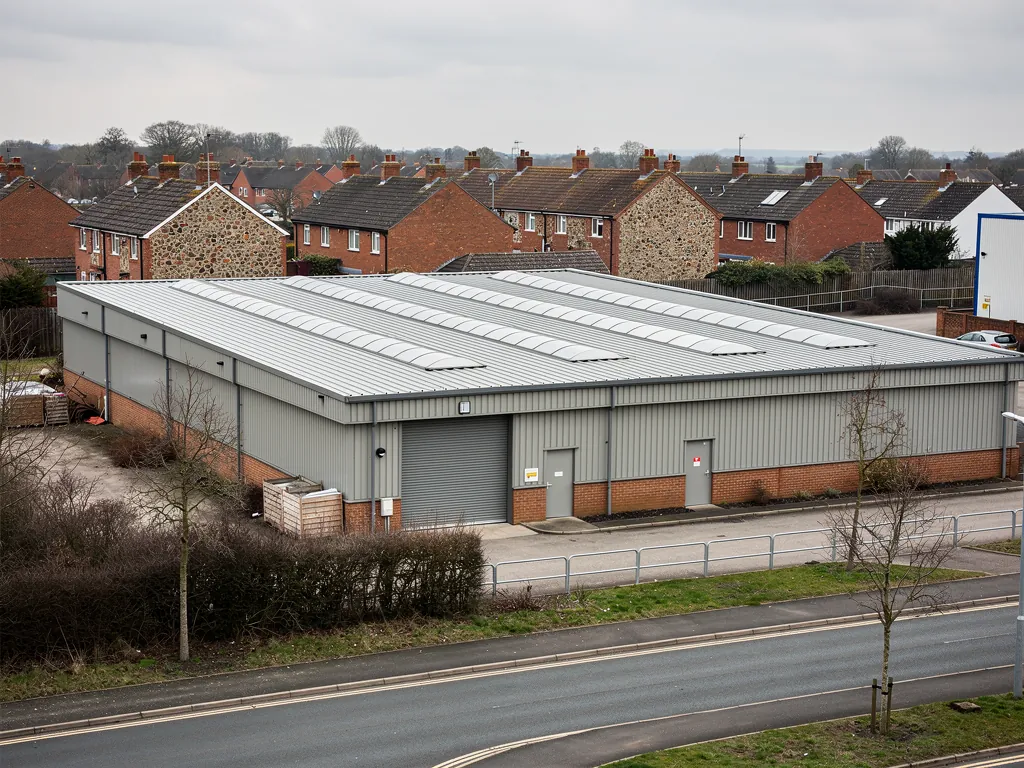
A homeowner can look up a ballpark for a three-bedroom semi. A shop owner, a landlord with a parade of units or the manager of a block of flats has a harder job, because published cost guides are written around houses. They quote a range per house type, or per square metre of domestic roof, and a commercial roof rarely behaves like one. The area is bigger, the access is awkward, the building stays in use while work goes on, and the deck underneath has often had decades of weather to work on.
So this guide takes a different route. It gives no invented price per square metre, because that would be a guess dressed up as a fact. It walks through the things that decide the figure, in the order they matter, and puts in a number wherever a named guide publishes one: scaffold, licences, lifespans, falls, VAT and the benchmark ranges for flat roofs. Where no national figure exists, it says what sets the cost instead.
The figure that counts arrives in writing once we have been up on your roof, taken photographs of the fault and checked what lies beneath. Use this page to understand that number, and to spot a quote that has left something out.
Size, covering and shape: the first three drivers
Three things set the starting point before anyone climbs a ladder: how big the roof is, what goes back on it, and how complicated the shape is.
Area behaves in a way that surprises people. A bigger roof costs more in total, but the cost per square metre can fall, because set-up, site cover and access are spread over more roof. The reverse also holds. A small, busy roof broken up by rooflights, plant, upstands and parapets costs more per square metre than a clean open one, because every penetration needs its own detail.
The covering comes next. Commercial flat roofs usually come down to three families, set side by side in our guide to commercial flat roof systems: felt built up in layers, liquid coatings and factory-made sheet membranes. Metal sheet, composite panels and lead or zinc on parapets sit alongside them. Each has its own material cost, method and labour time. A membrane that arrives on a roll goes down quickly over an open deck, while a roof crowded with details can turn that advantage round.
Height, pitch and complexity
Height decides how materials get up there and how people stay safe. A single-storey unit with a clear yard around it is simple. A fourth-floor roof above a busy street is not, and the hoist, crane or tower it needs shows in the price.
Pitch matters too. Steeper roofs need edge protection and slower working. Layouts with valleys, lead-lined gutters, hips and chimney stacks need skilled hands at every junction, and those hours add up faster than the area suggests.
None of this fits a table, which is why our method is the survey: look at the roof, photograph what is there, say whether a repair, a part re-cover or a full replacement fits, and put a single total on the agreed work.
Lifespans and why the covering is a cost decision
The covering that costs least on day one is not always the least costly to own. A fair comparison sets the price of the job beside how many years it will serve. These are typical figures as published, never promises, and a warranty is a different thing from a lifespan.
| Covering | Typical published life | Source |
|---|---|---|
| Torch-on felt | 10 to 20 years | Less, March 2026 |
| GRP fibreglass | 25 to 40 years | Less, March 2026 |
| EPDM rubber | 20 to 30 years (GreenSpec); 30 to 50 years (Less) | GreenSpec; Less, March 2026 |
| Lead sheet | 50 to 100 years on a flat roof | Less, March 2026 |
| Zinc | In excess of 100 years | VM Zinc, quoting the Building Research Establishment |
The spread inside each row carries the lesson. The same covering can finish at either end of its range, depending on how it is laid, how it drains and whether anyone looks at it after a storm.
That spread feeds straight into the money question. A felt roof at the lower end of its range, on a building you plan to keep for decades, may be replaced twice in the time a longer-lived membrane would just be maintained. On a unit with a short lease or a redevelopment on the horizon, a shorter-lived system can be the sensible buy. The right answer comes from how long you need the roof, not from the lowest line on a page.
Upkeep belongs in the same sum. A roof that is checked, cleared of debris and looked at after gales tends to reach the far end of its range. Our page on planned maintenance for commercial roofs explains what a visit involves.
Access, scaffold and highway licences
Access is where a commercial quote can move by thousands, because the building rarely lets you park a skip at the wall and start. Scaffold may be needed on every side, across a shop front or above a public pavement, and its price depends on the building more than on the roof.
In Checkatrade's scaffolding table, updated October 2026, the monthly figures for houses run to around £875 for a two-storey semi-detached, £800 for a terrace, £1,000 for a detached bungalow and £1,200 for a detached house. Those are domestic numbers. A shop with a long frontage or a tall block of flats costs more, and the scaffold firm prices it from the elevations.
Licences
A scaffold that occupies or overhangs the public footway needs a highway licence under section 169 of the Highways Act 1980, granted by the highway authority. West Sussex County Council charges £266 for a month and wants at least 10 working days' notice. Hampshire County Council, whose area takes in Havant and East Hampshire, charges £211.90 for the first fortnight and wants ten clear working days. In Portsmouth the city council is the highway authority, so the scaffold firm confirms what it needs.
The waiting period is a cost driver in itself. Work cannot start until the licence is granted, and a licence that runs out before the job does may mean a further charge: West Sussex lists an extension at £178 and a late extension at £335.
Access also covers everything that is not scaffold: protecting passers-by, keeping a shop door open, working around customer parking and delivery slots, and lifting materials onto a roof with no yard. We price these after the survey. When you compare two prices, ask each firm to confirm that scaffold and licence fees sit inside the total, because a figure that leaves them out is not the lower one once they arrive as an extra.
The deck, the falls and the insulation underneath
The covering is the visible part of the job. What lies under it can decide whether the bill is fair or doubled, and nobody can price it from the street.
Deck condition
If a flat roof has leaked for a while, the deck may be wet or rotten. On timber that means new boards, and on profiled metal it can mean treating or replacing sheets. A roofer who finds this after stripping is entitled to say so and re-price the extra, which is why a proper survey, with moisture checks and photographs where they are possible, saves argument later. Our guide to commercial roof surveys covers what gets recorded.
Falls and drainage
A flat roof that ponds is a flat roof that fails early. BS 6229:2025, which replaced the 2018 edition in December 2025, keeps a minimum finished fall of 1:80, and the usual design target is around 1:40, leaving margin for the build. A roof laid dead flat carries the same fault into its next covering. The cure is tapered insulation or new firrings, the tapered timbers that create a slope, and both add cost.
Insulation and the rules
Renewing a roof can pull an insulation upgrade into the job. For houses the Planning Portal sets two limits, 25 per cent of the total building envelope and 50 per cent of the roof, below which approval is normally unnecessary, and Approved Document L for dwellings counts a renewed flat roof membrane as renovation. Those figures are for homes. For a commercial building your building control body states what applies, and our guide to commercial re-roofing and Building Regulations lists the questions to put to them.
Extra insulation costs more at the start. Set that against the heat lost through the roof across the years you will own it.
Benchmarks, VAT and reading a quote
There is no national range for a commercial roof, so we will not offer one. What exists are domestic benchmarks, and they help with scale only.
Checkatrade lists a house flat roof replacement at £2,800 to £7,500 in its October 2026 roof replacement table, which is marked plus VAT. Less, in a guide updated in March 2026, puts small flat roof repairs at £150 to £500, and Checkatrade gives roofers' labour at around £35 to £45 an hour or £280 to £360 a day. A commercial roof is larger than a house roof, so the total will be larger, but area on its own does not predict it.
VAT
The standard rate of VAT is 20 per cent, and many cost guides show prices without it. Check with each contractor that VAT is inside the figure, and ask your accountant whether your business can reclaim it. Re-roofing is standard-rated, and where insulation is part of the job, how the work is supplied decides the rate. We explain that on the quote.
Before you set two prices side by side, ask each contractor whether VAT, scaffold and licences are inside the total, and what the survey found about the deck.
What a good quote contains
Our written quote lands after the survey, with a single total for the agreed work. It names the covering, says what happens to the old one, explains how the roof will drain, how access is handled and when work can begin. A quote that is thin on any of these deserves a question. For the wider picture of what we cover, see commercial roofing, and if your roof is near the point of deciding, repair or replace a commercial roof sets out how to make the call.
Questions
Commercial roof cost queries
Why can't you give a price per square metre for a shop or unit roof?
Published national guides price houses, and a commercial roof differs in area, access, deck condition and daily use. A house figure would mislead you. We look at the roof, photograph the fault and put one total on the work that fits, so the number you receive belongs to your building.
Do I pay VAT on a commercial roof replacement?
The standard rate is 20 per cent, and re-roofing is standard-rated. Many cost guides show prices without VAT, so ask each contractor whether the total includes it. Whether your business can reclaim VAT is a matter for your accountant, and our quote shows what is included.
Does the scaffold licence add to the time before work can start?
It can. Under West Sussex rules at least 10 working days must pass between application and erection, while Hampshire needs ten clear working days. The licence needs notice, so raise it early and allow for the notice period when you plan the job around trading.