
Flat roof systems · 8 min read
Commercial flat roofs: built-up felt, liquid and single-ply compared
Three families cover most commercial flat roofs: built-up felt, liquid-applied coatings and single-ply membranes. This guide compares how each is laid, how long each lasts and where each is the wrong choice.
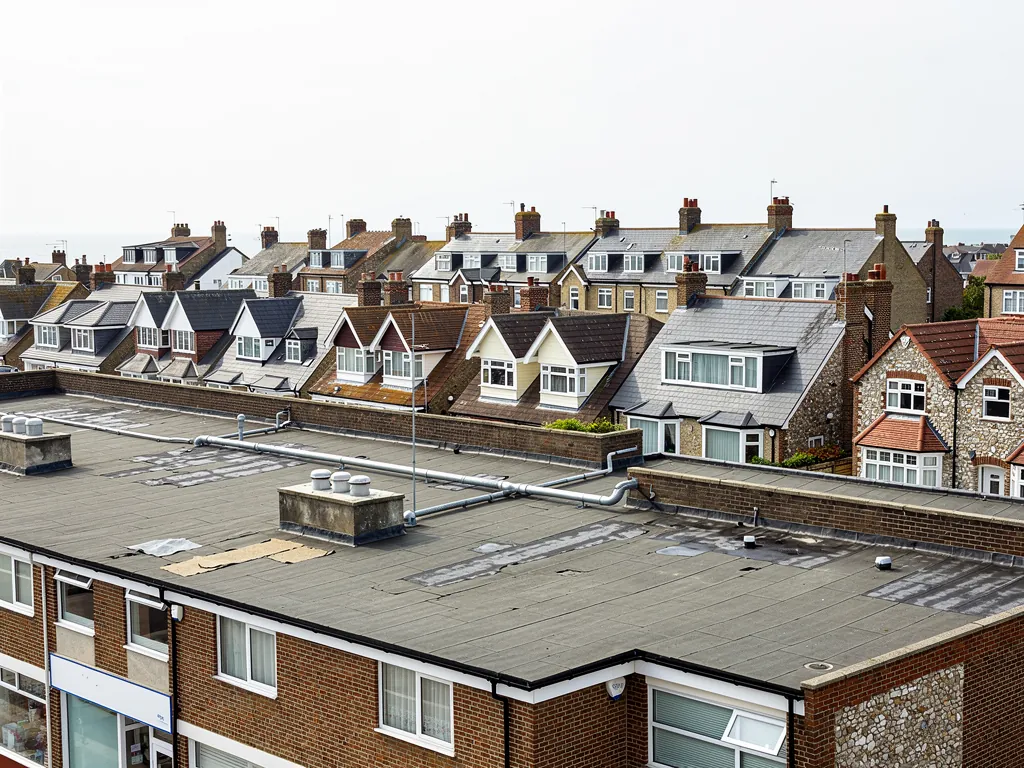
Pick up a commercial roofing brochure and the choice looks like a contest between brand names. In practice it comes down to three questions. How is the waterproof layer made, what does the roof have to put up with, and who will look after it afterwards?
Built-up felt is assembled on the roof in layers that are fused together into a continuous skin. Liquid-applied systems are brushed or rolled on and cure into a joint-free coating. Single-ply membranes arrive as factory-made sheets that are joined on site. All three can keep a building dry for decades. All three can also fail early when the falls are wrong, the details are poor or the roof is asked to do something it was not designed for.
This guide takes each family in turn, with the lifespans and repair rates that national guides publish. Those rates are mostly written for houses, and we flag the difference where it matters. Your own roof gets its own answer after a survey, with photographs of what is there and the work we recommend, priced as one written sum.
Built-up felt: layers laid on the roof
Built-up felt is the oldest of the three. A modern system uses bitumen-based sheets laid in two or three layers, each fused to the one below. The top layer is often a cap sheet with a mineral or reflective finish that shields the bitumen from sunlight. Torch-on felt, where the sheets are fused by heating them with a gas flame, is the familiar version.
Felt has real strengths on commercial buildings. It copes with irregular shapes and many penetrations, it is easy to repair locally, and roofers across the trade know it well. A multi-layer build gives some redundancy, because a flaw in one layer is covered by the next.
Limits of felt
Its weakness is workmanship. The laps and the upstand details are where felt fails, and a poorly fused seam can let water in within a few years. Torch-on work also brings fire risk, because it puts an open flame on a roof, so method and supervision become part of the job. Cold-applied or self-adhesive layers are often chosen near combustible materials for this reason.
On lifespan, Less gives torch-on felt 10 to 20 years in its guide last updated in March 2026, with the caution that careful laying earns up to 20 years and careless laying may fail inside 10. CORC puts it higher, at 30 years or more, so published sources disagree. Plan on the lower figure and treat the higher one as a bonus.
On repairs, Checkatrade's table, last updated in June 2026, gives bitumen felt flat roof repairs at £100 to £140 per square metre, excluding VAT. That is a domestic figure.
Our page on built-up felt roofing goes through layer build-ups and the details that matter.
Liquid-applied systems: a coating without joints
Liquid systems go on wet and cure into one continuous membrane. The best known is GRP, glass-reinforced plastic: a resin laid over glass-fibre matting and finished with a top coat. Others are polyurethane, acrylic or bitumen-based coatings, usually with a reinforcing fleece at joints and details.
The appeal is the lack of laps. A liquid system flows around rooflights, pipes and plant bases without the cut-and-fold work a sheet needs. It can sometimes be applied over a sound existing surface, which saves a strip-out. Our guide to metal roof coating covers the same idea on sheet roofs.
What liquid systems need
They need a sound, dry, clean base, and the weather has to cooperate while they cure. A liquid coating applied to a damp deck traps the moisture beneath it. Because a finished GRP skin is rigid, it can crack where a building moves, so it suits stable decks better than roofs that flex.
Less gives GRP 25 to 40 years. Checkatrade's June 2026 table puts GRP flat roof repairs at £130 to £180 per square metre, excluding VAT, again a domestic figure. For other liquid coatings we do not quote a lifespan, because no named guide we rely on gives one, and the manufacturer's data sheet for the specific product is the place to look.
Edges and finish
A liquid roof stands or falls on its edges. A straight, neat drip edge and a properly formed upstand are what make it look right from the street, and what stop water creeping behind the coating at the perimeter. We take extra time over trims, because a roof that is watertight but untidy still reflects badly on the building.
Rooflight kerbs and plant bases deserve the same care. Each is a place where a coating must be carried up and over a change of level without thinning, and each is checked before the final coat goes on.
Single-ply membranes: factory-made sheets
Single-ply roofs use one sheet of synthetic membrane, made in a factory under controlled conditions and joined on site. The main types are EPDM, a synthetic rubber, and thermoplastic sheets such as PVC. Our page on single-ply roofing compares the types in detail.
The strengths are consistency and speed. Large sheets go down quickly over an open deck, thickness is controlled at the factory, and there are fewer joins than with felt. Single-ply can be fully adhered, mechanically fixed through the insulation or held down by ballast, and the choice depends on the building. A mechanically fixed system suits lightweight structures. A ballasted system adds a load the frame must be able to carry.
Lifespan and cost
For EPDM, GreenSpec expects 20 to 30 years of service and Less expects 30 to 50. Checkatrade's June 2026 table puts EPDM flat roof repairs at £120 to £170 per square metre, excluding VAT. We do not quote lifespans for the thermoplastic types because we have no named source for them.
Where single-ply struggles
It dislikes sharp edges, grease and some solvents, and a roof with regular foot traffic needs walkway protection. Joins in the thermoplastic types are welded with hot air, and in EPDM they are glued or taped, so the standard of the finished roof rests on the hands doing it. A roof with many small penetrations takes longer, because each needs its own flashing piece.
For a large open roof with simple geometry, a single-ply system can be the neat answer. For a small roof crowded with plant, it may not be. The fixing method also changes with the structure, which is why the survey checks the deck and frame before any product is named.
Falls, drainage and insulation under every system
The covering gets the attention, but falls and insulation decide how the roof performs.
Falls
The current standard for flat roofs with this kind of covering is BS 6229:2025, which took over from the 2018 edition in December 2025. It holds the finished fall at a 1:80 minimum, and roofers usually aim for around 1:40 so the completed roof keeps shedding water after the build settles. Standing water shortens the life of any covering and is a common cause of early failure. If the existing roof ponds, a new membrane over it will pond too, so the fix often begins with tapered insulation or new firrings, the timber strips cut to create a slope. Our guide to repair or replace a commercial roof explains how ponding feeds into that decision.
Warm roof or cold roof
A warm roof puts the insulation over the deck and under the waterproof layer, which keeps the deck warm and lowers condensation risk. A cold roof puts it beneath the deck and relies on ventilation in the void above. Each suits some coverings better than others, and the choice changes upstand heights, so settle it before choosing the membrane.
Outlets and gutters
Every flat roof needs somewhere for water to go. Outlets, parapet gutters and rainwater pipes should be checked and sized as part of the job, not kept by default. A blocked outlet is among the first things to look at when a roof leaks, and a gutter lined badly can undo a good membrane.
Whatever the system, the edges, upstands and outlets decide whether it lasts, so that is where we spend most care. Parapet walls need their copings and linings checked at the same visit, since water that gets behind a parapet shows up inside the building well away from the original fault. Drainage capacity matters on large roofs too: one blocked outlet can load a roof with standing water that the structure was never meant to carry for long.
Choosing between the three for your building
No system wins everywhere. Match the choice to the roof, not to a brand.
| Question | Felt | Liquid | Single-ply |
|---|---|---|---|
| Many penetrations and details | Workable | Often the neatest | Slower, each needs a flashing |
| Large open roof | Workable | Slower to apply | Often quickest |
| Moving or flexing structure | Copes reasonably | GRP can crack | Copes well |
| Local repairs later | Easy | Easy within the same system | Needs the same membrane type |
The table is a guide, not a ruling. A site visit can overturn any line of it, and a mixed answer is common: a liquid finish around the plant, say, with a sheet membrane across the open field of the roof, as long as the two are compatible and the junction between them is detailed with care.
What the survey looks at
We check the deck, the falls, the existing layers, the number of penetrations, the foot traffic, how materials reach the roof and how the building is used while work goes on. We photograph what we find and say which system fits, whether the roof needs more than a mend, and what the building will have to put up with while the work goes on. Trading hours, deliveries, noise and fumes all affect the choice, and so does the notice your tenants or neighbours are owed. We recommend the least work that will properly cure the problem.
Cost and the quote
We do not publish a commercial price per square metre, since area, access and deck condition move the figure too far. Our commercial roof replacement cost guide explains the drivers. Checkatrade's October 2026 table, marked plus VAT, lists £2,800 to £7,500 for replacing a house flat roof, which shows how far a domestic figure sits from a commercial one. Our quote is put in writing after the survey and gives one overall sum.
For everything else we do on these buildings, start at commercial roofing.
Questions
Commercial flat roof system queries
Which flat roof system lasts longest on a commercial building?
Published lifespans overlap, so detail matters more than family. Less gives torch-on felt 10 to 20 years, GRP 25 to 40 years and EPDM 30 to 50 years, while GreenSpec gives EPDM 20 to 30 years. Falls, drainage and workmanship push any system towards the short or long end of its range.
Can a new membrane go over the old commercial flat roof?
Sometimes. It depends on the old layers being dry and sound, and on the structure carrying the extra weight. A survey with moisture checks decides. Where the old build-up is wet, covering it over only traps the problem, and stripping is the better route.
Do liquid coatings need dry weather to be applied?
Yes. They generally need a dry, clean base and suitable conditions while they cure, and a coating applied to a damp deck traps moisture beneath it. This is why liquid work is planned around the weather. We confirm the product's conditions from its data sheet before choosing a start date.