
Storm damage · 10 min read
Tiles or chimney pots blown off: dealing with storm damage safely
After a gale, a missing tile or a toppled chimney pot is a safety problem first and a roofing problem second. This guide covers what to do from the ground, who to tell, and how the proper repair is done.
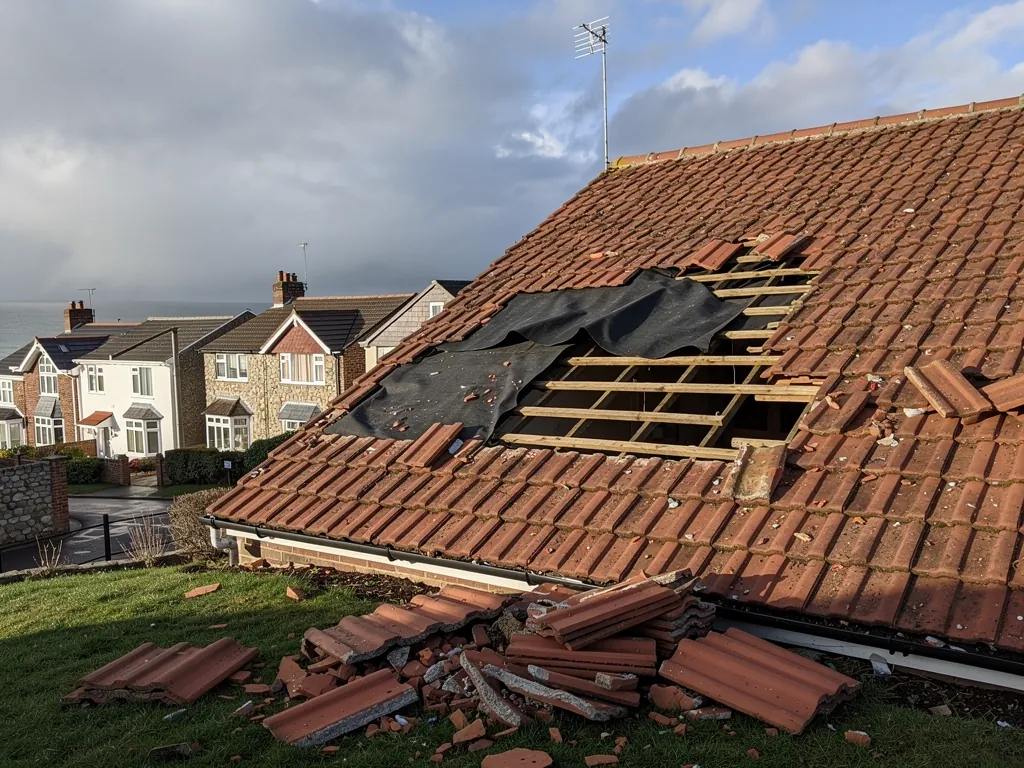
The wind drops overnight, and at first light you find broken clay on the lawn, a gap in the roofline or a chimney pot lying in the flower bed. The urge is to grab a ladder. Please do not. A wet, windy roof is the worst place to find out how much damage there is, and the pieces on the ground are only part of the story. The tiles beside the gap may have lost their grip too.
On this coast a roof takes wind-driven rain and sea weather through the autumn and winter, so loose fixings and tired mortar tend to be found out by the first strong blow. What you do in the first hour or two is simple and mostly involves staying put: keep people away from the drop zone, take photographs from the ground, stop the water getting in and let your insurer know. The repair itself comes after that, once the roof can be looked at calmly.
Below we take a blown-off tile and a blown-off chimney pot separately, because they behave differently and carry different risks. For the wider picture, our guide to a storm-damaged roof sets out the first steps, and the main emergency roof repairs page explains how we deal with urgent jobs.
Start from the ground, not the ladder
Do a slow lap of the house on foot, in daylight, and look up. Binoculars help. You are hunting for gaps in the tile pattern, a ridge line that looks wavy, tiles sitting proud of their neighbours and anything dangling from the gutter or the eaves. Note which slope it is and roughly where on that slope, counting tiles up from the gutter if you can.
Check the ground as well. Fragments of tile tell you something: a handful of broken pieces near the wall suggests a few tiles have gone, while a scatter across the path and the next garden suggests a bigger section has lifted. Broken pot, brick or mortar lying below a chimney points to the stack rather than the slope.
Keep children, pets and neighbours out from underneath. A loosened tile can slide hours after the wind has dropped, and a chimney pot that has shifted can come down without warning. If debris has landed on a footpath or the road, put something visible there and warn the people who use it.
Why not climb up yourself?
Wet tiles are slippery, loose tiles move under your weight and a gusty day can pull a ladder away from the gutter. Concrete and clay tiles are brittle, so the person who steps on one cracks it and sends the pieces down the slope. A roofer working from a scaffold, a tower or a proper roof ladder is secured and equipped for exactly this. You can learn nearly everything useful from the ground, and a photograph taken with a zoom lens is better evidence than a quick look from the top rung.
What a missing tile is telling you
A tile does not usually fail alone. Each one on a pitched roof is held by a nail or clip through a timber batten, and sits overlapped by the tiles above. When one has gone, the first question is why it let go.
A single missing tile in a roof that is otherwise tight often means that one fixing gave up. That is a simple repair: a replacement tile, properly secured. A run of loose tiles along one course points to something else, such as rotten battens, corroded nails or an underlay that has perished. Underlay is the sheet laid over the rafters and under the battens, and it is the roof's second line of defence. Nail sickness, where fixings corrode from behind, can leave a roof looking sound until a gale tests it.
Position matters too. Tiles at the verge, where the roof finishes over the gable wall, and along the ridge at the top are the most exposed, because wind lifts the edges first. Marley, a tile maker, notes that where a pitch is under 30 degrees the windward side can be pulled upward by strong suction. That is one reason a low-pitched bungalow roof can lose tiles in weather that a steeper roof shrugs off.
Cracked, slipped or gone
Three descriptions come up often. A cracked tile still sits in place but lets water through the break. A slipped tile has dropped down its course and left a gap above it. A missing tile has left a hole through to the underlay, and sometimes to the battens. Old felt can hold back some rain for a short while, but wind drives water sideways under tiles and tears tired underlay, so a hole is never a wait-and-see problem. Our page on slipped roof tiles covers the slipped case in more detail.
Chimney pots and stacks: a different kind of risk
A chimney pot is the clay or ceramic pipe on top of the stack. It sits in a bed of mortar called flaunching, which slopes to shed water. When a pot is blown off, or leans, the flaunching has usually cracked or washed out. Pots are heavy, and they fall a long way.
The stack itself, the brickwork that carries the pots, is the bigger concern. Gales can loosen the pointing, shift courses of brick and leave a stack leaning. A stack that moves threatens the roof below it and the ground beside it. Look for a visible lean, a gap opening between stack and roof, bricks lying about or daylight around the pot. If any of those is present, treat the whole area underneath as unsafe.
Who to tell about a dangerous chimney
If a stack looks ready to drop onto a pavement, a neighbour's garden or a shared access, the council's building control team is who to tell, according to the Institution of Structural Engineers. Make that call before anything else. Our answer on who to tell about a dangerous roof or chimney explains the route.
Once the area is secure, the repair depends on what has happened. A pot that has simply worked loose can be re-seated in fresh flaunching. A leaning stack may need taking down and rebuilding. Our page on chimney storm damage takes each case in turn, and the chimney repairs hub covers the wider work. In a conservation area or on a listed house, ask the council before you alter how a stack looks.
Stopping the water until the repair is done
If rain is coming in, the aim is to keep the building dry until the permanent work can go ahead. That might mean a bucket under a drip and a sheet of plastic over the loft insulation, or it might mean a temporary cover on the roof itself. The second job belongs with someone trained to work at height.
A temporary repair is exactly what it sounds like. A section of the slope is made weathertight with a membrane or a tarpaulin fixed over the opening, or loose tiles are refitted so water runs off the way it should. It is meant to see the house through a few wet weeks, not to stay on for a winter. Our guide to what a roof make-safe involves describes how a cover is fixed and when it is the right answer.
Inside the house
Move furniture away from the drips, roll back any wet carpet and put a container under a ceiling that is starting to bulge. Water pooling in a ceiling can bring the plaster down, so a small hole made over a bucket is better than a sudden collapse. If water is running near light fittings or sockets, switch off at the consumer unit for that circuit and keep clear until it has been checked by a qualified electrician. Take photographs of the stains as they appear, because they show how the damage developed.
Up in the loft, look for daylight, wet insulation and dark patches on the timbers. Daylight where there should not be any is a quick way to find the hole from the inside, and it helps the roofer find the right spot when they arrive. We prioritise leaks and storm damage. The lasting repair is scheduled when access, weather and materials allow.
Photographs, receipts and your insurer
Ring your insurer early; Which? notes that many keep an emergency line open. If you end up paying for an emergency fix yourself, the advice is to tell the insurer what you did and hold on to every invoice, since the outlay can form part of the claim. Damaged items are best kept unless they are a hazard to health.
Photographs carry as much weight as receipts. The Institution of Structural Engineers calls them vital evidence, and its list of what to report includes urgent repairs already carried out, such as temporary coverings. Take wide shots showing the house and the slope, then close shots of the gap, the broken tiles on the ground and any stains indoors. A date on each picture helps. Our answer on what photos of roof damage to take goes through the list.
Storm damage or wear and tear
Insurers separate damage caused by a storm from damage caused by age. Which? lists a leak through a roof that was not kept up as wear and tear rather than storm damage, and quotes Financial Conduct Authority data: only 32% of storm-related claims in 2024 ended in a payout. The insurer makes that call, not us. From us you get the clear photographs of the fault on your roof and a written quote, the papers most claims ask for. Should the outcome disappoint you, complain to the insurer, then take it to the Financial Ombudsman Service, which is free to use.
Our longer guide to claiming on insurance for storm damage covers the process in full.
The permanent repair, done to last
Once the roof can be reached safely, our survey ends in a verdict backed by photographs: fix it properly, patch it to get by, or strip and relay. If only a few tiles have gone and the rest holds, we repair, choosing the least work that cures the cause. The price then arrives as one written total.
For missing tiles the sequence is straightforward. The roofer lifts the surrounding tiles, checks the battens and underlay beneath, replaces anything rotten or torn, then lays new tiles and fixes them mechanically. Matching is the tricky part. Old clay tiles vary in colour and size, and a modern replacement can stand out for years. Reclaimed tiles can be a closer match but take longer to source.
Ridges, verges and fixings
If ridge capping has gone, the repair should follow BS 5534, which since its 2014 revision no longer relies on a mortar bed alone to hold the capping along a ridge or hip. Each capping tile also gets its own screw or clip. BS 8612:2018 covers dry-fix systems, where the capping is held down without mortar. This is the square finish that suits an exposed coast, and it is what we aim for at ridges and verges. Our ridge tile repairs page covers the capping side, and pitched roofing explains the wider tile work.
Scaffold and the cost
If the repair needs scaffolding over a pavement, a highway licence is needed, which takes notice. West Sussex County Council asks for at least 10 working days' notice and charges £266 for one month. That lead time is a good reason for a temporary cover to go on first. When you compare prices, check whether each one includes scaffolding and VAT.
Questions
Blown-off tiles and pots
Is one missing tile after a storm really worth fixing quickly?
Yes, because the gap lets wind-driven rain reach the underlay and battens, and the tiles around it have lost some of their protection. Caught early, one tile is a short job. Left through a wet winter, it can mean rotten battens and a stained ceiling. Photograph it from the ground and have it looked at.
A neighbour's chimney pot has landed on my roof. Who deals with it?
Start by keeping everyone clear and photographing where it landed and any damage. Tell your own insurer, and ask your neighbour to tell theirs. Who pays depends on the policies and the circumstances, which are for the insurers to judge. We can make your roof safe and give you a written quote for the repair.
Should I put a tarpaulin on the roof myself?
We would advise against it. Fixing a sheet on a wet, windy slope is how people fall, and a badly fixed tarpaulin can flap loose and tear more tiles off. A temporary cover fitted by someone trained to work at height is a different matter, and it can protect an opened-up roof for a few wet weeks.