
Garage roof materials · 9 min read
Felt, EPDM, GRP or sheeting: choosing a garage roof
A plain comparison of the coverings used on garage roofs, with typical lifespans, the pitch each one needs and the kind of garage each suits best, so you can choose before you ask for quotes.
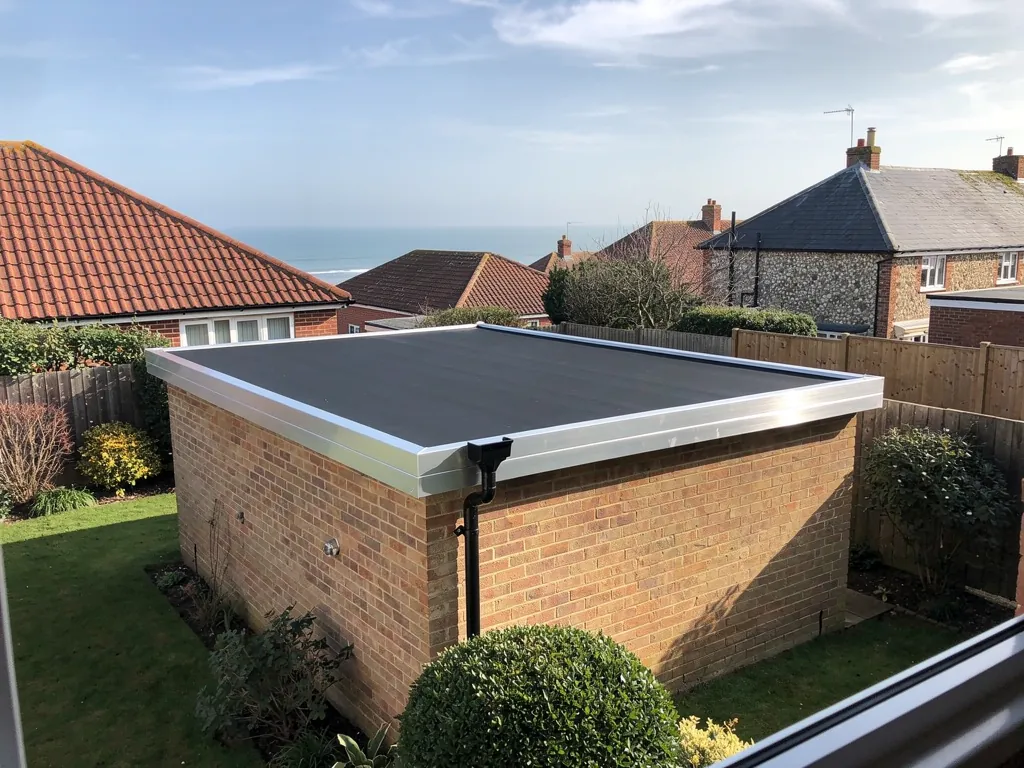
Open any builders' catalogue and a garage roof looks like a simple choice between a few rolls and a few sheets. In practice the covering has to suit the roof's shape, the condition of the structure beneath it, the budget and the number of years you want before the next big job. A covering that is right for one garage can be a poor fit for the one next door.
Flat garages split into three main families: bitumen felt, EPDM rubber and GRP fibreglass. Pitched or sloping garages tend to carry corrugated sheets, tiles or slates. Each has strengths and each fails in a particular way, and knowing the way is half the decision.
The sections below take them one at a time, using published lifespans and pitches with the source named, and finish with a short way of choosing. None of the figures is a promise, because laying matters as much as the material. Only a look at your own garage turns the comparison into a recommendation.
What a garage roof asks of its covering
A garage roof has a quieter life than a house roof, and a different set of demands. Nobody heats the space under it to living-room temperature, so it is rarely lived in, but it still takes every shower, every gale-driven spray and every hot afternoon. Mostly it needs to shed water reliably, resist the sun and survive the occasional ladder.
Four questions narrow the choice before price enters it.
Is the roof flat, low-pitched or properly pitched?
Flat roofs, which BS 6229:2025 treats as having a pitch not greater than 10 degrees, take continuous, flexible coverings such as felt, EPDM and GRP. Steeper roofs take sheets, tiles or slates, each with its own minimum pitch. Changing from one family to another usually means changing the structure underneath, so the pitch you have often decides the family.
What is the deck or frame like?
Flexible coverings need a continuous, sound deck. Sheets need purlins at the right spacing. Tiles need battens, an underlay and a frame strong enough to carry them. A covering cannot make up for a weak structure.
How long do you want it to last?
Published lifespans differ widely, as the sections below show. A garage that is going to be converted, extended or replaced soon does not need a fifty-year membrane.
What will touch it?
Overhanging branches, a satellite dish bracket, footfall for gutter cleaning and a neighbour's boundary wall all change what a covering must put up with. Mention them when you ask for a quote, because a roofer who knows about the overhanging tree or the narrow access can price the job properly and choose a covering that will cope.
Bitumen felt: the familiar flat garage covering
Torch-on felt is the covering most flat garages already have. Two or three layers of bitumen-coated sheet are fused together with a flame, or sometimes stuck cold, and the laps and edges are sealed. Done well it makes a tough, waterproof skin at a fair starting price. Checkatrade's repair table, dated June 2026, puts bitumen felt at £100 to £140 per m², excluding VAT, the lowest of the three flat coverings it lists.
The trade-off is life. Less gives torch-on felt 10 to 20 years, while CORC, a different source, suggests 30 or more, so published views disagree and the detail work decides where a roof lands in that spread.
How felt fails
Felt fails at laps and details. Seams open, edges lift, and the surface blisters where moisture was trapped beneath. It also hardens with age, and a brittle roof can crack across its whole width, at which point repairs stop paying their way.
When felt is the right pick
Felt suits a simple, sound deck, a modest budget and an owner who accepts a shorter cycle. It is also the easiest covering to match to an existing roof, so it often suits a garage attached to a house that has felt elsewhere. Systems with a cap sheet and a proper edge trim should outlast a bare-minimum two-layer job, and that difference is worth asking about, since it is rarely visible from the ground on the day the roof is finished.
Our garage roof cost guide gives the national totals for a re-felt and for a full flat roof, with the VAT labels that go with each. Ask any roofer who recommends felt which system they mean, because a bare-minimum job and a full cap-sheet system are priced and aged differently, and the quote should say which one is being laid.
EPDM: a rubber sheet with few joins
EPDM is a synthetic rubber membrane, supplied on a roll that can be cut to a garage's width, so a single garage can often be covered in one piece. It is glued to the deck, turned up at the walls and finished with trims. With so few seams, there is less to open up.
Lifespans are good but not agreed. GreenSpec gives an expected service life of 20 to 30 years. Less, with a table dated March 2026, gives 30 to 50. Checkatrade's repair rate for EPDM is £120 to £170 per m² excluding VAT, a little above felt. The sensible reading is that EPDM can outlast felt comfortably, and the exact number depends on the fit of the details.
How EPDM fails
EPDM rarely fails across the field. Trouble comes at the edges, at corners where the sheet is folded, at outlets and at points where it has been punctured or where the adhesive has let go. These are local faults, so a repair is usually possible.
When EPDM is the right pick
EPDM suits a garage you want to forget about, a roof with an awkward outline that benefits from a single sheet, and an owner willing to pay more at the start for a longer cycle. It needs a clean, smooth deck, because grit or a sharp edge under the sheet can wear through it.
Ask whoever lays it how the corners will be formed, because folds and welded or taped corners are where a rubber roof most often needs attention. A tidy corner is a good sign, and it is the sort of finish we aim for on every flat roof.
GRP: fibreglass laid wet on the roof
GRP stands for glass-reinforced plastic, better known as fibreglass. Resin and glass matting are laid onto the deck as a liquid and cure in place, producing a hard shell with no overlaps. The finish is a coloured topcoat, and the edges are formed with moulded trims.
Less gives GRP 25 to 40 years. Checkatrade's repair rate is £130 to £180 per m², excluding VAT, the highest of the three flat coverings in its table, which reflects the skill and curing time involved.
How GRP fails
GRP is rigid. If the deck moves, as timber does with moisture and temperature, the shell can crack, usually at joints between boards or along the line of a joist. A hairline crack that returns after repair is a sign of movement, not necessarily of a poor repair. Badly cured resin and thin laminates cause trouble too, so the conditions on the day matter. GRP needs to be laid in dry weather, on a dry deck.
When GRP is the right pick
GRP suits a garage with a firm, stable deck, where a smooth finish and neat moulded edges are valued. It stands up to someone walking on it to clear a gutter. Where the existing deck has been moving, or where a garage sits against a house wall that settles, a flexible covering such as EPDM is the safer option.
Our wider guide to EPDM, GRP and felt on flat roofs compares the three on house roofs and extensions as well.
Corrugated sheets: fibre cement, steel and bitumen
Many garages, particularly freestanding ones with a single slope, are covered with corrugated sheets laid over purlins. The sheets can be fibre cement, profiled steel with a coating, or corrugated bitumen. They go on quickly and need no continuous deck, which is why they are common.
Old sheets may contain asbestos
Before choosing anything, find out what is there. HSE's rule of thumb is to treat a garage put up or refurbished before 2000 as containing asbestos until testing proves it clear. Weathered asbestos cement sheeting that is lifted off in one piece, not substantially damaged, counts as non-licensed work under HSE guidance. Sheets that crumble or break up as they go move the job into notifiable non-licensed work, where HSE must be told first. The waste goes double-wrapped and labelled into a lockable skip, with a consignment note for household asbestos waste. Never drill, cut or walk across such sheets.
What sheeting asks of the structure
Sheets need an adequate pitch and laps, the right fixings with seals, and purlins at the spacing the maker specifies. Their price and lifespan depend on the product, so ask for the data sheet. Since a sheeted roof has so many fixings through the covering, every one is a possible leak, and a neat finish at ridge, eaves and the wall junction matters.
Overcladding and condensation
Fitting new sheets over old ones is called overcladding, and it is only sometimes suitable. Sheeted garages can also drip with condensation if warm air meets a cold underside, which a lining or insulation can address.
Our guides on corrugated garage roof sheets and pitched garage roofs take these options further. If a garage is shared with a neighbour, or part of a row with a common roof, tell the roofer at the start, because the work then involves the other owner as well.
Tiles and slates, and a simple way to choose
Where a garage has a proper pitch, particularly one that matches a house roof, tiles or slates are an option. The covering sets the minimum pitch. Marley lists its interlocking concrete tiles from 12.5 and 15 degrees up to 25 degrees depending on the pattern, Lincoln clay pantiles at 15, plain concrete tiles at 35, and clay plain tiles from 30 to 40. Cupa Pizarras cites BS 5534 as indicating a minimum of 20 degrees for natural slate, with hook fixings not used below 25.
Their lifespans are long. Marley expects concrete tiles to give around 60 years, though it adds that this guarantees nothing about longevity, whereas CORC puts well-kept slate at over 100. The cost is a heavier roof. Changing from light sheets to tiles adds load. Per the Planning Portal, a replacement covering that is 15 per cent or more heavier than the old one is one trigger for building control approval, so a structural check comes first.
A short way to choose
| Your garage | Usually worth considering |
|---|---|
| Flat, sound deck, modest budget | Torch-on felt |
| Flat, awkward shape, want long life | EPDM |
| Flat, firm deck, jointless finish | GRP |
| Light frame, single slope | Profiled sheeting |
| Pitched to match the house | Tiles or slates |
It is a starting point, not a verdict, and the price of each option still has to be set against the condition of your deck. A survey of the garage, with photographs, turns it into a plain recommendation, and our garage roof replacement page explains how we then quote.
Questions
Choosing a covering: questions
Does the covering change whether Building Regulations apply?
It can. Among the Planning Portal's triggers for approval are extra weight of 15 per cent or more from the new covering, and a covering that behaves quite differently if fire reaches it. Approved Document L also treats renewing a flat roof membrane as renovation. Ask your building control body about your garage.
Which covering is easiest to repair later?
EPDM and felt both tolerate local patches, provided the deck beneath is sound. GRP can be cut out and laid again but cracks if the deck moves. Sheets are repaired by replacing individual panels and refixing. The best predictor is the quality of the details at the edges, not the material alone.
Can I mix coverings on a garage with an extension roof?
Yes, as long as the junction between them is built properly. Different coverings move and age at different rates, so the meeting point needs a flashing or an upstand dressed with care. A roofer should tell you in the quote how that joint will be formed and who is responsible if it leaks.