
Corrugated sheets · 10 min read
Corrugated garage roof sheets: fibre cement, steel and bitumen
What corrugated garage roof sheeting is made from today, how fibre cement, steel and bitumen differ in weight, noise and wear, and the fixing details that decide whether the roof stays dry.
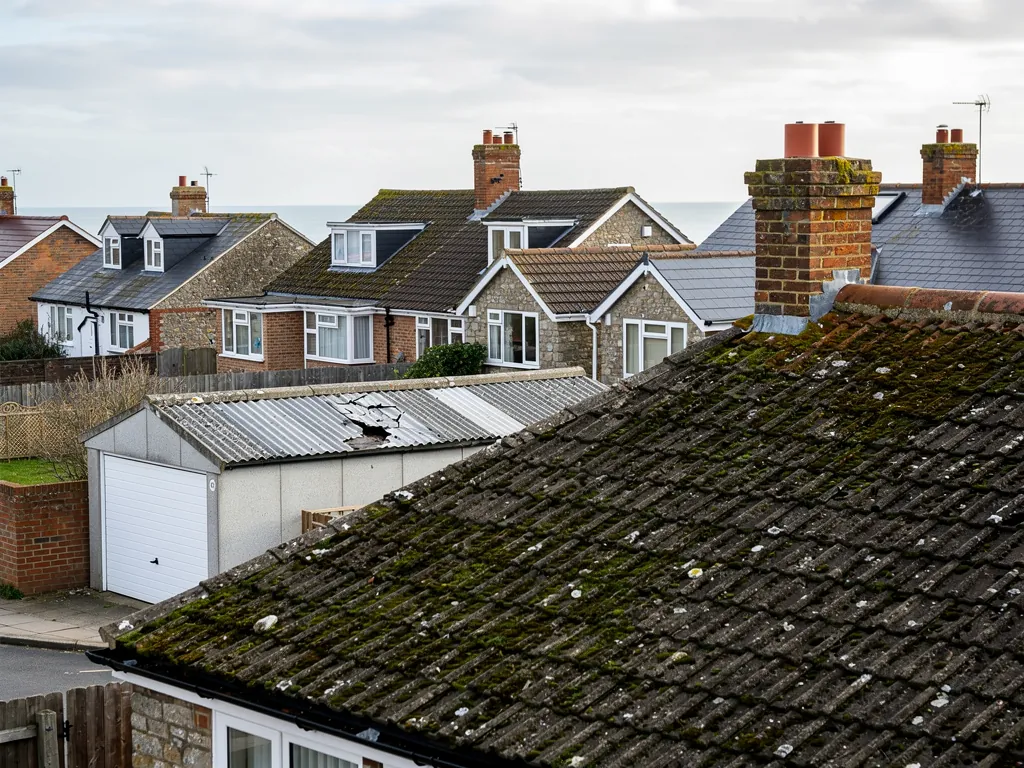
A corrugated roof is the classic garage covering: long ribbed sheets laid across timber purlins on a shallow slope, quick to fit and easy to replace in sections. Walk down any lane of older garages and you will see them in every state, from pristine to green with moss. They have lasted because the design is simple, but the material underneath the ribs has changed a good deal over the years.
Today three families dominate. There is modern fibre cement, made without asbestos, there is coated steel in a corrugated or box-section profile, and there are sheets of bitumen, a fibre base soaked in the same tar-like material used in roofing felt. Each has strengths, and each has a weak point that shows up in a garage in a particular way.
This guide compares them in plain terms, then covers the details, laps, pitch, fixings and supports, that decide whether any of them leaks. For the wider choice, including flat-roof systems, see our garage roof replacement page.
Three families of sheet and what each is made from
Fibre cement sheet is a mixture of cement and reinforcing fibres, pressed and cured into a rigid corrugated panel. It is grey or tinted, heavy for its size, stiff and hard-wearing, and it looks like the older roofing material it replaced. Modern sheets contain no asbestos, but the look is similar enough that you cannot tell old from new by eye. The age of the garage and the date of the sheets are what matter, and our guide to how to tell whether a garage roof is asbestos covers that first step.
Steel sheet is a thin metal panel formed into ribs, then coated for protection. Plain galvanised finishes are common, and plastisol or polyester colour coatings are used where appearance matters. The profile may be a gentle wave, matching the cement look, or a squarer box section with wider flats and deeper ribs. It is far lighter than cement, sold in long lengths and cut to size.
Bitumen sheets
Bitumen sheet is the least familiar of the three. A fibre base is saturated with bitumen and pressed into a wave profile, usually with a coloured, textured or painted face. It is light, flexible and quiet underfoot, and it suits small outbuildings and garages where weight and cost matter. Compared with the other two it is softer, which has consequences for how it is supported and how it ages.
These differences drive everything else: how the sheets are carried, how they behave in rain and sun, how long they are likely to last and what happens at the end. None is the right answer for every garage, and the best choice depends on the frame, the pitch and the way you use the building.
Modern fibre cement: stiff, heavy and brittle
Fibre cement earns its place by being rigid. It does not drum in the rain the way thin metal can, it does not sag between supports as quickly as softer materials, and it takes paint if the grey is not to your taste. For a garage that has always had cement sheets, a like-for-like replacement keeps the look, keeps the frame loading close to what it was designed for and keeps the roofline unchanged against neighbouring walls.
The cost of that stiffness is brittleness and weight. Cement sheets crack when walked on, dropped or knocked at the edge, and they are awkward to carry up a ladder because of their size. The HSE's guidance on fragile roofs lists fibre cement sheets among the coverings that may fail underfoot, so the safe working assumption is that nobody should stand on the roof. That applies to the new sheets as much as the old ones, and it matters for any later work, such as clearing a gutter or fitting a satellite dish.
When fibre cement is the sensible match
It suits a garage whose frame is sound, whose purlins are at the spacing the sheet needs and whose owner wants an unchanged appearance. It is a weaker choice where the frame is light, where the garage may be converted later or where access is poor, since each long sheet is a two-person lift.
If the existing sheets are the old asbestos kind, nothing about a new fibre cement roof changes the need to deal with them properly first. Our guide to asbestos garage roof removal covers the rules, and the survey is where the material is identified. After that, fitting new cement sheets onto a cleared frame is a standard job, and one with a long record behind it.
Steel profile: light, quick and noisy in a downpour
Steel is the choice of owners who want a light, quick job. A long steel sheet can run from the ridge to the eaves in a single length, which removes the end laps that cause so many leaks in shorter sheeting. It weighs a fraction of cement, so it asks little of an old frame and goes up faster. A colour coating gives a tidy appearance, and the roof can be finished with matching ridge, verge and eaves pieces.
Steel has three habits to plan for. The first is noise: a thin metal roof amplifies heavy rain, which matters if the garage is also a workshop or if there is a bedroom above or beside it. The second is condensation. Warm damp air meets a cold metal underside, and water can form and drip, an effect that anti-condensation coatings or linings are meant to reduce. The third is the cut edge, since any place where the coating is broken, at a cut or a drilled fixing, is where corrosion can start.
Coatings and coastal sites
Ask the supplier for the coating specification and the manufacturer's stated life, and make clear the garage is near the Channel. A coating warranty is not a lifespan, and the terms matter more than the headline number. Look at what the warranty excludes, who must apply for it and what it says about sea air.
Owners still choosing between sheeting and a membrane roof on a boarded deck should weigh the two families against each other before ordering anything. Steel works best when the pitch is generous and the frame is plain, and less well on a nearly flat roof, where laps and fixings cannot shed water quickly.
Bitumen sheets: light, soft and dependent on support
Bitumen corrugated sheets are the lightest of the three, and that is their main selling point. They are easy to carry, easy to cut with simple tools and easy to fix, and they are friendlier to a frame that cannot take much load. They are also quiet in rain, because the bitumen deadens the drumming that thin metal produces. For a small lean-to garage or a shed-like outbuilding they can be a sensible and economical covering.
The weakness is softness. Bitumen is a flexible material that responds to temperature, so a sheet carried over a wide span can sag under its own weight, or under snow, and the fixings loosen as it moves. The manufacturer's instructions give the maximum distance between supports, and they should be followed exactly, with additional timbers added where the existing purlins are too far apart. Dark sheets also take up a lot of heat in strong sun, and the face can fade or soften over the years.
Where the roof is close to flat
Every corrugated product has a minimum pitch below which its laps do not shed water reliably, and bitumen sheets are no exception. A garage roof that is nearly flat usually does better with a membrane on a deck than with any corrugated sheet. In that case the sheeting families belong in a different comparison: our guide to choosing a garage roof material sets sheeting against felt, EPDM and GRP.
A roof that already sags needs the same caution. Water lying in a trough is a sign that the support is wrong, and new sheets over a failing structure only hide the fault for a season. Fix the frame first.
Laps, pitch, fixings and supports
Material matters less than detail. Leaks in a corrugated roof tend to appear where a sheet overlaps the one beside it or the one below, at a fixing hole or at a junction with a wall. Four things decide whether those places stay dry. The first is the pitch, because each product has a minimum angle in its data sheet, and below it the laps can let water creep back uphill in wind-driven rain. The second is the lap itself: how far sheets overlap down the slope (the end lap) and across it (the side lap) is set by the manufacturer for the pitch involved, and a shorter lap is a leak waiting for a gale.
The third is the fixing. Each sheet is held down by screws or bolts with sealing washers, driven through the crests or the troughs as the product requires, into the purlins beneath. The right number, the right type and the right position are all in the manufacturer's instructions, and on a coastal garage that sees sea weather and gusts, the fixing schedule is not the place to economise. The fourth is the support spacing, which has to suit the sheet.
Eaves, ridge and walls
Profile fillers close the gap at the eaves and ridge, where the wave would otherwise let in wind, rain and birds. A ridge piece caps the top, and a flashing, normally lead, seals the line where the sheets run up against the house wall. This is where the finish is set. The lead is tucked into a cut in the wall and folded down over the ribs, and a neat job here stops water tracking behind it.
If any of this sounds like a lot for a garage, it is why small leaks recur on cheap re-sheeting jobs. The sheets themselves are rarely the fault; the lap, the washer and the junction usually are. Repairs after the event cost more than getting the details right the first time.
Choosing, pricing and what the survey should tell you
Between the three, a rough guide helps. Fibre cement suits a sound frame and an owner who wants the old look back. Steel suits a light frame, a long run and a generous pitch, with the noise and condensation questions answered in advance. Bitumen suits a small, lightly loaded building where economy matters, as long as the supports are close enough. If your garage is close to flat, or the frame is unreliable, none of them may be the right answer.
What moves the price is the area, the access, the chosen material, the state of the frame and whether old sheets must come off first. VAT at 20 per cent applies on top of any figure that excludes it, so check what each quote includes, and ask whether scaffolding is part of it. Checkatrade's October 2026 roof replacement guide gives a typical re-felt of a garage as around £1,000 to £2,000, which is a reference point for the cost of a membrane roof and not a price for sheeting.
Our survey and quote
When we survey a garage, we look at the frame from inside, photograph the sheets, the laps, the fixings, the eaves and the wall junctions, and say whether the roof can be repaired, patched or replaced and why. Where the sheets are old cement, the survey tells you what to do about that before we talk about the new covering. You then receive a written quote with one total, and we aim to keep it fair.
Photographs of your own garage, sent through the quote form, are a good start. They show the pitch, the state of the laps and the wall junctions well enough for us to say what the visit should concentrate on, and what material is likely to make sense for your building.
Questions
Corrugated garage roof sheet questions
Are the cement sheets sold today safe to put on a garage?
Modern fibre cement sheets are made without asbestos, so the material itself is not the concern. The concern is the roof they go onto, and the old sheets that come off it. Treat a garage from before 2000 as likely to have asbestos cement until tested, and plan the removal first. The new roof then fits to a clean frame.
Why does a steel garage roof drip inside on cold mornings?
Warm damp air inside the garage meets the cold underside of the metal and turns to water, which then runs down the ribs and drops off. It is condensation, not a leak. An anti-condensation coating or lining reduces it, and ventilation helps. If the drips fall in the same places after dry weather, that points to condensation.
Can I mix steel and cement sheets on one garage roof?
It can be done on a split roof or an extension, but the sheets move and expand differently, and laps between unlike materials are weak points. The profiles must match closely, or the join needs its own flashing. On a single plane of roof it is better to use one product throughout, and to keep to the manufacturer's laps.