
Stone roof alternatives · 8 min read
Horsham stone vs sandstone, slate and reconstituted stone
Stone slabs, slate and cast stone all get called stone roofing. They are not the same covering. This guide compares them on weight, lifespan, look, cost drivers and permission, so you can see what a change involves.
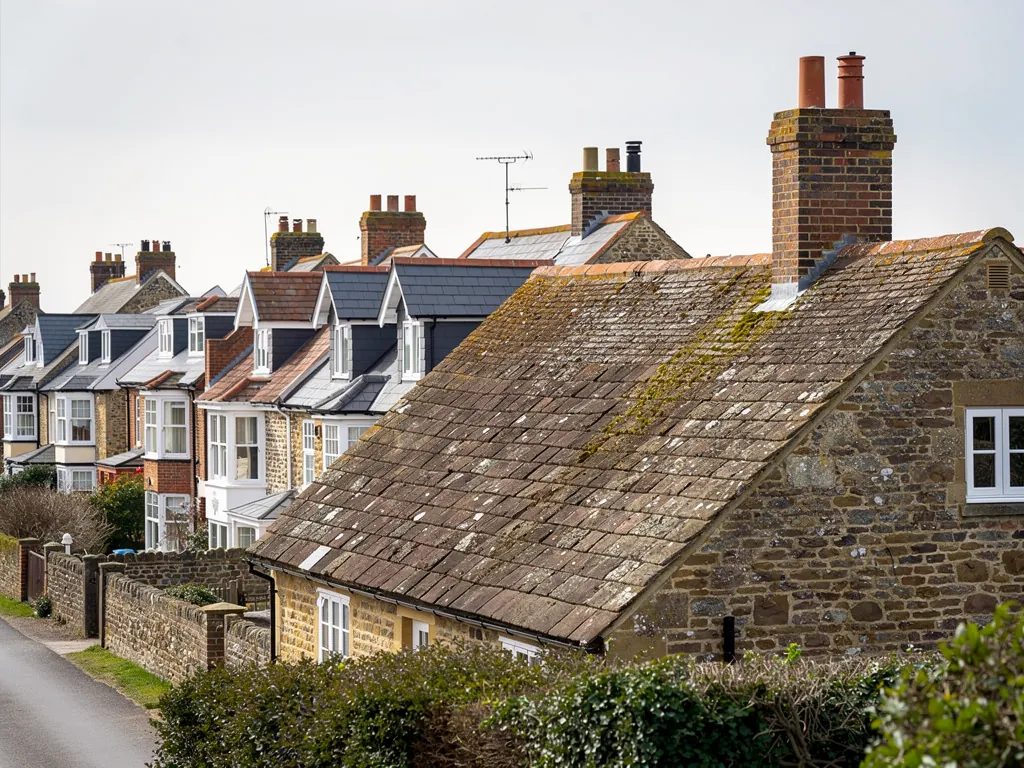
When a Horsham stone roof starts to fail, someone always asks whether it would be easier to put something else on. It is a fair question. Stone is heavy, slow to lay and not cheap to repair, and there are lighter coverings that look a little like it.
The honest answer is that the alternatives are different products, not cheaper copies. Other sandstone is the closest cousin. Natural slate is the covering most often suggested in its place. Reconstituted stone is a cast product made to look like split stone from a distance. Each carries its own weight, pitch, fixings and rules.
The other part of the answer is that the building decides. A listed house or a house in a conservation area may not be able to change its covering at all without consent, and even a plain house gains or loses character when the roof changes. So this guide is about weighing, not selling. We set out what is known, say which figures come from national guides, and leave out any price for stone itself, because every stone roof is priced after a survey. Our Horsham stone roofing page explains how that survey runs.
Horsham stone against other sandstone
Horsham stone is one particular sandstone, quarried from Wealden rock and laid as thick, uneven slabs. Other sandstones are quarried elsewhere and sold as stone slates or flags for roofing, and some come from abroad. At a distance they can look alike, and in use they behave alike: heavy, laid in graded courses and hung from battens.
The differences are in the detail. Colour is the first. Each quarry has its own range of tones, and another source may run cooler or warmer, which shows the moment it meets old slabs. Thickness and size are next. A stone with a different grain splits into different sizes, and the courses depend on a spread of sizes to step down from big slabs low on the slope to small ones high up. Condition and fixing holes matter too.
That is why a roofer working on a Horsham stone roof tries first to match stone to stone. A different sandstone can make a good repair stone where the original is hard to find, but it is a decision for the survey, with photographs, and on a listed roof with the conservation officer.
For a repair, then, the closest alternative is a matched slab from another source. For a whole roof, it is the same kind of covering from the same family of rock. Our guide to reclaimed or newly quarried Horsham stone covers the supply side.
Why a similar look is not enough
Stone that looks right in a sample can still be wrong on the roof if it is thinner, softer or more regular than the original. The courses are the test. Lay a trial area, step back and judge it from the lane before the rest is ordered.
Horsham stone against natural slate
Slate is the covering most often proposed in place of stone, and it is a very different material. Natural slate is a dense rock split into thin sheets of near uniform size. Horsham stone is a coarse sandstone split into thick slabs. The thin sheets weigh far less per square metre, and they go on in even rows rather than diminishing courses.
Both last. On lifespan, CORC (the Confederation of Roofing Contractors) says slate that is kept up can reach 100+ years, and Checkatrade gives stone slate more than a hundred. Those are typical figures, not promises, and on both coverings the fixings and battens tend to fail well ahead of the rock.
Cost is where national guides can help. Checkatrade's slate cost guide carries a table dated September 2026 with a typical UK range of £160 to £210 per m² for natural slate and £95 to £125 per m² for Spanish slate. Its repair table, dated June 2026, puts natural slate repairs at £150 to £220 per m². We quote no matching figure for Horsham stone, because the total turns on the stone available, the access and the timbers, and it comes only after the survey.
Pitch and fixing are practical points. Cupa Pizarras, a slate supplier, reads BS 5534 as setting a 20 degree minimum for natural slate (500 mm slate, moderate exposure) and says hooks have no place on a pitch below 25 degrees. A roof built for stone should be checked against the product data sheet before anything is chosen.
Slate changes the look as well. On a house built for stone, a smooth, dark, even covering reads as a different building. Our answer on whether Horsham stone is the same as slate gives the shorter version, and our slate roofing page covers the thinner material.
Reconstituted and cast stone
Reconstituted stone is a manufactured slate or slab. It is cast or pressed from crushed stone or cement in a mould, then sold in a regular pattern and often in a set of colours. It is lighter and more uniform than split stone, and that regularity is both its appeal and its weakness on an old roof.
From the road it can pass at a glance. Close up, repeated patterns, even edges and an unvarying surface show it for what it is, and it weathers in its own way. The slabs on a real stone roof differ because they were split from rock and sorted by hand. Moulded pieces do not, which is why a conservation officer is unlikely to see them as like for like.
Practical details depend on the product. Weight, minimum pitch and fixing method vary between makes, so the right source is the maker's data sheet for the exact product, not a general rule. Marley publishes minimum pitches tile by tile, from 12.5 degrees for some concrete interlocking tiles to 40 degrees for its Canterbury clay plain tile, and tells readers to check them product by product. The same applies to any cast covering. Ask for the data sheet and read the pitch, the fixings and the guidance before you commit.
Lifespan is product specific as well. For a sense of scale, Marley quotes around 60 years for concrete tiles and stresses that no guarantee or warranty is implied. Stone slate has a long record that no moulded product has yet had time to match.
Where a building is not protected and not old, reconstituted stone can be a sensible choice for a new extension or outbuilding that needs to sit beside a stone house without competing with it. On the old roof itself, it needs a hard look.
Weight, structure and the Building Regulations
Any change of covering starts with the structure. A stone roof sits on stout timbers because the slabs are heavy. A lighter covering seldom overloads them, but it alters how the roof behaves and can change the pitch needed, the underlay and the fixings.
The Planning Portal's guide sets the thresholds. Work touching under 25 per cent of the total building envelope and under 50 per cent of the roof does not normally need an application, and a covering that is 15 per cent or more heavier than the old one does. A new covering that performs very differently if a fire starts brings approval into play as well, and so does any structural alteration. Ask which applies to the roof you have, because the answer changes with every scheme. Where the new material is far heavier or far lighter, the Portal's advice is to have the structure checked by a surveyor or structural engineer before starting.
Arun's building control pages count replacing a pitched or flat roof covering as approval work, so check with the body that will inspect your job.
Part L can follow. Approved Document L looks for better insulation once more than 50 per cent of one thermal element is renovated, or the renovation passes 25 per cent of the external building envelope. The 2021 edition applies until 24 March 2027, when the 2026 edition takes over, and the survey tells you whether it is likely to apply to your roof.
BSI warns that BS 5534 can be a poor fit for some old roofs, especially those built with traditional or reclaimed materials. That is one more reason to settle the detail roof by roof. Our guide to Horsham stone roof weight looks at the structure underneath.
Permission, character and when to keep the stone
Swapping the covering changes how the building looks, so permission is the first thing to settle. On a listed building, a new covering that changes the character of the roof calls for listed building consent almost by definition. In a conservation area the council may take a firm line on materials. Even outside protected areas, a different covering on an ordinary house can alter its appearance enough to raise planning questions, so ask the council before you buy anything.
Arun District Council's own conservation guidance shows the direction. In the appraisal covering The Steyne and Waterloo Square, the council wants natural slate or plain clay brought back where modern substitutes crept in. For Aldwick Road it notes that slate has often been replaced by concrete interlocking tiles that harm the buildings and the street scene. Those are Bognor examples, but they show how councils lean when a historic covering has been lost.
There is a plain value argument too. Stone that has stayed on a roof for generations is rarely the first part to fail. The fixings and battens usually go first, and they can be renewed without throwing the stone away. Discarding a long lived covering to save on a repair can turn out the dearer route over the life of the house.
The usual order of preference is therefore simple: repair, then re-lay with matched stone, and only then consider a different covering, with consent. Our guide on repairing, re-laying or replacing a Horsham stone roof sets out how we reach that verdict, and our answer on replacing a stone roof with tiles deals with that one change.
At the survey we photograph each slope and the timbers beneath, then give a plain verdict on whether the stone should stay. If you are leaning towards a change, tell us at the start, and we will say what it would involve before any figure is written down.
Questions
Stone and slate questions
Is a lighter covering a safe swap for a heavy stone roof?
It lightens the load, but it is still a change of covering with its own pitch, fixings and underlay. The Planning Portal advises a structural check where a replacement is far heavier or far lighter, and a listed or conservation area house may need consent first. Ask your building control body before ordering materials.
Does natural slate cost less than Horsham stone?
National guides give figures for slate but not for Horsham stone. Checkatrade's September 2026 table gives £160 to £210 per m² for natural slate. Stone is priced on survey, because the sound slabs, the timbers, the access and the detail at ridges and valleys all move the total. Once we have been up on the roof, the written quote gives one price.
Can reconstituted stone pass as Horsham stone?
From a distance it can look similar, but it is a cast product with regular edges and a repeated pattern, whereas Horsham stone is split from rock and sorted by hand. On a protected building the council is unlikely to treat it as like for like. Ask the maker for the data sheet covering weight, pitch and fixing.