
Repoint or dry-fix · 9 min read
Repoint or go dry-fix? Choosing a ridge repair
Two repairs compete for the same worn ridge. This guide sets out what each one does, the signs on the roof that favour one over the other, and the questions that settle the choice.
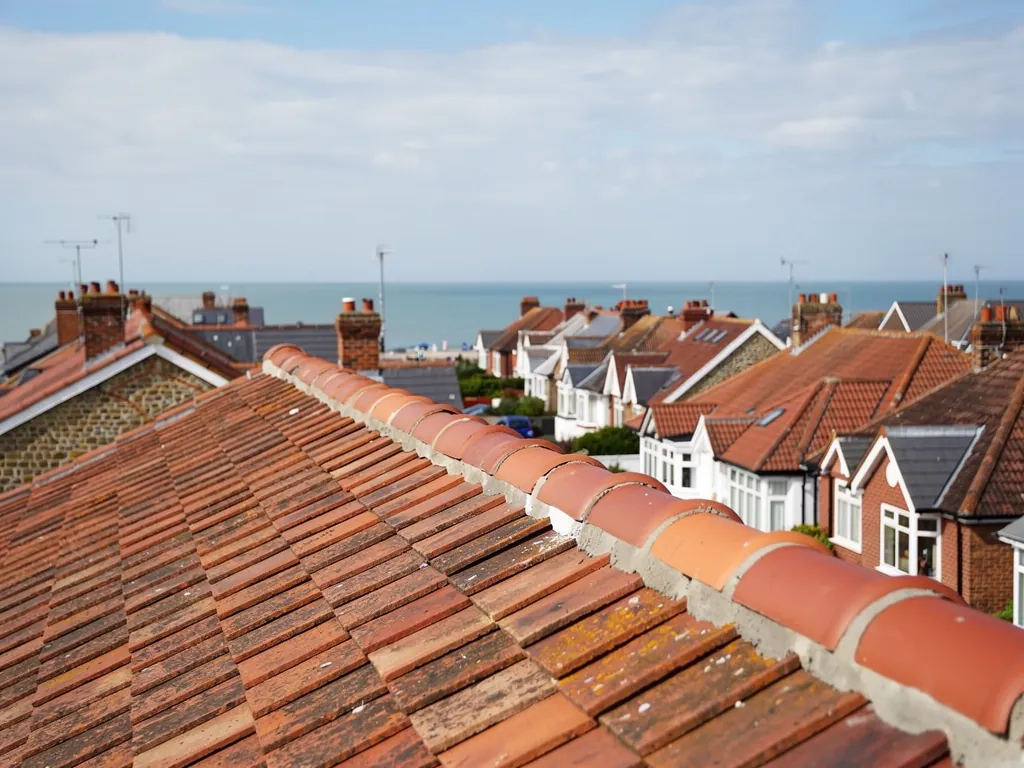
A tired ridge usually leaves you with a choice. One route is to repoint: rake out the cracked mortar at the joints and fill them again, keeping the bed the tiles sit on. The other is to go dry-fix, which means the capping tiles are lifted, the old mortar is cleared off, and the tiles are held down with a fixed batten and clips or screws, so that no wet mortar carries any load. Both are legitimate repairs. Each suits a different set of conditions, and a poor match between repair and roof is how a ridge ends up failing a second time.
The ridge, for anyone new to the vocabulary, is the row of capping along the highest line of the roof. Hips are the sloping capping on the angles of a hipped end, and the verge is the tiled finish above a gable wall. What follows applies to all three, though we use the ridge as the example because ridge capping is usually the first to show trouble.
The decision is rarely about price. It turns on what lies under the capping, how the tiles are held at present and what the building is. We cover each of those in turn and finish with the questions we put to every ridge on the survey.
What repointing does, and what it leaves alone
Repointing treats the visible face of the work. The roofer rakes out the loose or cracked mortar along the joints and at the ends of the run, brushes the gaps clean and fills them with fresh mortar, finishing it neatly so that it sheds water. The tiles themselves are not lifted. Everything beneath the capping, the bed that supports and seals each tile, stays exactly as it is.
That makes it quick, light on materials and gentle on the roof, and it explains the appeal. It also sets its limit. A repoint is only ever as good as the bed it is applied to. If the bed is firm and still adhering to each tile, new joint mortar restores a weathertight finish and the ridge carries on. If the bed has cracked through, shrunk away from the tiles or turned to crumbs, the new joint mortar sits on something that no longer holds, and the fault returns when the next gale tugs at the capping.
What a repoint does not add
A repoint does not add a mechanical fixing to any tile. If the ridge was laid before the 2014 revision of BS 5534 and has nothing but mortar holding it, a repoint leaves it that way. That is a workable result on a calm, sheltered slope, but it counts for more on a roof that takes sea gales head on. For the same reason we tell you plainly when a ridge needs more than a repoint, instead of putting the smaller job forward to win the work. Whether you can simply repoint is a common doubt, and the answer depends on what the lifted tile shows underneath: a clean, solid bed makes it a fair choice, while a hollow or powdery one rules it out. A cracked tile or two can be swapped as part of the same visit, which keeps the extra cost small.
What going dry-fix means in practice
Dry-fix is the trade name for holding the tiles at the ridge, hips and verges without leaning on wet mortar. A batten or rail runs along the apex, secured to the roof, the capping is laid over it, and each tile is held with a clip, bracket or screw according to the system's instructions. Gaps at the ends of tiles are often closed with a manufactured filler or seal rather than mortar. The relevant standard is BS 8612:2018, which BSI lists as current: it sets performance requirements and test methods for mortar-free ridge, hip and verge kits, and Marley's name for it is the test specification for dry systems.
To fit one, the old capping has to come off and the old mortar has to be cleared from the top of the roof. That makes dry-fix a bigger job than a repoint, in time and in disturbance. What you get back is a ridge whose grip does not depend on a bed that can crack with temperature and movement.
Dry-fix also takes away a repeat chore. Where mortar is the only thing holding the capping, joints can open up again in time and call for attention. With the load carried by fixings, the ridge no longer relies on that mortar to stay put, and any filler used at the ends is a seal, not a support.. Dry ridge systems explained goes through the parts, the standard and the variations between makes.
Reading the roof: signs that favour each repair
Several checks, made on the roof rather than from the ground, point towards one repair or the other. None needs special equipment, only a close look and some patience, and a few can be spotted from a safe spot on the lawn with binoculars before anyone goes up.
Signs that a repoint may be enough
- The capping tiles are all present and none rocks when pressed by hand.
- The ridge line is straight and level along its whole length.
- The cracks stay in the outer joint, and the bed beneath sounds solid when tapped.
- The tiles already have mechanical fixings, so the mortar is a seal rather than the thing holding them.
Signs that point to dry-fix
- Capping tiles move under light pressure, or have slipped out of line.
- The ridge dips or ripples, which suggests the bed has lost its grip.
- Pale grit from the bed turns up in the gutters or on the ground below.
- Daylight shows between the tiles and the bed.
- A previous repoint has failed within a short time.
These are indications, not rules. A ridge can show one sign from each list, and that is where the lifted tile matters most. Taking up a single capping tile and looking at the bed under it tells us more than the surface ever can, and it is photographed as part of the survey, so you see the same thing we see.
Where the signs are mixed, we lean towards the repair that deals with the cause instead of the symptom, and we explain why. A ridge that has already failed once after a repoint is, in our view, telling you something.
The fixing question that applies to both routes
BS 5534 sets out how slating and tiling should be done, and its 2014 revision took away the idea that a mortar bed can hold ridge and hip tiles single-handed. Marley, in a guide updated on 27 February 2026, explains that mortar's grip in tension is no longer something to depend on for these fittings, and that each bedded tile or fitting should be mechanically fixed as well. BSI lists the current edition as BS 5534:2014+A2:2018.
Two consequences follow. First, a ridge that is rebedded, as opposed to repointed, should have a fixing in or through each capping tile, as well as the mortar. Second, a repoint leaves whatever was there before. If the original work had no mechanical fixing, a repoint does not supply one, so lifting a tile to look beneath the capping is the sensible first step before choosing it.
What the standard does not say
Marley adds that fitting to BS 5534 is not itself a legal duty, so the standard is guidance that good practice follows and not a statute to wave at a roofer. BSI sounds its own note of caution: the code might suit certain older roofs badly, especially ones covered in traditional or salvaged materials. Both points weigh on a period house, where the method has to suit the fabric already on the roof.
Our guide to ridge tiles and BS 5534 goes through the standard in more detail, including how the fixing rule came about.
What each route costs
Prices follow the work, so the three options sit at different points. Checkatrade, in the repair table of its roof repair guide updated in June 2026, gives ridge tile repairs at £50 to £70 per metre. Its dry ridge guide, with a table updated September 2026, puts a full system at around £800 on a semi-detached house. Both are typical UK ranges. Checkatrade excludes VAT from its figures, so 20 per cent should be added.
At first sight, repointing should cost less than either, because it involves less, and often it does. No national guide gives a separate rate for repointing on its own, so there is no number to quote for it. What can be said is that a repoint that must be redone within a few seasons costs more over time than a repair that lasts, because scaffold or tower access is paid for each time.
What moves the bill
Whichever route is chosen, the same things push the total up or down: how many metres of ridge there are, how high it is, whether any tiles are cracked and need replacing, and how neatly the ends have to be finished. A hipped roof has more lines of capping than a gable-ended one, and a long terrace can have a very long run. The survey measures all of this, and what you receive afterwards is a single written price. For worked sums and the access costs on top, see our guide to the cost of repairing ridge tiles.
Period roofs, matching and the final call
On a Victorian terrace, a flint cottage or a listed building, the choice carries more weight, because the look of the roofline is part of the building. Traditional lime mortar is often what a period roof was built with, and a hard modern mix can behave differently from the original work. BSI's note of caution about older roofs points the same way, and a lime or lime-gauged mix is a question to settle with whoever is doing the work before a tile is lifted.
Dry-fix systems are made from manufactured parts, so matching the look of the existing ridge matters, and so does choosing a system whose parts will sit comfortably with the capping already there. If the work would change how a listed or period roof appears, ask the planning department of the district council or, inside the South Downs, the National Park Authority first. Listed building consent applies to changes that affect a listed building's character, so it is the council that confirms whether yours needs it.
How we put it to you
On each ridge we ask four things. Is the bed solid? Is every tile held by a fixing? Does the line run true? And what is the building? The answers give a plain verdict, repoint, rebed with fixings or dry-fix, and we put forward the lightest repair that cures the fault. For the wider job list, see our ridge tile repairs page.
If your ridge is on a period roof, say so when you get in touch. It changes what we bring up the ladder.
Questions
Choosing a ridge repair
Is dry ridge compulsory on a re-roof?
No. Marley notes that installing to BS 5534 is not required by law, and the standard calls for mechanical fixings, not a particular system. Dry ridge is one way to meet that, and a mortar bed with a fixing in each tile is another. The right choice depends on the roof and the building.
What happens to the old mortar when a ridge goes dry-fix?
The capping is lifted, the old mortar is chipped off the crest of the roof, and all of the debris is taken away when we finish. The batten and clips then go on a clean surface. Nothing is left under the new ridge for the weather to work on.
How can I tell whether the bed under my ridge is sound?
From the ground you cannot say for certain. Grit in the gutters, a crest that dips and capping tiles that rock all suggest trouble. Lifting one tile and looking at the bed underneath is the real test, which is why we do it during the survey.