
Ridge repair costs · 9 min read
How much does it cost to repair ridge tiles?
What national cost guides publish for ridge tile repairs, a worked sum for a sample length of ridge, and the access, fixing and tax points that push the final price up or down.
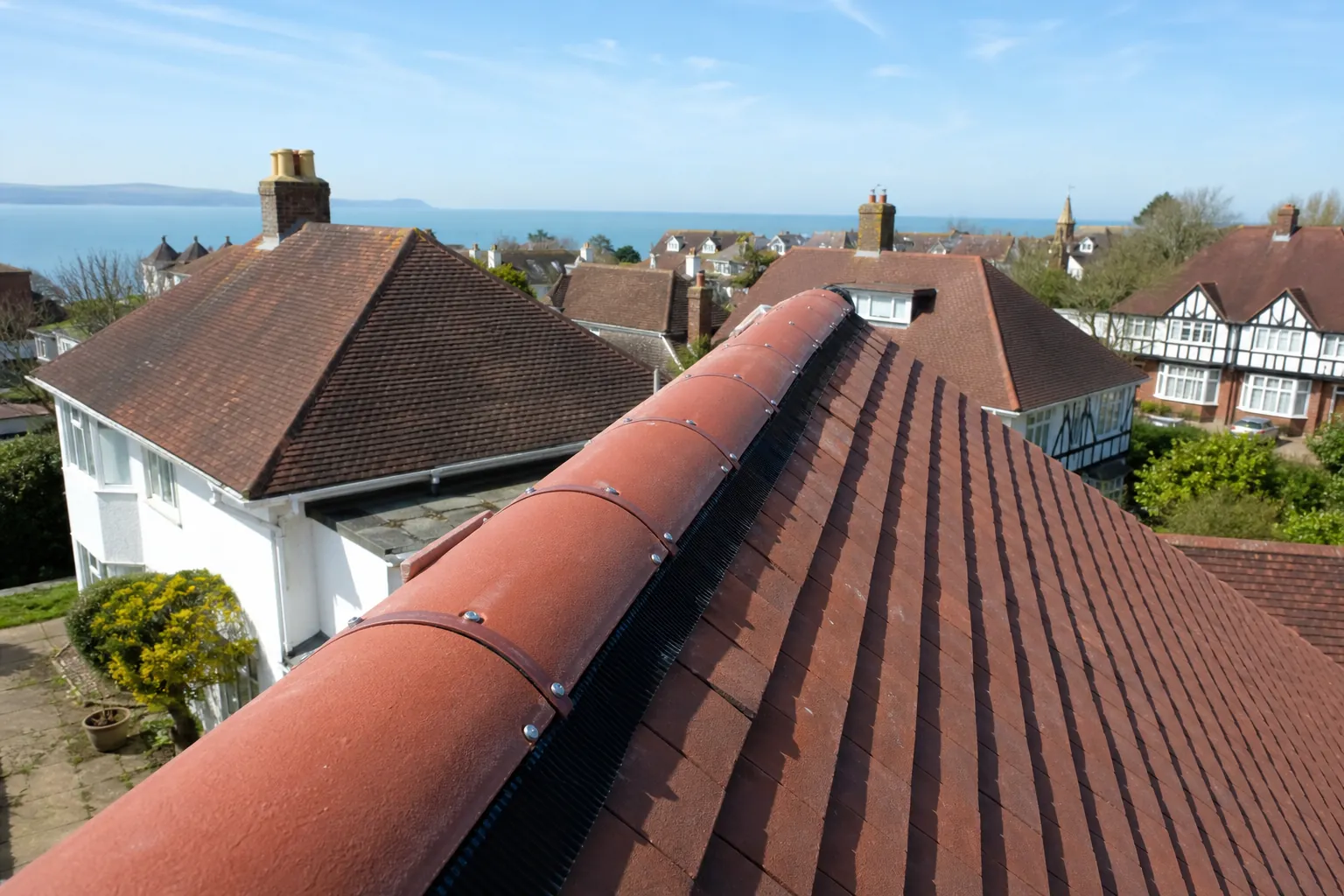
The ridge is the crest of a roof: the line of curved or angled capping tiles that seals the join where two slopes meet. Most sit on a mortar bed, and once that bed crumbs and cracks the tiles start to shift. What the repair costs comes down to two things, the number of metres of ridge involved and the way a roofer gets up to it. No single price covers every house, yet the national cost guides publish enough rates to build a realistic sum.
Here we take those rates, give each guide by name with its date, and work a sample ridge through to a total. We then deal with the items that sit on top of a per-metre rate: the fixings that a modern ridge repair includes, the scaffold or tower that makes the work safe, and VAT. Hips, the sloping capping that runs down the corner of a hipped end, and verges, the tiled edge over the end wall of a gabled house, are priced on much the same footing, so the reasoning carries across to them.
Everything below is a typical UK range for an ordinary house. These figures are not quotes for your own roof. Photographs from our survey show the state of your ridge, and the written quote after it states a single total.
What the national guides charge per metre of ridge
Checkatrade's roof repair guide, whose price table was last updated in June 2026, puts ridge tile repairs at £50 to £70 per metre. Checkatrade prices a whole dry ridge differently, at around £800 for a semi-detached house (table updated September 2026), with each hip £300 to £400. Dry ridge is the system where the capping is screwed or clipped to a fixed batten rather than set in wet mortar. Checkatrade says its repair figures leave VAT out, so tax is extra.
A sample length shows what the repair rate means in pounds. Take a ridge of 8 metres, purely as an illustration:
| Method | Rate per metre | 8 metre ridge, before VAT |
|---|---|---|
| Ridge tile repair (Checkatrade) | £50 to £70 | £400 to £560 |
| Dry ridge (Checkatrade) | Priced per house | Around £800 on a semi |
With VAT at 20 per cent the repair row climbs to £480 to £672 and the dry ridge figure to about £960. These land mid-range for the national market on a house with straightforward access.
Read them with some care. The two Checkatrade guides price different jobs, so neither figure proves that mortar wins on every roof. A per-metre rate also describes the length of ridge and nothing else. Height, damaged tiles under the capping and the finish at each end all push the total around, and the sections below take them in turn.
To set the ridge rate beside other common jobs on a house, such as lead flashing or a few dislodged tiles, our overview of what a roof repair costs is the place to look. Remember too that a ridge rate is an average of many different roofs, from a short bungalow ridge reached from a ladder to a long run on a three-storey terrace, so your own survey matters more than any table.
Patch, repoint or rebed: three jobs, three totals
People say ridge repair as if it were one task, yet three distinct jobs share the name. A patch swaps a handful of cracked or missing capping tiles and leaves everything else alone. Repointing rakes out the cracked outer joint and fills it with fresh mortar while the bed beneath is kept. Rebedding lifts all the capping, clears away the old bed and relays each tile on new mortar.
At the small end, a patch is close to the minimum a roofer must charge to cover the travel, ladders and tidying up. At the large end, the metre rate takes over and decides the bill. A crest that dips or ripples along its length usually means the bed has let go, and repointing the face of a bed that has failed only postpones the fault. Where the bed is firm and just the joint has opened up, repointing is the lighter job, so that is the one we put forward.
Why the survey comes before the number
We look along the whole run from a ladder, tower or scaffold, lift a doubtful tile and photograph what is under it. That settles which of the three jobs your ridge needs. A cheaper route that leaves the fault in place ends up costing more, because access has to be paid for again when the repair gives out.
Our guide on whether to repoint or go dry-fix walks through that decision in full. It is a better starting point than a price per metre if you are unsure what your ridge needs.
Why a fixing in every tile belongs in the price
BS 5534 is the code that governs how slate and tile coverings are fixed on pitched roofs. Its 2014 revision changed how ridge and hip tiles are held: a mortar bed stopped being treated as enough on its own, and each tile now gets a mechanical fixing too. Marley, in a guide updated on 27 February 2026, says the tensile strength of mortar could no longer be depended on for these fittings, and advises mechanical fixings on every bedded tile and fitting. BSI lists BS 5534:2014+A2:2018 as current. Marley also notes that fitting to the standard is not a legal requirement in itself, so it is fair to ask any roofer what they plan to do.
For pricing, this means a rebedded ridge has a screw, clip or strap holding each capping tile, besides the mortar. The fixings cost money, and fitting them takes time. A quote that omits them looks tidy on the page, but the repair that results leans on the very material the standard moved away from.
Dry ridge removes the mortar bed altogether. BS 8612:2018, which BSI lists as current, sets out specification and test methods for mortar-free kits at the ridge, hips and verges, and per Marley it is the specification that its dry kits are tested to. Because those systems are built from manufactured parts, their cost is less affected by how the old bed happened to fail, which is one reason the dry ridge rate in the table above runs a little lower. Our guide to ridge tiles and BS 5534 covers the standard itself.
Scaffold, tower or ladder: what access adds
A ridge is the highest line on the house, so access is often the largest swing in the bill. On a low bungalow, a roof ladder and perhaps a tower may do the job. On a taller house the safe route is a scaffold, and the hire can come to more than the ridge work itself.
Checkatrade's scaffolding table, last updated in October 2026, shows monthly hire of around £875 for a semi, £800 for a terrace, £1,000 for a detached bungalow and £1,200 for a detached house. Those are monthly national figures. A short ridge job is usually finished within a day or so and does not need a month of hire, which is why the survey works out how long the scaffold really has to stay up.
Pavement and road licences
Scaffold that stands over a pavement or road is covered by section 169 of the Highways Act 1980: the county council, as highway authority, must grant a licence first, which needs advance notice. West Sussex County Council wants 10 working days between applying and putting the scaffold up, at £266 for a month. across the county line Hampshire County Council expects ten full working days before work begins, and £211.90 covers the first fortnight. If the repair is not urgent, book it with that notice period in mind.
Whichever way the ridge is reached, the written price should make clear whether scaffold is part of it. Our pages on scaffolding for a roof repair and on repairing a roof without scaffolding describe when each method is the right one.
Hips, verges and the finish at each end
The ridge is rarely the only line of capping on a roof. A hipped roof has hip tiles running down each corner, and a gabled roof has a verge, the tiled edge above the end wall, which is often bedded in mortar in the same way as the ridge. When one of these fails, its neighbours on that side are often not far behind, because they were laid together with the same mix.
National guides publish ridge rates by the metre, and none of them gives a separate rate for hips or verges, so we do not put one forward here. The survey measures each run, checks how it is held and sets the figure, and the quote in writing gives you a single price. What can be said in general is that the ends call for more care than the long straight run. Each end tile has to sit square, line up with its neighbour and stay put in a gale, and a tidy finish at that point is what makes the repair look right from the street.
Doing the verge while the access is up
If mortar is dropping out of the verge as well, tackling it in the same visit saves paying for access a second time. Our guide to dry verge on gable ends sets out what that involves, and the same logic applies to hip tiles, which have a guide of their own under ridge tile repairs.
One more point of detail: the tiles at the very end of a ridge take the most stress from wind and from the weight of the run behind them. Where we find one loose, we check the next few along before deciding how much to lift.
Labour rates, VAT and what a quote should state
Labour sits underneath every rate above. Checkatrade puts roofers at around £35 to £45 an hour, or £280 to £360 a day. A small ridge job may carry a minimum fee, since the roofer has to drive out, rig up and load the waste away however short the repair is. At those day rates, a ridge job that runs past a day climbs quickly with its length and height.
Tax follows. The standard rate of VAT is 20 per cent on gov.uk, and Checkatrade's repair figures leave it out. A ridge repair priced at £500 before tax would therefore come to £600 with VAT included.
Check that each roofer's price covers VAT and scaffold, and ask what fixing goes into every capping tile.
When a storm has lifted the ridge
After a gale has lifted or cracked a ridge, the order is: contact your insurer, get the roof made safe, photograph the damage, and file every receipt for stop-gap work. Which? points out that a roof in poor condition letting water in counts as wear and tear, which insurers treat differently from storm damage, so a payout cannot be assumed either way.
Our survey brings photographs of the ridge and a plain verdict on whether it needs a patch, a repoint, a rebed or a dry ridge. The quote then arrives in writing as one all-in figure, priced fairly for the work involved.
Questions
Ridge repair price questions
Is a ridge repair priced by the metre or as a fixed job?
National guides quote ridge work per metre, because the length of capping is the biggest driver of the bill. A short patch may be charged as a minimum visit instead. Whichever way a roofer works, ask for a written total that states whether VAT and scaffold are included, and what holds each tile.
Does a dry ridge always cost less than rebedding on mortar?
Not on the day. Checkatrade gives around £800 to dry-fix a whole semi and reckons bedding the ridge in mortar is frequently the cheaper job, though its £50 to £70 a metre repair rate measures a different job. Tile condition, access and the shape of the roof matter more than the method when you compare final totals.
Can a few loose ridge tiles be replaced without a full scaffold?
Sometimes. A low roof can often be reached with roof ladders or a tower, while a taller house usually needs scaffold for safe working at the crest. The height, the pitch and what lies beneath the roof decide it, and the survey confirms which method applies before any price is written.