
Ridge tiles and wind · 9 min read
Ridge and verge in coastal wind: what holds them on
Ridge and verge tiles sit at the top and the edges of the roof, where a gale pulls hardest. This guide explains why they work loose, what actually holds them on, and what to look at after a storm.
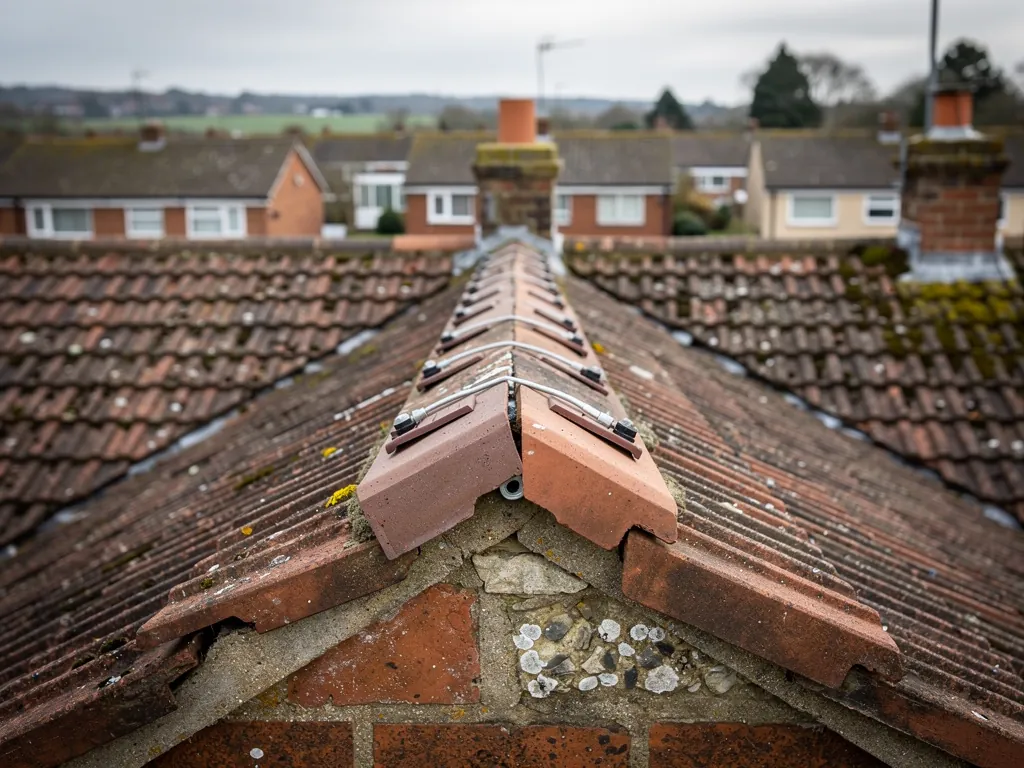
Walk down any road on the Sussex coast the morning after a gale and you can read the damage from the pavement. A scatter of mortar crumbs on a drive. A ridge tile lying in the front garden. A gap along the gable edge where the line of the roof no longer runs straight. Those are rarely the first tiles to fail by accident. They fail first because of where they are.
Along the top of the roof runs the ridge, a row of capping tiles. Where the roof meets a gable wall, its last tiles project past the brickwork, and that edge is the verge. Both stand proud of the main slope, and both meet the wind from more than one side at once. A tile in the middle of a slope is held down by the courses around it. A ridge tile is held by what is under it, and nothing else.
So the question is what that fixing is. This guide looks at how wind lifts the top and the edge of a roof, what mechanical fixing adds to a bed of mortar, how verges are finished, and what to check from the ground after a storm. Our ridge tile repairs page covers the repair work itself.
Why the ridge and the verge go first
Wind does not push on a roof so much as pull at it. When air is forced over the top of a house it speeds up, and the pressure above the roof falls. The covering is then being lifted from above as well as pushed from the side. Edges and high points feel the strongest pull, which is why a gale tends to strip a ridge or a verge while the middle of the slope stays put.
Marley notes that on roofs under 30 degrees, the side facing the wind can see severe suction, a negative pressure that pulls the covering upward. Low pitches are a feature of plenty of seaside bungalows and chalets here, so suction at the ridge and verge matters to them as much as to anything taller.
A second thing works against these tiles. They are the parts of the roof that spend their lives in the weather without the shelter of another course above them. Rain, sun and frost hit a ridge mortar joint from every direction. Small cracks open in it, water gets in and softens what is underneath, and the bed loosens over the seasons. When a gale arrives, it finds a tile that is already half free.
That sequence is why a ridge failure in a storm is seldom a surprise to a roofer. The wind finishes what weather started. It also explains why a tile that looked fine from the garden can go in a blow: the weakness is in the bed beneath it, which you cannot see from below.
If you want to know the signs before a storm does the damage, our guide to signs of loose ridge tiles lists them.
What mortar holds and what it does not
For generations a ridge was a run of curved or angled tiles seated in sand and cement mortar. Done well, that bed makes a snug, weatherproof joint. It is good at keeping rain out. It is much less good at keeping a tile on in a hard blow, because mortar is strong when it is squeezed and weak when it is pulled.
Marley's reading of the 2014 revision of BS 5534 is that mortar, which is weak when pulled, should not be what holds ridge and hip tiles by itself, and that every bedded tile or fitting should carry a mechanical fixing too. In plain words, the standard stopped trusting a mortar bed to resist the pull of the wind. Marley is also clear that installing to BS 5534 is not required by law, so this is the accepted way to build a ridge rather than a statutory rule. Mortar is not banned. It just has company now.
There is a second weakness. Mortar shrinks as it cures and cracks as the roof moves with the seasons. Once a hairline crack lets water behind the bed, frost and wetting do the rest. A ridge that was sound ten years ago can be held on by little more than friction and habit today.
Where cracks start
The joints at the ends of the run and at the junction of ridge and hip are usually first. Those spots carry more movement and see more rain. If you can spot a missing chunk of mortar at one end of a ridge from the pavement, there will often be loose bedding further along as well.
Our guide to ridge tiles and BS 5534 looks at what the standard asks for.
How a mechanically fixed ridge stays on
A mechanical fixing is a screw, clip or bracket that ties the ridge tile to something solid, so the tile no longer depends on the bed alone. There are two common ways of doing it.
In the first, the ridge is still bedded in mortar, and each tile also carries a fixing that passes through or clips over it and is anchored into a ridge batten or a bracket beneath. The mortar seals the joint. The fixing resists the lift. If the mortar cracks in ten winters, the tile stays where it was put.
In the second, a dry-fix system replaces the mortar bed. A batten runs the length of the apex, each ridge tile is fastened down with a screw or a clip, and a flexible seal closes the space beneath. Nothing needs to cure and nothing can wash out or crack. BS 8612:2018 covers dry-fixed ridge, hip and verge components, and it gives you a useful question for anyone fitting one: has the kit been tested to it? Dry-fix kits go together in different ways depending on the maker.
Why the details count
Whatever goes in has to bite on sound timber. A screw driven into a rotten batten, or a clip hooked over a tile whose edge has spalled, holds nothing. That is why a proper repair starts by looking at the timber under the ridge and the condition of the tiles themselves before anything is fixed.
Where only a few tiles have come loose and the rest of the bed is sound, re-fixing those with a mechanical fixing can be all a roof needs. Where the bed has failed along a run, taking the whole run off and fixing it properly is the repair that will hold.
Verges: the edge the wind gets under
The verge is where a roof stops at a gable wall. The tiles overhang the wall slightly so rain drips clear of the brickwork, and the underside of that overhang is sealed. On many older roofs the sealing is a fillet of mortar pointed along the edge and holding the end tiles down. On newer ones it is a dry verge unit, a plastic or metal profile clipped and screwed to the roof, with the tiles fixed behind it.
Wind goes for the verge for the same reason it goes for the ridge: it is an exposed edge. Air that is forced up the gable wall gets under the overhang and lifts. If the mortar fillet has cracked or dropped out, the lifting tile has nothing but a nail to resist it, and the tiles beside it unzip one by one.
A loose verge is not just a cosmetic fault. When the edge tiles go, rain reaches the timbers at the roof edge, and the barge board, the board that closes the roof timbers at the gable, is the next thing to rot.
For what a dry verge does and where it can go wrong, see our guides to dry verge systems and the ridge page linked above. On a gable end that is rendered or pebbledashed, the edge is also where cracks in the wall finish, so the roofer and the plasterer sometimes end up looking at the same detail.
Finishing it neatly
The verge is what the street sees of the roof. Tiles that run true, a clean, even edge and trims that sit square all make a roof look right, which is the part of the job we care about. A good verge repair should be hard to spot once it is done.
What to check from the ground after a gale
You do not need to climb to find out whether a ridge has been disturbed, and you should not try. A roof is no place to look around when it is wet or windy, and a fall costs more than any tile.
Start in the garden or on the pavement with the sun behind you. Look along the ridge line for a dip, a gap or a tile sitting at an odd angle to the tiles beside it. Look at the gable edges for tiles that stick out or sit lower than the rest. Binoculars help a lot, and a phone with a zoom lens will do. Check gutters, paths and flower beds for pieces of tile and lumps of mortar, which tell you something has moved even when you cannot see where from.
Inside, take a torch into the loft and check under the ridge and along the roof edges. Daylight showing where it should not, or a damp patch on the underlay beneath the ridge line, points to a failed joint above.
Taking photographs and telling your insurer
If a tile has come down, make the area underneath safe and keep people away from it. Which? says to contact your insurer promptly. The Institution of Structural Engineers stresses photographs as evidence and says to report any urgent repairs you arrange, with receipts kept. Policies differ, and Which? cites a roof let go through lack of upkeep as wear and tear.
Send us the photographs and we will look at them with you. Leaks and storm damage get priority on our list, and stopping the water comes before any tidying.
Fixing for an exposed site, and what the survey looks at
There is no single fixing specification that suits every roof on this coast. Wienerberger links the right fixing to where the house stands, how high up it is and how much wind reaches the site. A house on the seafront at Aldwick, a bungalow tucked into the Peninsula and a cottage on the Downs are different situations, and the right answer for each is worked out on site, not read from a table.
When we survey a ridge or a verge, we look at the following:
- the condition of the bed along the whole run, not just at the damaged tile;
- whether the ridge batten or bracket underneath is sound;
- whether the tiles themselves are cracked or chipped at the edges;
- how the verge is finished, and whether the barge board behind it is dry;
- how the pitch and the position of the house affect the fixing.
You then receive pictures of your roof taken at the survey, a clear view on whether a patch will last or the full run needs redoing, and a written quote giving one total. The quote proposes the least work that puts the fault right; where a handful of tiles can be re-fixed, the quote says that.
Ridge work is usually reached from a ladder or a tower, though a tall house may need scaffolding. Check whether any quote you are given includes VAT and scaffolding, so you are comparing like with like. Our ridge tile repairs page describes the work in full, and photographs can come to us by WhatsApp or the enquiry form.
Questions
Wind and ridge tile questions
Can a loose ridge tile be fixed without taking the whole ridge off?
Sometimes. If the surrounding bed is sound and only a tile or two has lifted, those can be re-fixed with a mechanical fixing and fresh mortar. If the bed has cracked along the run, patching leaves the weak sections in place, so the survey decides how much needs to come off.
Does a gale always mean a tile is damaged beyond reuse?
No. A tile that has simply slid or lifted is often sound and can go back once the bed and the batten beneath it have been checked. A tile that has fallen and cracked needs replacing, and an old roof may need a close match found, which can take time.
Is a dry ridge better in a windy spot than a mortar ridge?
A dry-fix ridge ties every tile to a batten, so nothing relies on mortar. A mortar ridge with a proper mechanical fixing on each tile is also held. The deciding factors are the roof, the tile and the budget, and the survey will tell you which suits yours.