
Slate, clay and concrete · 9 min read
Cleaning slate, clay and concrete roofs: one method does not fit all
Three coverings, three sets of weak points. This guide explains how slate, clay and concrete tiles respond to cleaning and why a roofer who treats them all alike is guessing.
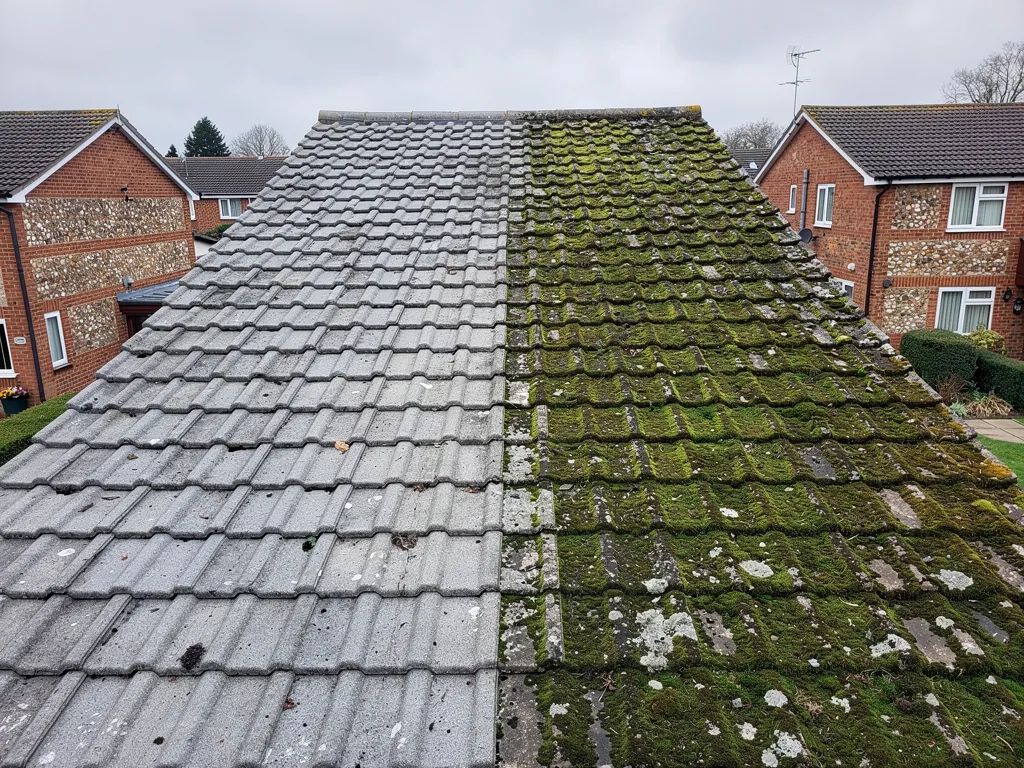
From the pavement, a green roof is a green roof. Up close it is nothing of the kind. A slate roof is thin, hard and held on by nails or hooks. A clay tile roof may be soft, porous and hundreds of years old. A concrete tile roof is heavy, dense and usually newer than either. Each one wears in its own way, and each one reacts differently to water, brushes and chemistry.
That matters because a lot of cleaning is sold as a single product: one method, one price per roof, applied the same way to everything. It works well enough on sound modern concrete. It can go badly wrong on a tired clay roof or a brittle slate one, and the damage often shows up as a leak a few weeks later.
Here we go through the three coverings in turn, with the sourced figures on how long each lasts and what each one needs from a roofer. Then we explain how a survey decides. No price appears, because the cost depends on the roof, and the quote we write after the survey is a single sum.
Why the covering decides the method
Three things vary from one covering to the next: how hard the surface is, how it is fixed and how much weight it can take underfoot. Hardness decides how much rubbing it will stand. Fixing decides what a nudge from a brush or a splash of water can shift. Strength decides whether anyone can safely walk the slope, and that in turn settles how the roofer gets up there: crawling boards, a tower or a full scaffold. It also decides how much of the work can be done by hand from a safe position.
Porosity matters as well. A porous tile soaks up water and holds it, which suits moss and algae. A dense, slick tile sheds water faster and gives growth less to grip, though it still collects a film where leaf litter and shade sit. Where growth clings, it is usually in a joint, a laps line or a shaded corner, whatever the material.
Age is a fourth factor
Age comes on top of the material. A twenty year old concrete tile and a twenty year old clay tile are both young. A hundred year old slate is middle aged and a three hundred year old peg tile is a different matter altogether. Our guide to cleaning historic and listed roofs picks up the oldest end of the range.
The survey therefore starts with three questions: what is the covering, how is it fixed and what condition is it in? Only then does anyone talk about method, product or price. A roofer who names the method before looking at the roof has decided in advance, and the roof will not have been consulted.
Natural slate: hard surface, fragile fixings
Slate is a dense stone that takes a lot of surface wear. Cupa Pizarras, a slate producer, sets natural slate at a 20 degree minimum on a moderately exposed site using a 500 mm slate, and says hooks should stay off any pitch below 25 degrees. A slate is far more likely to fail at its fixing than on its face. CORC puts well-maintained slate at 100 years and more, and that is long enough for nails to rust and holes to enlarge.
That is why cleaning slate is a question of the fixings. A jet blasts water up under the laps and can lift a slate that is held by a single weakened nail. A heavy-handed brush can snap the tail of one that is already delaminating. Walking is the biggest risk of all, and a slate that cracks underfoot is a repair bill that no clean can justify, as our guide to walking on a slate roof explains.
What suits slate
The sensible method on slate is hand removal of the moss with a soft brush, working from the ridge down the slope, followed by a low-pressure treatment. Slipped or cracked slates found along the way should be flagged, and they are normally mended before the clean, not after, so that no water finds a way in. Our answer on removing moss from a slate roof goes through that order step by step.
Slate is a covering that rewards care. Treated sensibly, a good slate roof comes up with its deep colour restored and nothing broken.
Clay tiles: porous, characterful and easy to scar
Clay tiles range from machine-made modern ones to handmade plain tiles that have been on a roof for generations. Marley cites a minimum life expectancy of 60 years for clay tiles, a number drawn from research by the Building Research Establishment. A building conservation article cautions that for old peg tiles the figure is no dependable guide, because individual roofs vary so much.
The consequence for cleaning is caution. Clay is porous. A surface that has weathered for decades may be thin, and a scraper or a jet can take off the face of the tile, leaving it pale, rough and more open to the next round of growth. Arun's Felpham village appraisal records orange and red clay tile as the roofing material of the village, and the Craigweil estate in Aldwick is described as plain clay tiled, so the covering is part of the local character as well as the weather barrier.
What suits clay
Hand work comes first, with a soft brush and no scraping across the face of the tile. Treatment follows at low pressure, and the roofer keeps off the slope wherever possible. Ridge and hip tiles on older roofs may be bedded in mortar that has weakened, and washing them hard can loosen them.
A clay roof cleaned gently will often come up looking richer in colour than the owner remembered. A clay roof cleaned roughly can look washed out for the rest of its life. Our guide to soft washing and biocide treatment explains the low-pressure approach that most clay roofs need.
Concrete tiles: tough, but not indestructible
Concrete tiles are the most forgiving of the three, which is why most cleaning methods are designed around them. Marley expects concrete tiles to last around 60 years and adds that the number promises nothing about any particular roof. A concrete roof of middle age can therefore still have decades in it, which is a good reason to clean it gently and keep it.
Concrete is also a covering that has replaced older ones. Arun's Aldwick Road guidance notes that slate has commonly been replaced there with modern concrete interlocking tiles, which tells you how widely the material has been used. Those tiles were not always a good match for the buildings, but they are what many owners now have.
Surface wear and sealed edges
A concrete tile is porous at a fine scale, and many carry a finish on the exposed face. Rough scrubbing or a close-range jet can wear that finish away, exposing the body of the tile and leaving it more open to growth. The overlapping edges and the interlocking joints are also places where water can be driven in if the pressure is wrong, and a wet loft is a poor reward for a clean roof.
On a sound roof the right method is therefore still gentle: moss lifted by hand, a treatment applied at low pressure and the roof left to clear gradually. Where the tiles are sound it is a well-proven approach, and the result is a roof that looks much as it did when it was laid. Our answer on whether roof cleaning is safe for your tiles covers the same ground.
Fibre cement, asbestos cement and other lookalikes
Not every grey roof is slate or concrete. Fibre cement slates look very like natural slate from the ground, and older sheets of fibre cement may contain asbestos. Our guide to the lifespan of fibre cement slates explains why the difference matters.
HSE's asbestos cement guidance warns that such roofs are always fragile. Its guidance on non-licensed work covers asbestos cement that is carefully handled without breaking it up, and weathered material that is not otherwise substantially damaged. If the material breaks up and creates significant dust, the work becomes notifiable. None of that is something to improvise with a brush or a jet. If there is any doubt about what a roof is made of, identify it before it is touched.
Garage and outbuilding roofs
The coverings most likely to be asbestos cement are corrugated sheets on garages, sheds and outbuildings, where nobody has looked closely for years. HSE tells owners of anything constructed or refurbished prior to 2000 to presume asbestos is in it, and that takes in a good many garages. Our guide to whether a garage roof is asbestos shows how to recognise it.
Artificial slates, metal sheets and bitumen coverings each have limits of their own as well. The first look at the roof, and the photographs taken at the survey, tell us which one we are dealing with, and the plan is written to match.
How a survey chooses the method
A good survey looks at the roof in layers. First comes the covering itself: material, age, colour, damage and the thickness of growth. Next the fixings and the details that fail first, such as ridges, verges, hips and valleys. Then the setting: tree cover, shade, the pitch and whether the slope can be reached without standing on it.
Pitch changes the picture. On a shallow slope water runs more slowly and moss holds on harder. On a steep one, every step is a risk to the roofer and to the covering. The minimum pitches that tile and slate makers publish also tell you whether a roof is working near the edge of what its covering is designed for.
Test patch, photographs, written plan
Where the covering is unusual or old, a small test patch tells us how it responds before the whole slope is treated. Photographs are taken of each slope before work starts, and again when it is finished, so you can compare them. The plan, which is written up with one total price, names the method for each slope and flags any repair that should come before the clean.
That plan is the real answer to the question in the title. It will say hand work and low pressure for clay, careful fixings checks for slate, and a gentle treatment for concrete. If a roofer cannot tell you which of those they intend to use, ask again. Our main page on roof cleaning and moss removal sets out how we carry out the survey, and our comparison of slate and tile roofs helps if you are weighing a replacement instead.
Questions
Tile type queries
Can the same product be used on slate, clay and concrete?
Sometimes, but not automatically. Many treatments are suitable for all three, and the label will say so. What changes is the application: how much force is used, how the roof is reached, and how the fixings are protected. Ask for the data sheet and the plan for your own covering.
My roof tiles are fading and flaking after previous cleaning. Is that normal?
Flaking is usually a sign that the surface has been scoured, by a jet or a hard brush, or that the tile is simply old and weathered. Neither is reversed by more cleaning. A survey will tell you whether the tiles are sound enough to treat gently or whether the covering is nearing the end of its life.
How do I know whether my garage roof is safe to clean?
Find out what the sheeting is before anyone touches it. Corrugated sheets on a building from before 2000 may be asbestos cement, and HSE treats those roofs as fragile. Photograph the roof, read our asbestos guide for garage roofs, and ask for the material to be identified before any cleaning is planned.