
Removing roof moss · 9 min read
How can you remove moss from a roof in the UK?
Moss comes off a roof in stages: check what is growing, lift the thick growth, treat the remainder and deal with the gutters. This guide sets out each stage, what to avoid and when to leave it to a roofer.
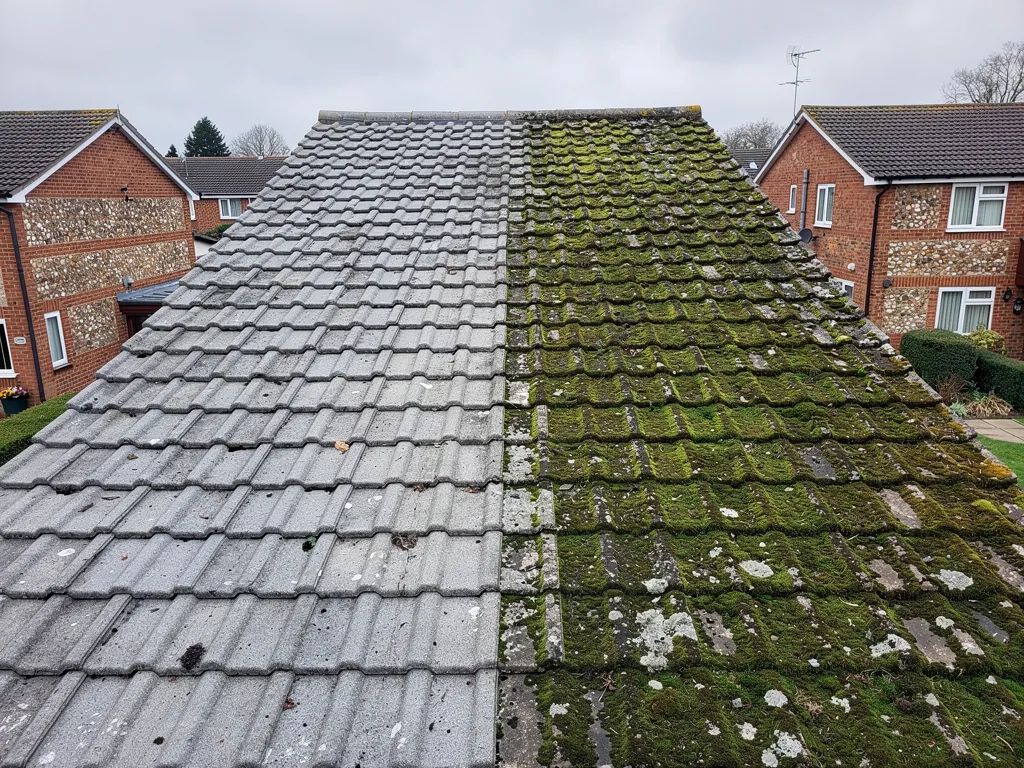
Moss is easy to see and tempting to attack. A ladder, a stiff brush and a free Saturday seem like all it takes. In practice the safe way to remove it from a UK roof is slower and more careful than that, and the first job is not scraping at all. It is finding out what is growing, what it is growing on, and whether the roof is safe to work on.
The method below is the one a roofer follows. First check the covering. Then lift the thick growth gently by hand, treat what remains so it dies back, and clear the gutters of everything that came down. Last, change what encouraged the moss so it does not return as soon as you have finished.
Roofs are dangerous places. Falls from ladders and roofs cause serious injuries every year, wet moss is slippery, and some coverings break under a person's weight. If you are not completely sure of your footing and your covering, the right move is to call someone who works at height every day. We say where the line sits at each stage below.
First, find out what is on the roof and under it
Look from the ground with binoculars or a phone camera on zoom. Moss forms raised green or brown cushions. Algae shows as dark or green streaks with no raised texture. Lichen is crusty and grey, orange or yellow. Each calls for a slightly different approach, and mistaking one for another is how the wrong product ends up on the roof.
Next, identify the covering. Natural slate, clay tiles and concrete tiles all tolerate different treatment. Slate is thin and easily cracked. Old clay tiles vary in strength and can be soft. Concrete tiles are tougher, though not indestructible. If you do not know which you have, a roofer can tell you in a minute.
Asbestos cement and fragile roofs
Check the age of the building. HSE's rule of thumb for a building built or refurbished before 2000 is to assume asbestos is somewhere in it. Asbestos cement roof sheets turn up on garages, outbuildings and some older bungalows, and HSE guidance describes such roofs as fragile every time. Weathered sheets still in one piece can be handled with care by someone who knows the rules. Once the material starts to break up and throw off dust, the work becomes notifiable.
Never scrub, scrape or wash a roof you suspect is asbestos cement. Stay off it, and ask for advice before anyone touches it. The same caution applies to rooflights and to old, brittle sheeting of any kind.
Last, look at the condition of the roof. Slipped tiles, sagging battens or a soft patch underfoot mean the roof should be repaired before it is cleaned, and probably by a professional. If the roof is in that state, spend first on the repair, and treat the moss afterwards. A clean only makes sense on a roof whose tiles are worth keeping.
Staying safe: what can be done from the ground
The safest way to deal with moss is from the ground, and that sets a limit on what a householder should try. A long-handled soft brush or a garden sprayer with a product made for roofs can reach the lower courses of a low roof from a stable footing. That treats growth near the eaves, and nothing more.
It does not clear moss from the higher slopes, valleys or the area behind a chimney. Those places are exactly where growth does the most harm, and they are the places you cannot reach safely without access equipment.
- Never climb onto a roof you have not checked for strength.
- Never lean a ladder against gutters, which are not built to carry weight.
- Never work alone, in wet or windy weather, or with a ladder that is not footed.
- Never stand on moss, which is slick when damp.
If your roof needs more than a few courses treated from below, it is a job for someone with the right equipment: roof ladders, crawl boards, a tower or scaffolding. Saving money is not worth a fall. Access equipment does add to a quote, but it is what makes the job safe, and it lets the roofer reach the valleys and the ridge, where growth does the damage.
Using a ground-level treatment
Moss killers sold for use on roofs are applied to the surface and left to work over time. Follow the label for dilution, dry-weather timing and the protection of plants, ponds and drains. A product made for patios or paths is not designed for tiles. Check that the label names roofs, and keep the container to read again if you have a question afterwards.
Lifting the growth by hand
Hand removal is what a roofer does first on a roof with thick moss. A plastic or wooden scraper lifts the cushions from the surface, and a soft brush follows. The idea is to detach the moss without scouring the tile beneath it, because a tile with a roughened surface collects more growth in future.
The direction of work matters. Working from ridge to eaves moves the moss in the direction the tiles shed water, and avoids catching the lower edge of each tile and lifting it. Brushing upwards drives debris under the laps and risks lifting tiles that are only just held. Stiff wire brushes scratch the surface and are best left in the shed.
The waste needs a plan. Moss that falls into the gutter creates a worse blockage than the one you were trying to cure, so it is bagged as it comes off, or caught on a sheet below, and carried to the ground. Dry moss weighs very little, and wet moss weighs a good deal more, so choose a dry spell for the work and keep the bags small enough to handle on a ladder. Our answer on scraping moss off by hand looks at when the technique is the best choice.
What a roofer checks as the moss comes off
Removing moss from tiles shows what it was hiding. Cracked edges, slipped tiles, tired pointing on the ridge and flashings that have lifted all come into view. We photograph each one so you can see it yourself, and report it separately from the clean. A sensible roofer treats the clean as a survey that happens to include scraping, and tells you straight away if something needs attention. Small faults found early, such as a single slipped tile, cost very little to put right while the scaffold or ladders are already in place.
Treating what is left
Even a thorough scrape leaves moss spores and roots in the surface of the tile. Without treatment they regrow, often faster than before. A biocide is a product that kills moss, algae and lichen. It goes on with a low-pressure sprayer and is left to do its work, and the dead growth loosens and drops away over the following weeks as rain and wind take their share. Rushing that stage by scrubbing at half-dead moss only grinds it into the tile.
That timing catches people out. The roof does not look new the day after treatment. In the early weeks it can look patchy, and some dead growth stays put until it weathers off. Expect a gradual improvement over the following weeks, and do not judge the result on the first day.
Ask what is in the product, how it is applied and how it is kept off plants and out of drains. A professional should be able to tell you in plain words. A product used carelessly can mark paving, harm planting and run into surface water, so the care taken over application matters as much as the chemical.
Soft washing
Some roofers wash the treatment through with a very low-pressure rinse, a method known as soft washing, which is a different thing entirely from a pressure washer. Our guide to soft washing and biocide treatment explains the difference and why the pressure matters.
What not to do
A few tempting shortcuts do more harm than the moss ever would. Heading the list is a pressure washer. A hard jet can strip the face of a tile, drive water beneath the laps and shift slates and ridge tiles out of place. We have a full guide on why pressure washing a roof can do more harm than good, and the short answer is to leave it alone.
Household bleach, patio cleaners and other products not made for roofs are the next mistake. They can discolour tiles, damage planting and run into drains and watercourses. A product made for roofs, used to its label, is the only sensible route for a householder.
Scraping hard with a metal tool is another. A tile surface that has been scored holds water and growth better than before, so a roof cleaned that way tends to go green again sooner.
Finally, do not leave removed moss to rot in the gutter. It breaks down into a dark mush that blocks the outlet, and the first heavy rain will send it overflowing down the wall. Clear the gutters as soon as the moss is down, and check the downpipe outlets with a hose. A blocked outlet is easy to miss from the ground until the next downpour shows it.
Cleaning a flat roof
Flat roofs are a special case. A membrane of felt, rubber or fibreglass can be cut or punctured by scrapers, so moss on a flat roof is best lifted gently, and any ponding that encourages it should be looked at. Where the surface is sound, a soft brush and patience are usually enough, and sharp tools should stay in the van.
Keeping the moss from coming back
Moss needs damp, shade and a surface to hold on to. Take away any of the three and it slows down. You cannot remove the weather, but you can change some of the rest.
Trim branches that overhang the roof, because they cast shade, drop leaves and keep the slope damp. Keep the gutters clear, since water that overflows onto the lower courses keeps them wet. Look at north-facing and shaded slopes first, since they dry slowest and carry the heaviest growth. The pattern is plain once you look for it: growth gathers wherever the sun and wind rarely reach.
Plan a regular check rather than waiting for green cushions. A short look from the ground each spring and autumn, with a camera, catches growth while it is thin and cheap to treat. Our roof maintenance checklist turns that into a routine.
When to call a roofer
Call a roofer when the moss is on the higher slopes or in the valleys, when the covering is slate or old clay, when you cannot reach the growth from the ground, or when anything looks loose. We survey the roof, photograph it, tell you what we found and quote one total price in writing. Our roof cleaning and moss removal page explains how we work.
Questions
Moss removal questions
What should I do with the moss once it is off the roof?
Bag it as it comes off and carry it to the ground, never letting it fall into the gutters. Dry moss can go with garden waste or into a compost heap, if your local council accepts it. Ask a roofer where it goes if they take it away, as the waste should leave site with them.
Does moss on a roof mean the roof needs replacing?
No. Moss grows on sound roofs as readily as on tired ones, and a covering in good order can be cleaned and kept for many years. What matters is the state of the tiles beneath it, which a survey shows. If they are failing, the repair-or-replace decision comes before the clean.
Is it safe to walk on a roof to scrape moss off?
Not unless you have the right equipment and know the covering will take your weight. Wet moss is slippery, and slate, old clay and asbestos cement can all break underfoot. If you cannot do the job from the ground, it is safer and often no dearer to have a roofer do it with proper access.