
Natural or artificial · 9 min read
Natural slate vs fibre cement and composite slates
Manufactured slates imitate the look of natural stone at a lower material cost, but the saving depends on the job, and age, weight, pitch and local rules all need checking before you swap.
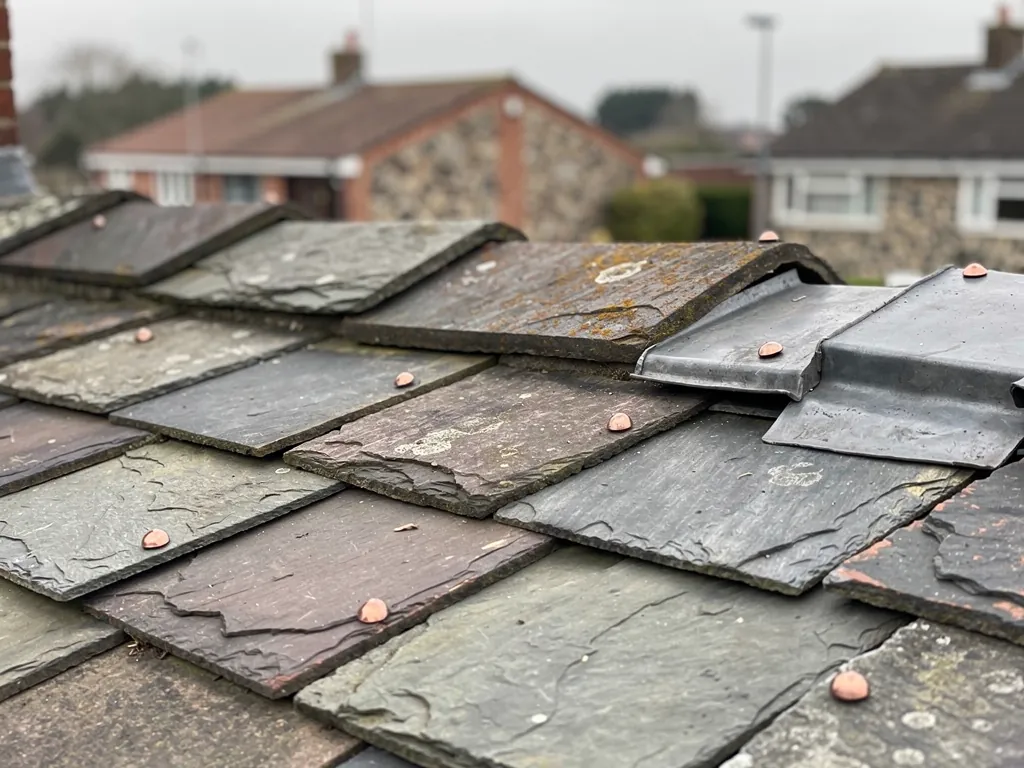
Walk past enough slate-grey roofs and you will not be able to tell which are stone. Fibre cement and composite slates are made to look like natural slate from the pavement, and they are sold on price, on weight and on the idea of a uniform finish. Natural slate is sold on its age, its look and its record. Both are laid in overlapping courses, and from the ground both can pass.
The real differences are closer to the roof. They are in how long each lasts, what the older versions are made of, what the structure underneath can carry, how steeply the roof must rise, and what your local council will accept on a street where the original material was slate.
This guide compares natural slate with manufactured alternatives on those points. We use published prices and lifespans where they exist and say plainly where the answer depends on the product. The survey of your roof settles the rest, and the one total price in our written quote reflects what we find, not a catalogue average.
What counts as an artificial slate
Natural slate is split from quarried stone and cut to size. Artificial slate is the trade's loose name for anything manufactured to stand in for it. The family has three main branches.
Fibre cement slates are thin sheets of cement reinforced with fibres, pressed and coloured to resemble stone. Their age matters, because older fibre cement is the source of the asbestos question covered later in this guide. Composite slates are moulded from blends that vary by maker, which can include plastics, rubber or mineral fillers, and are marketed as light and tough, though the claim belongs to each product. Concrete slates are cast from the same material as concrete roof tiles, in the proportions of a slate, and they are the third branch of the family.
Why the label matters for your roof
Each branch behaves differently once it is fixed to a house. Their weights, their pitch limits, their fixing rules and their warranties come from the manufacturer, not from a common standard, so one product is not a stand-in for another. When a quote says artificial slate and nothing more, it has told you very little. We name the product, so that its data sheet can be read, and we tell you the thickness, the pitch it needs and how it is fixed.
None of this says manufactured slate is a poor choice. It says the choice is made product by product, in the way a natural slate is chosen by size, thickness and grade. Our separate guide to Welsh, Spanish and Brazilian slate shows the same logic for stone.
Price: where the saving is and where it is not
Natural slate sits at the top of the published price tables. Checkatrade's slate pricing, dated September 2026, runs from £160 to £210 per m² across slate roofs, averaging £184, and lists imported Spanish slate lower at £95 to £125 per m². Slate roofers are listed at £280 to £360 a day. Add the standard 20 per cent for VAT if a figure leaves it out.
Manufactured slates are marketed as the lower-cost route, and the material itself is often cheaper than natural stone. Be careful with the next step, though. The cost of the job is the covering plus everything done to get it onto the roof: stripping the old covering, any repairs to battens and rafters, new underlay, the fixings, the lead at hips and valleys, the scaffold and the clearing away. Most of that is the same whatever the covering is.
The access cost does not shrink
Scaffold is priced by the house. In Checkatrade's October 2026 table, a month around a two-floor semi is about £875, with a terrace at £800, a detached bungalow at £1,000 and a detached house at £1,200. Poles over the footway bring a licence from the highway authority, and in West Sussex that costs £266 for a month. On a tall, awkward roof that cost can be a large share of the bill, so a cheaper slate takes a smaller bite out of the total than the per-metre prices suggest.
It is also worth asking what the lower first cost buys over the whole life of the roof. A covering that has to be replaced sooner can cost more across the years. The sections below on lifespan and on older sheets show why that sum is not simple. Check that every quote you compare includes VAT and scaffolding, and that each names the exact slate.
Older fibre cement and the asbestos question
This is the point on which a manufactured slate can matter most for safety. Fibre cement of an older date can contain asbestos. The Health and Safety Executive starts from the position that a property dating from before the year 2000 may well contain asbestos. A manufactured slate roof on a house of that age is worth identifying before anyone touches it.
HSE draws a line through the way asbestos cement is treated. Taking off sheets and similar products counts as non-licensed work when each piece comes away whole and is lowered with care, and weathering alone does not change that. If the sheets are badly broken, the job moves into notifiable non-licensed work, and HSE wants notice given before it begins. Its guidance also describes asbestos cement roofs as fragile at all times, so access needs proper arrangements.
Waste and what to do first
The household exemption from hazardous waste paperwork does not stretch to asbestos, and the contractor fills in the consignment note as the producer of the waste. HSE asks for double wrapping and labelling, a lockable skip for cement sheet, and no mixing with other rubbish.
So if your roof has manufactured slates that you cannot date, do not drill, scrape or clean them, and do not let anyone else. Have the material identified first, because a sampled roof is a plan and an unsampled one is a gamble. We would rather tell you before the scaffold goes up that a roof needs sampling than discover it halfway through. Our guides on checking whether a roof is asbestos cover the signs, and the point applies to a house just as it does to a garage.
Lifespan, warranty and what the numbers mean
Natural slate holds the strongest record. CORC puts well-kept slate at 100 years or more, and Checkatrade has stone slate passing a century. These describe stone that was sound when it went on.
For comparison, Marley expects concrete roof tiles to give around 60 years, and adds that the figure is no guarantee. That caution is worth carrying over to manufactured slates. A manufacturer's warranty is a legal promise about replacement or repair under stated conditions. A lifespan is an estimate of how long the covering will keep doing its job in ordinary use. They are different numbers and are rarely close.
What we ask of a manufactured product
We do not quote a lifespan for any manufactured slate on this page, because the right figure belongs to a named product and its tested performance. What we do ask is for the maker's data sheet, the terms of its warranty and the conditions that would void it. The warranty may require particular fixings, a minimum pitch or particular underlay. A roof laid outside those terms may leave you without the cover you thought you had.
Our answer on how long fibre cement slates last looks at the question for that branch. The comparison to take away is simple: natural slate has the longest record of any pitched roof covering in the tables, and a manufactured slate has to earn its comparison with documents, not with a colour card. If a supplier offers a long figure without a document behind it, treat the figure as marketing and ask for the paper.
Weight, pitch and fixings: the engineering checks
A different covering is a different load. The Planning Portal sets 15 per cent heavier or more as one of the trigger points for building control, and Approved Document A speaks of a rise of more than 15 per cent as a significant change in roof loading. Manufactured slates are often sold as lighter than stone, which can help on a roof that is already near its limit. The same swap in the other direction, a heavier covering on old timbers, is where the structural check earns its place.
Pitch is the second check. For natural slate, Cupa Pizarras reads BS 5534 as setting a 20 degree minimum in moderate exposure with a 500 mm slate. Manufactured slates have their own limits, set by the maker, and the rule for tiles applies equally: always check the data sheet. A roof that suits one product may be too shallow for another.
Fire, fixings and approval
The Planning Portal also lists a new covering that performs significantly differently in a fire among the reasons approval is required, so the fire rating of a manufactured slate is part of the conversation with building control. BS 5534 governs slating and tiling on pitched roofs and expects mechanical fixings, and the maker's fixing schedule must be followed.
None of this blocks a manufactured slate. It means that a switch between coverings is treated as a job in its own right, with the weight, the pitch, the fire performance and the fixings written down before the order is placed. We raise each one at the survey. Where the work needs the Building Regulations notification, we handle it. Our guide to re-slating and Building Regulations gives the thresholds in full.
Appearance, conservation areas and listed buildings
From street level the argument for a manufactured slate is that nobody can tell. Councils tend to look closer. The test is whether the new covering preserves the look and character the area was designated to protect, and planning law passes over works that make no material difference to how a building looks, and treats those that do as a planning matter.
Arun District Council's conservation area guidance is explicit in places. For Aldwick Road, designated in July 1994, it lists slate, stucco and flint as the area's character materials and observes that concrete interlocking tile frequently stands where slate once did, which it counts against the street. For The Steyne and Waterloo Square (August 1979, extended July 1994) the same document asks for the return of natural slate or plain clay where inappropriate modern materials crept in.
Who decides, and in what order
Whether a particular manufactured slate is acceptable in such an area is for the council to say, and we cannot predict it from the product's brochure. Ask Arun's planning team, or its conservation officer, with a named product and a sample in your hand. If your house is listed, listed building consent applies to alterations that affect its character. Inside the South Downs National Park, the Authority or the district council acting for it handles the application, depending on the district.
Where a council has asked for natural slate, the sensible course is to fit it. Where no rule applies and the roof, the structure and the budget suit a manufactured product, there is nothing wrong with choosing one. We tell you which case you are in. Our guide to slate roofs in conservation areas explains the consent route, and the slate roofing page describes the work we do.
Questions
Natural and manufactured slate questions
Can fibre cement slates replace natural slate on a house?
Sometimes. The swap changes the weight, the minimum pitch, the fire performance and possibly the look, so it needs checking with building control and, in a conservation area or on a listed house, with the council's planning team. Arun's guidance on Aldwick Road and The Steyne favours natural slate, so ask before ordering.
Should I assume an old fibre cement roof contains asbestos?
Yes, until it is identified. For a house of that age HSE's starting point is to treat the cement as suspect until a test says otherwise. Leave the roof undisturbed, do not drill or break it, and arrange for the material to be checked before any work starts. Carefully handled asbestos cement removal is non-licensed work, but damage changes that.
Is there a cheaper slate that is still natural stone?
Yes. Checkatrade's slate pricing table, dated September 2026, lists Spanish slate at £95 to £125 per m², against £160 to £210 for natural slate roofs generally. Imported stone is still natural slate, which matters in streets where the council asks for it, but its size, thickness and grade should be named on the quote.