
The RICS guide · 9 min read
What RICS says about spray foam insulation
The Royal Institution of Chartered Surveyors published a consumer guide to spray foam in March 2023. Here is what it covers, what it asks of owners and what it leaves open.
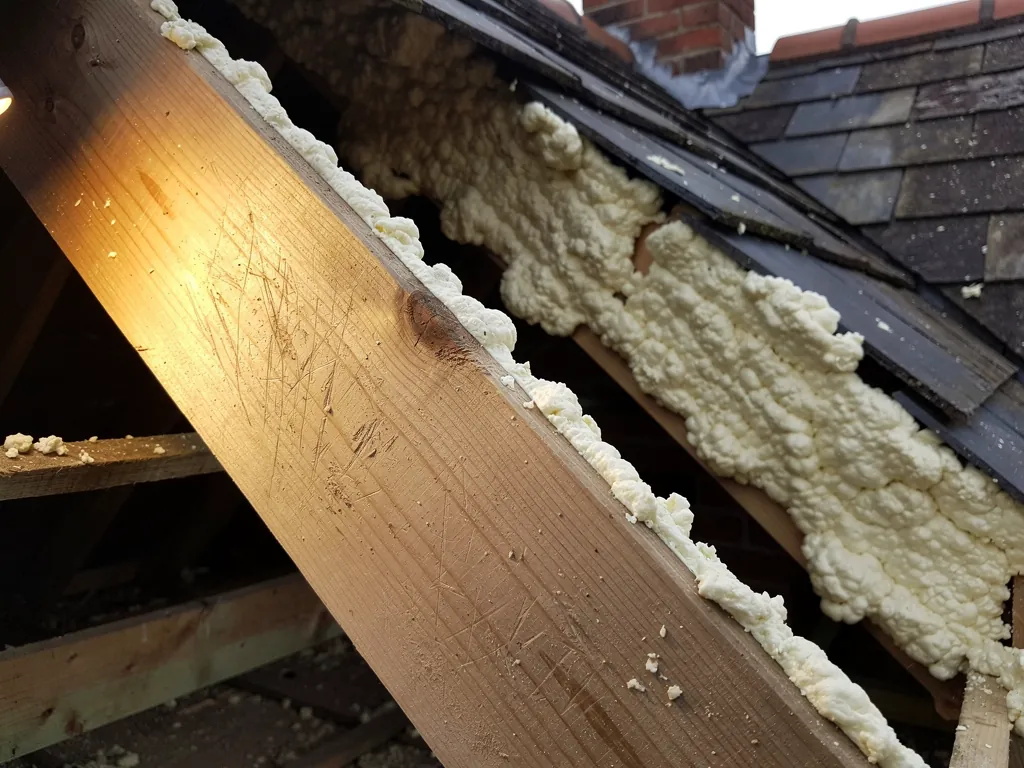
When a surveyor writes a note about spray foam in a loft, the document most worth reading beside it is the RICS consumer guide to spray foam insulation. RICS is the professional body for chartered surveyors, and its members carry out the home surveys and lending valuations where foam tends to come up. The guide is addressed to homeowners, and it reads as a set of cautions rather than a ban.
The date matters. The web page is undated, but the downloadable guide carries a March 2023 filename and the trade press reported its launch that month, so we cite it as the March 2023 guide. Anything that has changed since then, including individual lenders' policies, is outside it. Each section below sticks to what the guide says, in our words, and flags where we are adding the practical view of a roofer.
If you came here because a survey mentioned foam, read the sections on valuation and independent advice first. If you are weighing up whether to have foam installed, the section on questions to ask is the one to start with. Our spray foam insulation removal page covers what we do when a roof needs the foam taken off.
What the guide is for, and what it leaves out
The guide opens by saying that spray foam may look like a simple way to cut heat loss but should be viewed as a serious modification. It says consumers often understand little about how foam affects valuation, home surveys and lender decisions, and it adds that Trading Standards and media reports flag cold calls and unsolicited offers to sell or to remove foam. Those three themes drive the rest of the document.
Its scope is specific. It applies to existing roofs in loft voids where owners are thinking of having foam applied after the building was finished, or already have it. Three groups sit outside it: new homes where foam was part of the original roof build-up, loft conversions where insulation was designed and installed to suit the new room, and roofs where a foam was sprayed on to glue tiles together.
Why the exclusions matter to a reader
If your foam went in as part of a designed loft conversion, or your home was built with it, the cautions about retrofit do not apply in the same way, and a surveyor will expect a different set of papers. If your tiles were glued with foam, RICS treats that as a different situation again, one where the roof is often already past economic repair.
Reading the scope first heads off the commonest mistake, which is to quote the guide against a roof it was never written for. A foamed bungalow loft converted to a bedroom years ago, with building control paperwork, is not the same case as a retrofit onto a tired roof.
Cold roofs, warm roofs and the whole-building view
RICS builds its argument on a simple picture. In a traditional pitched roof, insulation lies above the ceilings and the loft above it is ventilated and cold. Air movement keeps moisture within acceptable limits. Foam on the underside of the roof structure creates a warm roof, in which the space itself is heated and extra condensation control may be needed.
The guide's point is that these are two different designs, and combining or swapping them without a plan is where trouble starts. It says buildings are made of component parts that work together, and introducing a new material can have positive and negative effects. Its own example is that sealing hot air in can also seal water in, which makes roof repairs more difficult.
Wind and watertight first
Before any insulation, the guide says the property needs to be wind and watertight. Adding insulation to a poorly maintained roof increases its vulnerability and can accelerate decay in untreated timbers. That is advice any roofer would give. A leaking roof is a repair job first, and an insulation job a long way second.
RICS also tells owners to think about how the roof space is used. If it is only storage and does not need heating, the guide says mineral wool at ceiling level improves the home's thermal performance, is considerably cheaper and leaves the roof easier to maintain. It suggests asking why insulation should go under the pitch of the roof if nobody lives there.
For rooms in the roof, such as dormer and Dutch bungalows, it says partial upgrades can lead to condensation forming elsewhere, and recommends professional advice on upgrading the whole home.
The risks RICS lists
The guide groups its risks under four headings. The first is hidden problems. Foam can hide the roof timbers from anyone standing in the loft, and a leak behind certain types may go unseen. The second is damp and condensation, where poor installation can cause uncontrolled condensation and damage to the property. The third is energy saving: claims may not be achieved if the installation is not planned correctly. The fourth is fire.
On energy, the guide is even-handed. It accepts that foam insulates better than the same thickness of mineral wool, but says topping up existing loft wool can beat the typical maximum of 100mm of foam between the rafters, and that the sums might show old wool has to be removed, so you could not have both ceiling and roof level insulation. That affects running costs, because the roof space has to be heated before warmth builds up in the rooms below.
Fire and the Class E rating
On fire, RICS says polyurethane foam is combustible, with a typical rating of Class E under the British and European reaction-to-fire standard, a class it describes as resisting a small flame for only a few seconds. A loft that nobody uses does not require fire protection, but the guide warns that a fire in the house would be worse because the foam is there, for the property and the neighbouring ones.
It adds that foams differ from one another in how they perform, and that after spraying the job cannot easily be undone. We explain how that plays out for removal in open-cell vs closed-cell spray foam.
Valuation, lenders and listed buildings
Here the guide is direct. Foam in the roof could shift the surveyor's view of what the home is worth. A surveyor who finds it may ask for an independent specialist report, and the result could change their opinion. Foam applied incorrectly, or to a listed property without prior consent, will be reflected in the valuation, and the surveyor must follow whatever instructions the lender gives.
The guide recommends that the installer hand over the installation contract, the relevant calculations, a description of the roof works, whatever warranty came with it and any third-party test certificate. For anyone buying a home with foam in place, it says to make sure those papers exist, since they help answer questions from the valuer, lender and legal team. We go through the lending side in spray foam and mortgages.
Consent for protected buildings
RICS is firm about listed and other protected buildings: consent must be obtained before foam is used, and because foam is a permanent installation whose removal could harm the existing structure, it is not considered reversible. The guide judges that consent is unlikely to be given for a listed building. In practice, an owner who finds foam in a listed home has a consent question as well as a roofing one, and should speak to the council's conservation or planning team.
This guide applies in England, and your local authority is the first call. For homes in Arun, that means Arun District Council, and for the South Downs the right body depends on the part of the Park you live in.
The dos and do nots RICS gives owners
The guide closes its advice with a checklist. In summary it says: do not accept cold-call or unsolicited offers about spray foam; do not fit foam to a listed or protected building without listed building consent beforehand; and do not carry out isolated alterations without due diligence and planning.
On the positive side it says to get advice from an independent, impartial professional who has no commercial interest in selling you a product, to keep the property in good repair and wind and watertight, to consider the whole property, to understand where ventilation is needed, and to put insulation next to the rooms you live in, for example at ceiling level in the loft. It also tells owners to check with their mortgage provider and their insurer, the latter because of potential increased fire risk.
What independent means
The word is doing real work. RICS describes independence as being commercially separated from the installer and the manufacturer. A salesperson who offers a free inspection before selling you foam, or before selling you its removal, is not independent in that sense. A chartered surveyor appointed by you, who has nothing to sell, is.
As roofers we do have a commercial interest in roof work. What we offer is a plain verdict after a survey of the roof space, backed by photographs, and a recommendation of the smallest job that properly puts things right. If the answer is to leave it alone, that is what we tell you. Where an owner wants a second opinion from a surveyor as well, that is a sensible step and we are happy to supply photographs to them.
What RICS does not say
It is worth being clear about the limits of the guide, because it gets quoted well beyond them. It does not say foam must be removed from every roof. It does not name lenders or insurers, and it does not say what any lender will decide. It does not give a price for removal. It sets out risks, asks for independent advice and tells owners what to check before and after installation.
It also stops short of giving technical specifications for a correct installation. It says no single set of instructions suits every home, that reputable manufacturers each have their own technical literature, and that consumers must satisfy themselves that products are installed correctly by recognised, industry-qualified operatives. The questions it lists include whether the roof is close to needing replacement, whether it is free from defects and damp, how ventilation will be controlled as the manufacturer requires, whether existing insulation must come out, and whether extra layers such as vapour control layers are needed.
Putting the guide to use
For an owner with foam already in the roof, the guide suggests a calm sequence. Find the paperwork. Check your lender's and insurer's position. Have the roof space inspected by someone who can see and photograph the timbers. Then decide whether to leave the foam, part-remove it or take it all off, on the evidence.
Our guide to spray foam surveys sets out what such an inspection looks at. Our verdict on the roof comes before any figure, and the quote after the survey is a single total in writing. A surveyor is welcome to see our photographs if it helps their report.
Questions
RICS and foam questions
Is the RICS spray foam guide law or regulation?
No. It is a consumer guide from a professional body, giving advice and cautions to homeowners. It is not a Building Regulation or a statute. Surveyors and lenders still pay attention to it, which is why its points about papers, ventilation and independent advice come up so often in house sales.
Does RICS tell owners to remove their spray foam?
It does not. The guide describes risks, says foam is not easily reversible and recommends independent advice and good records. Whether foam stays, is part-removed or comes off depends on what is under it, which is why an inspection of the roof timbers comes before any decision.
What if my foam was fitted as part of a loft conversion?
The guide says it does not apply to loft conversions where new insulation was designed and installed to suit the conversion, or to new builds with foam in the original roof. Your building control paperwork and the designer's calculations are the documents that matter in that case.