
Foam removal cost · 9 min read
How much does it cost to get spray foam insulation removed?
Removing spray foam from a roof is not a job with a fixed price. This guide explains what moves the total, what costs sit around it and how to get a written quote you can rely on.
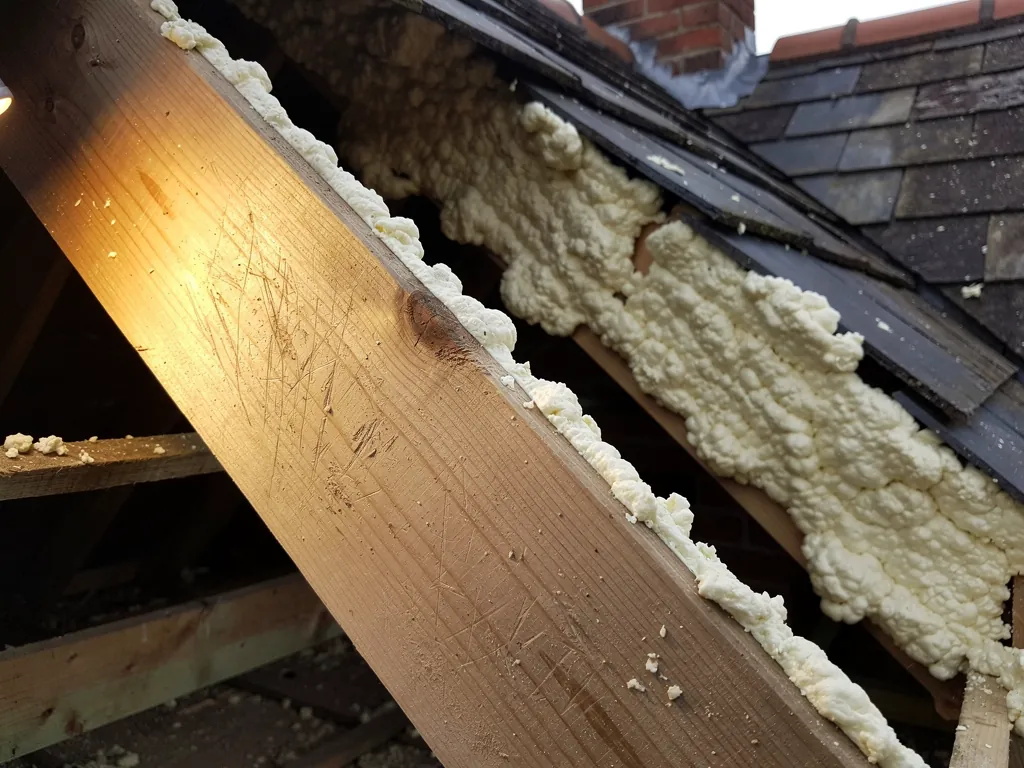
Spray foam went into thousands of lofts as a quick way to cut heat loss. Years later, some owners find that a surveyor will not report on the roof timbers, a buyer's lender hesitates, or a damp patch has appeared under the roof. The next question is always the same: what will it cost to get it out?
The honest answer starts with what the price is not. It is not a fee per square metre that you can multiply by the size of your loft. Foam is stuck to timber, tile battens and underlay in different thicknesses and by different methods, and the work involved changes with each of those. Two lofts of the same floor area can differ by a large margin once the roof is open.
This guide therefore works backwards from what decides the total on a removal job. It then gives national figures for the work that travels with it: scaffold, survey, replacement insulation and any roof repair. It ends with how to get a quote that holds together. Ranges carry their sources, and the quote that follows our survey is a single total for your roof.
Why one number cannot cover every removal
A price per square metre works for jobs where the material and the method are the same every time. Spray foam removal is not like that. The foam may be open-cell or closed-cell, thin or thick, sprayed onto bare rafters or onto the back of the tiles and felt. It may have been put on with care or in a hurry. Each case needs a different amount of labour.
The RICS consumer guide to spray foam, published in March 2023, adds a further reason for caution. It cautions that taking foam out may harm the timbers it sits on, and describes the material as not easily reversed once applied. The work is closer to careful dismantling than to clearing out, and the time it takes shows in the price.
What the roofer has to find out first
Before pricing, a roofer needs to know a handful of things. How thick is the foam, and is it stuck to timber alone or to the underlay and battens as well? Is the loft a plain void or a converted room? What state are the rafters in beneath the foam? Can the foam be reached from inside, or does part of the roof covering have to come off to get at it?
The answers set the hours, the people needed and the equipment. That is why a sensible quote only follows a survey, and why a phone price for foam removal should be treated with caution. Our survey looks at the loft and records the foam and any visible timber in photographs, which reach you alongside the written quote.
What sets the total on the day
Five things do most of the work in deciding a total. Understanding them lets you compare one quote with another on a fair basis.
Roof area. More roof means more foam and more hours. A bungalow with a wide, low roof space can involve a lot more surface than a small terrace, even though the house looks modest from the street.
Foam type and thickness. RICS says that foam is typically installed to a maximum of about 100 mm between the rafters. Where it has been sprayed thicker, or has crept up and over the timbers, there is more to take out. The Energy Saving Trust, discussing foam sprayed onto a roof that leaks, says the risk is expected to be far smaller with open-cell foam, so the type is high on the list of questions at survey.
How firmly it grips. Foam sprayed straight onto timber and felt is harder to lift than foam on a separating layer. RICS also describes foam used to hold failing tiles together, a quick fix that often means the covering is already past economic repair.
Access. Whether the work is done from inside or needs the roof opened affects the labour and may bring scaffold into the sum.
The condition of what lies beneath. RICS shows how a timber can look dry on its exposed face and be wet behind the foam. Timbers that are found damp or soft once the foam is off need attention, and that can change the nature of the job.
The national costs that sit around a removal job
Foam removal rarely happens on its own, so it helps to see the typical costs that attach to it. Each row comes from a named third-party guide and is a national typical range, not one of our own prices.
| Item | Typical UK range | Source |
|---|---|---|
| Roof survey | £300 to £500, plus VAT | Checkatrade, table last updated September 2026 |
| Roofer, per person per day | £280 to £360 | Checkatrade, table last updated June 2026 |
| Scaffold, two-storey semi, per month | £875 | Checkatrade, table last updated October 2026 |
| Scaffold, detached bungalow, per month | £1,000 | Checkatrade, table last updated October 2026 |
| Natural slate or tile roof repair | £90 to £220 per m² | Checkatrade, table last updated June 2026 |
The repair row spans concrete tile at £90 to £120 per square metre up to natural slate at £150 to £220. Checkatrade states that its repair costs exclude VAT, so 20 per cent is added.
Scaffold and licences
Poles and boards over the footway need a highway licence under section 169 of the Highways Act 1980, and the highway authority issues it. The West Sussex county council charge is £266 for a month, with 10 working days' notice. Over the border, Hampshire County Council wants ten clear working days ahead and charges £211.90 for a first fortnight. Allow for the wait when planning the work.
When you compare prices, ask whether each includes scaffold and VAT. A quote that leaves them out has not saved you anything if they arrive later.
When the roof itself needs work
Sometimes taking the foam out shows that the roof beneath needs repair. Rain that got in behind the foam may have soaked battens, softened the felt or marked the rafters. RICS notes that a leak behind some types of foam can go unseen and lead to rotting timber. Spraying foam over a roof that already leaks is something the Energy Saving Trust advises against.
A repair of a patch of tiles or slates is a modest cost, while replacing timbers is more. Where the covering is at the end of its life, re-roofing becomes the sensible move, because stripping it to reach the foam and then rebuilding on old tiles makes little sense. Checkatrade's roof replacement guide, updated October 2026, gives a UK average around £8,000, with most roofs between £4,000 and £19,000, and about £12,000 for a three-bedroom semi. Its table, headed plus VAT, puts hip roofs at £9,250 to £18,000, gable at £7,000 to £16,250 and flat roofs at £2,800 to £7,500.
Repair, patch or replace
You hear our view of the roof before you hear a price. A sound roof needs removal and a patch repair. Where timbers need local work, we mark exactly where. Where the covering is failing, we show you why. The aim is the lightest job that fixes the problem, with no push towards a new roof where the old one will do.
Our guide to the spray foam removal process explains the stages, from survey to clearing up, so you know what the labour in the quote is for.
What leaving the foam can cost instead
Removal is not always the answer, and RICS does not say that foam must always come out. What it does say is that foam can colour a surveyor's view of what a home is worth, and that owners should ask their mortgage lender about its policy.
Lenders differ. Reporting in November 2024, Today's Conveyancer found some lenders unwilling to offer a mortgage on a house with spray foam, while others weighed each property individually. Positions can change, but foam may narrow your pool of buyers or slow a sale.
Weighing the two costs
On one side is a removal bill and the roof work that may come with it. On the other is the chance of a failed sale, a lower valuation or a surveyor who cannot inspect the timbers. If you are not selling or remortgaging and the roof is dry and sound, leaving the foam in place and keeping watch may be reasonable. If a buyer's surveyor has flagged it, or timber damage is suspected, removal is likelier to pay for itself.
A specialist survey is the way to decide. Our guide to the spray foam survey sets out what an inspection can and cannot show.
RICS also warns that foam is combustible and that existing loft insulation may have to be reconsidered if foam is added. That is part of why many owners return to mineral wool after removal, which brings its own cost.
Insulating again after the foam is out
Taking out foam leaves a loft or roof void without insulation, and that needs replacing. RICS observes that topping up mineral wool at ceiling level is likely to be substantially cheaper than installing spray foam, although it takes up more loft space. It also notes that mineral wool makes the roof easier to maintain, since the timbers stay visible.
That is a sensible default for an ordinary loft that is used for storage and not as a room. A converted loft or room in the roof is different, and its insulation has to suit the design of the conversion. Our guide to insulation after spray foam goes through the options.
VAT on insulation
Most roofing work carries VAT at 20 per cent, and re-roofing sits at that standard rate. Insulation is treated separately: VAT Notice 708/6 gives a zero rate to fitting listed energy-saving products, roof and loft insulation among them, from 1 May 2023 to 31 March 2027, with a 5 per cent rate after that. Whether the insulation within a bigger job qualifies turns on whether it counts as a single supply with the rest, and the quote sets out how it applies to yours.
There is also the question of Building Regulations. Replacing roof insulation can bring thermal requirements into play, so check with your building control body or ask us. No national grant is lined up for this work: the Great British Insulation Scheme finished in March 2026, so plan to fund it yourself.
Getting a quote you can trust
RICS points out that Trading Standards and press coverage have flagged unsolicited approaches to sell or take out spray foam. If someone you never contacted rings or knocks offering a quick removal or a free inspection, decline and arrange your own survey.
A fair quote should follow a survey of your roof, name the work in plain words, state the total and say whether VAT and scaffold are in it. Ours arrives in writing with pictures of your own loft, so you can see what the surveyor saw.
Your rights on the contract
If you sign a contract at home after a survey, the Consumer Contracts Regulations give a 14 day cancellation period for off-premises contracts, running from the day the contract is made. Nothing starts inside those 14 days unless you ask for it in writing. Urgent repair visits that you specifically request are treated differently under the rules, so ask if you are unsure which applies.
What to send us
A few things speed up a first look: the age of the house, roughly when the foam went in and who installed it, any paperwork or warranty, photographs of the loft and any stains on the ceilings below, and the reason you are asking, whether that is a survey report, a sale or a leak. Our spray foam insulation removal page explains how we work from there.
Questions
Foam removal cost queries
Is there a standard price per square metre to remove spray foam?
Not one you can rely on. Foam type and depth, how firmly it grips, the route in and the timbers underneath all change the work. We survey first and give a written quote with one total for your roof, rather than a rate that ignores those differences.
Does the quote include scaffold and VAT?
Check it with any roofer, including us. Scaffold depends on height and access, and VAT is 20 per cent on most roofing work. Some national guides exclude it from the figures they publish. A quote should say plainly what is in the total, and whether anything is excluded.
Will removing spray foam help me sell my house?
It can, where a surveyor or lender has raised the foam as a concern. RICS says foam can affect a valuation, and in November 2024 some lenders were declining such homes while others decided one at a time. A specialist survey tells you whether removal is needed.