
Why foam comes out · 9 min read
Why are people removing spray foam insulation?
Spray foam went into many lofts as a quick energy saving measure. Here is why some owners now want it out, from hidden timbers and damp to surveys, lenders and repairs.
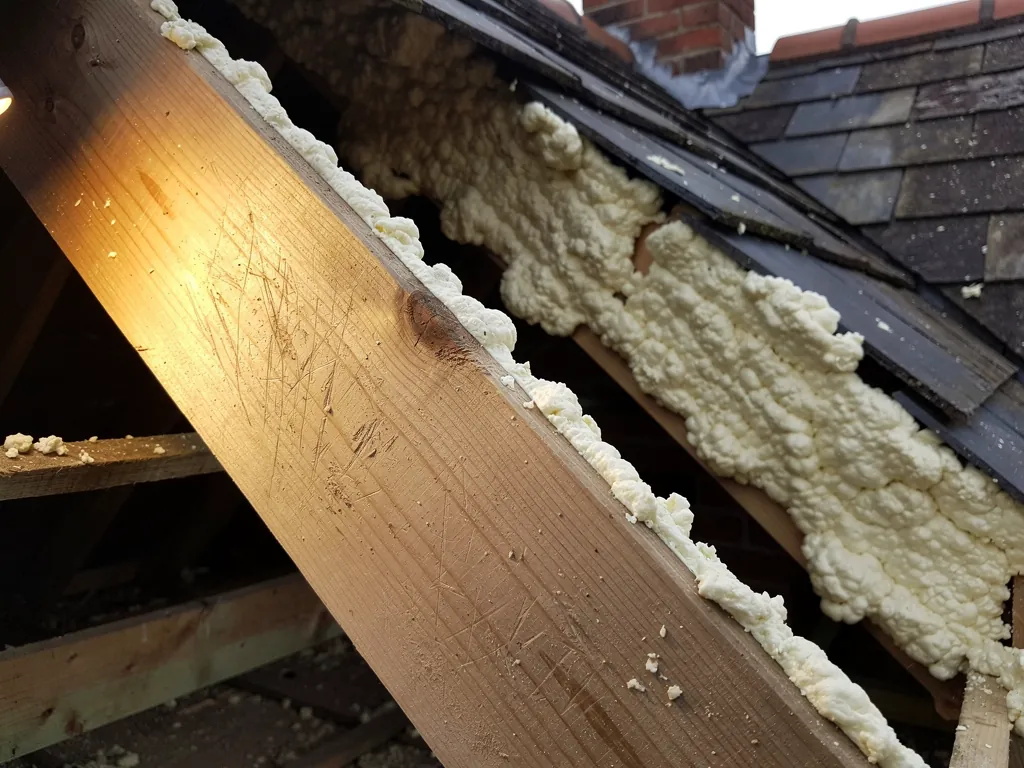
Spray foam was sold to many homeowners as a quick way to cut heating bills. It goes onto the underside of the roof, sets, and the loft is insulated. Years later, some of the same owners ask a roofer to take it out. The reasons usually have less to do with warmth than with what the foam does to everything around it.
This guide sets out those reasons one at a time, drawing on the RICS consumer guide to spray foam from March 2023 and the other published sources we rely on. It covers the change to how the roof breathes, the rafters nobody can see, the moisture that may have nowhere to go, the questions a surveyor or lender will raise, and the way foam can complicate an ordinary roof repair.
It also says where removal is not the answer. Plenty of foamed lofts are never touched, and nothing here says foam must always come out. If you are unsure which group you are in, a survey of the roof space is where the decision starts, and the aim is the smallest job that fully deals with what the survey finds. Our spray foam insulation removal page explains the work itself.
A roof built to breathe, turned into one that does not
Most houses and bungalows have a ventilated roof space. The insulation lies on the loft floor above the ceilings, the loft stays cold, and air moving through it carries off the moisture that drifts up from the rooms below. RICS calls this a cold roof. Foam sprayed on the underside of the roof turns it into what the same guide calls a warm roof: the roof space is sealed, the draughts stop and the air no longer circulates as the roof was designed to allow.
RICS describes that as a fundamental change from how the roof was originally designed to perform, and warns that it may lead to unexpected problems when the original design requirements are not met. That sentence explains most removal requests. The foam is rarely the whole story. It is the foam combined with a roof that was built to work another way.
Where the change bites hardest
Bungalows make the point. Their roof spaces are large, and once the foam is on the slopes the whole volume has to be warmed before heat is held in the rooms below. RICS notes that this may not be cost effective where the roof space is big, and that moving insulation from ceiling level to rafter level can even raise the energy a home uses.
The guide also compares the two approaches on cost. It says foam insulates better than wool of equal depth, but that existing loft wool can be topped up to the current Building Regulations standard and then outperforms the typical maximum of 100mm of foam fitted between the rafters. Topping up is likely to be substantially cheaper, though it takes up more loft space. Owners who read that after the foam is already in sometimes feel they were steered towards the more complicated option.
Timbers that nobody can inspect
The rafters, purlins and battens that hold a roof up are the part you cannot afford to lose. In an ordinary loft you can put a torch on them and see staining, daylight, a soft patch or a rusty nail. Foam sprayed straight onto the timbers hides all of that. RICS says plainly that if the timber roof structure is covered with spray foam it cannot be fully seen or inspected.
The guide goes further. It illustrates timber that looks dry on its exposed face while it is wet behind the foam, and it warns that water coming in behind certain foams may never be noticed. An undetected roof leak can lead to rotting timber, and the owner may not see a problem developing until it is too late.
Why this worries buyers more than owners
Living under a foamed roof for a few years, a homeowner may notice nothing. A surveyor acting for a buyer has a different job. They are asked to report on the condition of the roof structure, and they cannot do that for timber they cannot see. RICS says that if a surveyor meets spray foam during an inspection, they may request an independent specialist report. That extra step costs the seller time and sometimes a sale.
For some owners the only way to answer the question is to take the foam off the section of roof in doubt, look at the timber, and decide from there. We cover what that kind of inspection involves in our guide to spray foam surveys, and what the foam can do to the wood itself in does spray foam damage roof timbers.
Moisture with nowhere to go
Every household puts water vapour into the air: cooking, washing, breathing, drying clothes. In a cold roof that vapour finds its way out through a ventilated loft. Foam seals the gaps that let it escape. RICS puts it this way: foam creates a warm roof void, seals the gaps to prevent draughts and retain heat, but will also seal in moisture unless adequate precautions are taken.
The precautions it lists are a roof free of defects and damp to start with, a plan for how ventilation to the roof structure is controlled as the manufacturer requires, a decision on whether the old loft insulation has to go to keep condensation in check, and in some cases extra materials such as vapour control layers. Incorrectly installed insulation, the guide says, can lead to dampness such as uncontrolled condensation and damage to parts of the property.
The underlay question
The guide adds that certain foams should not go against old felt or plastic underlays, since those sheets stop vapour passing, and that others need an air channel left behind them. Foam that was sprayed on without that thought is one of the situations that leads to a removal enquiry.
Signs people notice include damp-smelling lofts, dark patches on ceilings under the roof and mould on timber that can be reached. None of those proves the foam is at fault, since a leak or a blocked vent can look the same, which is why the roof is checked before anyone decides. Our guide to spray foam, condensation and roof ventilation goes into the mechanism in more detail.
Surveys, valuations and lenders
This is the reason that moves most owners from worry to action. RICS says foam in the roof can influence how a surveyor values the home. It adds that badly fitted foam, or foam sprayed into a listed house before consent, will be reflected in the figure, and that the surveyor works to whatever policy the lender has set.
On the lending side, a report in Today's Conveyancer from November 2024 found that a number of lenders would refuse a loan where foam is present, with the rest deciding property by property. That is a snapshot from one date, not a rule you can rely on for your own purchase or remortgage, and each lender's position can change. Before any foam goes in, the RICS guide wants the owner to put the question to the mortgage provider.
Paperwork matters as much as foam
RICS recommends keeping the installation contract, the calculations, a record of works to the roof, any guarantee and any independent test certificate such as a BBA or Kiwa certificate. If you are buying a house that already has foam, it says to make sure that documentation is available, because it settles questions that a valuer, a bank or a buyer's solicitor may put.
Owners who cannot produce those papers, or who find the foam was fitted with no ventilation plan, often decide that taking it out is simpler than arguing the point at every sale. We deal with the buying and selling side in selling a house with spray foam insulation, and the lender side in our guide to spray foam and mortgages.
Repairs get harder under foam
A roof is a surface that needs looking after. Tiles slip in a gale, a flashing lifts, a ridge loosens. Normally a roofer finds the entry point from inside by following the stain, then repairs from outside. With foam stuck hard against the underlay and the tiles, the usual signs are hidden. RICS observes that sealing hot air inside can also seal water inside and make roof repairs more difficult, and that foam can, in certain circumstances, make repair more difficult after storms.
Practical problems follow. A slate or tile that has been foamed in place cannot simply be lifted and replaced. Battens stuck to foam are slow to cut free. Water that gets in sits against the foam rather than running to the eaves, and it can spread further before it shows.
Foam used to hold a failing roof together
RICS treats one case separately: roofs where a foam was applied to glue the tiles together. The guide says this is often done when an old roof needs replacing and the owner used foam as a cheaper way to put that off, with thermal performance not the main aim. It describes these as roofs often already past economic repair, where the next action would be replacement.
If that sounds like your roof, the question is usually not whether to remove the foam but what to put in its place. Our guide on foam sold as a cure for leaks covers the pitch that leads to this, and the Energy Saving Trust, in advice updated in May 2026, advises against foaming a roof that still leaks, and says an open-cell foam brings a much lower risk.
Fire, insurance, consent and when to leave it alone
Three smaller points sit behind the main reasons. First, fire. RICS notes that polyurethane foam is combustible and typically rates Class E under the fire classification standard, which it describes as a rating that will only resist a small flame for a few seconds. It says that if a fire started, the foam would make the damage worse and spread it further, including next door, and it advises owners to check with their insurer whether the policy allows foam to be installed.
Second, consent. The guide says a listed or protected building must have consent in hand before foam is sprayed, and because taking it out could harm the structure, foam is not seen as reversible and is unlikely to be consented in a listed house. Third, cold calls. RICS records that Trading Standards and media reports report trouble with doorstep and phone offers to sell or take out foam, and its advice is not to accept them.
Not every foamed loft needs work
Where foam has been fitted by a competent installer to a sound roof, with the ventilation, vapour control and paperwork in order, there may be no reason to touch it. The guide's own advice is to look after the roof, inspect it regularly and keep it watertight. A lender or buyer may still ask questions, and the documents are what answer them.
When we are asked to look, we photograph the roof space and the outside, say whether the foam should stay, be partly removed or come off entirely, and give one written total price after the survey. Our spray foam removal cost guide covers what moves that figure.
Questions
Spray foam removal queries
Is spray foam in the loft dangerous in itself?
RICS does not call it dangerous. It lists specific risks: hidden timbers, trapped moisture where installation was poor, and a combustible material that rates Class E. Whether those apply depends on how the foam was fitted and what the roof is like underneath, which is why a survey comes before any decision to remove it.
Can I just top up the old loft insulation instead of removing foam?
Only where the foam is not the problem. RICS says adding more wool at ceiling level is likely to cost far less than foam, but if foam is already on the rafters, the two layers together can cause moisture trouble, and calculations by a qualified professional should decide whether any old wool must come out.
Who should I ask first if my buyer's surveyor flags foam?
Start with the surveyor's wording and your paperwork. RICS suggests an independent specialist with no stake in selling or making the product. Once you know what they want to see, a roofer can open up and photograph the timbers so the report has evidence to work from.