
Black streaks on tiles · 9 min read
Black streaks and green algae on roof tiles
Dark streaks running down your tiles are algae, a living film and not dirt. Here is why they appear, whether they matter, and the gentle ways of clearing them.
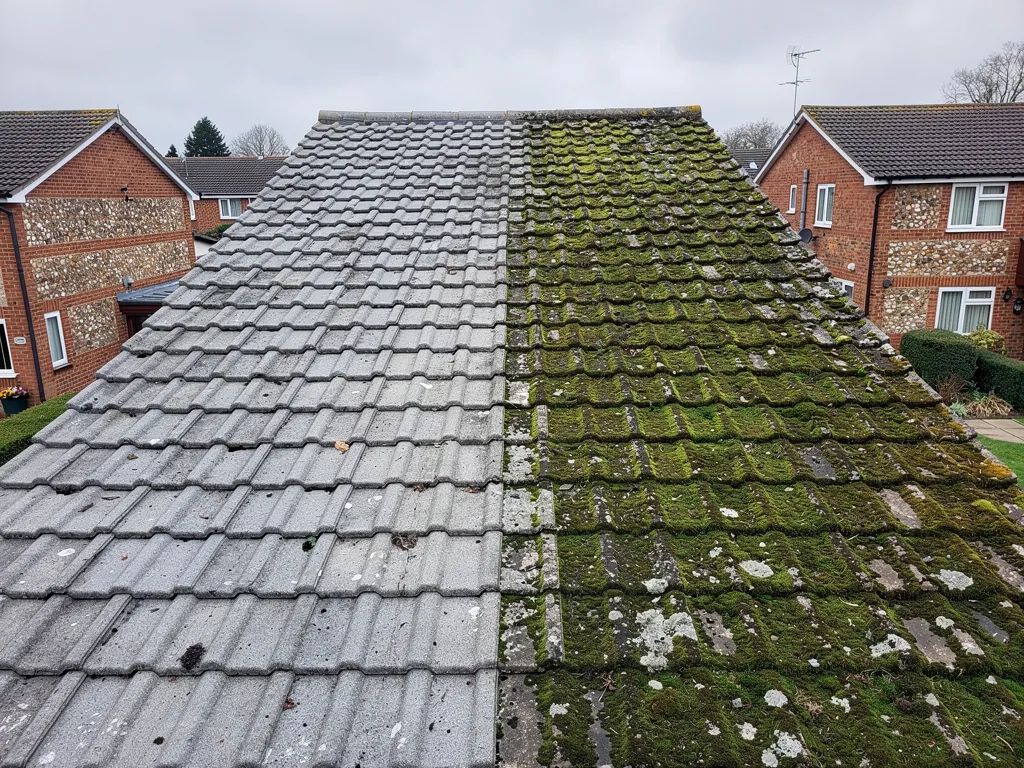
Stand across the road from a row of houses and you can usually pick out the roofs that have gone dark. The tiles are streaked from ridge to eaves in black, grey or dull green, as if something had been poured down them. Concrete tile roofs show it most, but clay and slate get it too.
The staining is algae. These are tiny organisms that settle on a damp surface and form a film, and the dark colour is partly the pigment they make to protect themselves from sunlight. They are not soot and they are not a coating failure, though plenty of owners assume one or the other. The streaks follow the line of the rainwater, which is why they run in stripes down the slope.
On its own, a dark film is mostly a matter of appearance. It can still tell you something about a roof, though, and it can be the first stage of a heavier growth. This guide explains what causes the streaking, where it tends to appear, when it deserves attention and what treatment suits it. It also covers what to expect afterwards, because algae are good at coming back if the conditions stay the same.
What the dark streaks actually are
The black streaks are a film of algae, often with a bit of fungus mixed in. Algae are among the simplest living things, and they need only light, moisture and something to cling to. A roof tile gives them all three.
You will see the film in several shades. Fresh growth can be green, especially in spring and after wet weather, and as it matures and dries it darkens to a grey-black. That is why the same roof can look green in March and streaky black by late summer. The colour is a stage, not a different problem.
The pattern is the giveaway, and we read it from the ground before anything else. Algae spread where water runs and where the surface stays damp, so you get vertical stripes beneath ridges, chimneys and any point that concentrates rainwater, and wider patches at the lower edge of the slope. Dirt from traffic or smoke would settle in a more even wash.
If you have a low outbuilding or porch roof with the same staining, a damp cloth over a streak will smear it without fully lifting it. That is the film, anchored to the surface, and it explains why a quick wipe or a hose seldom does the job. Never climb onto a roof to test it.
It is worth separating algae from the two other growths. Moss stands up from the tile in cushions, and lichen forms a flat, tough crust. Algae sit in the surface, not on it. Our pages on green algae on a roof and lichen on a roof deal with the neighbours.
Why some roofs stain and others stay clean
Two roofs side by side can look completely different, and the reason is usually moisture and time. Algae need the surface to stay wet or damp for long stretches. Anything that slows drying favours them.
Shade is the biggest factor. A slope that faces away from the sun, or sits under trees, dries slowly, and you will often find the streaking is worst there. Shelter from a neighbouring wall or a tall hedge has the same effect. A roof that gets sun all day dries quickly and shows less.
The covering matters. Concrete tiles are porous and hold moisture in their surface, so they stain readily. Clay is denser. Natural slate is less welcoming still, though even slate gets a film in the right conditions. Older tiles with a weathered face give algae more to hold on to than new ones with a smooth finish.
Pitch and flow
A shallow pitch lets water linger and so does a surface broken by debris, so low-angle extension roofs and porch roofs often streak before the main slopes do. Where a valley collects leaves or a gutter overflows onto the lower slope, the staining often starts there. The edge of the roof where runoff concentrates is another early site.
Air quality and nutrients play a part, since the film feeds on what rain and wind deliver. We would not claim that coastal air makes it better or worse, because staining turns up on roofs everywhere, and our experience is simply that sheltered, shaded slopes show it first.
None of this means the roof has been badly built. It means it has been left to its own devices for a few seasons, in a spot that stays damp.
Is algae staining harmful or just unsightly?
This is the question most owners really want answered, and the fair reply is that it depends on how thick the growth is and what lies beneath.
A light film does little structural damage. The tile still sheds water, the laps still seal and the roof still does its job. In that case the streaks are a cosmetic problem, and if you are not bothered by the look, you can wait.
There are three reasons not to wait indefinitely.
First, algae keep a surface damp. A tile that stays wet takes in more water, and on a porous concrete tile the wet-and-dry cycle slowly wears at the face. How fast varies from roof to roof, but it is a recognised reason why roofers suggest keeping surfaces clear.
Second, a film makes a good bed for moss. Moss spores land on the damp, textured surface algae leave behind, and once they take, the growth is thicker and holds more water. Our guide on whether moss is bad for a roof covers that stage.
Third, the streaks hide the roof. A dark, uneven surface makes it harder to spot a cracked tile or a slipped one from the ground. A clean roof shows its faults.
There is also the question of the property. Streaked roofs make a house look neglected from the street, and that matters if you are selling. Our page on cleaning a roof before selling weighs it up.
How algae are removed from tiles
Because algae live in the surface of the tile, a wash with water alone rarely clears them. A hose will rinse off loose dirt and leave the stain. Effective treatment does two things: it kills the organism, and it lifts the dead film from the surface.
The common approach is a soft wash. A biocide, the chemical wash that kills living growth, is applied at low pressure to the roof following the product instructions, then left to work. Rinsing follows, using plenty of water at gentle force. Our page on roof soft washing explains the method in detail.
It is a clear alternative to high-pressure washing, which can strip the face from concrete tiles, drive water under the laps and damage the mortar or fixings at the ridge. Our page on pressure washing roof tiles covers why we steer away from it.
Sprayed and left to work
Some treatments are applied and left to do their work gradually, and the rain washes the dead film away over the following weeks. These are slower, with less to do on the day, and suit roofs where a full wash is awkward. The roof looks patchy for a while as the dark film fades unevenly, which can worry owners unless they have been told to expect it.
Before any spraying, the area below needs protecting. Runoff can reach plants, ponds and drains, so we cover and plan for it, and we check the gutters afterwards.
If the clean exposes a cracked or slipped tile, you will be told before anything else is done. The repair is separate from the clean, and it is priced in the written quote.
What to expect afterwards, and whether it comes back
On the day of a soft wash, the roof will look wet and the colour may seem unchanged. The real result appears over a few weeks as the treated film dies, loosens and is carried away by rain. Owners are sometimes surprised by this, since they expect a clean roof by teatime.
Some staining can stay in the surface of a porous tile. If the algae have been there for years, a faint shadow may remain after treatment, and a roof will rarely look factory-new. That is normal. The aim is to stop the growth and let the roof recover, not to restore the first-day look.
Will it return, and how fast? Algae spread on the air and the wind, and the factors that favoured them in the first place, shade, damp and a porous surface, are still there. So the honest answer is that it can, but slowly, and a treated roof usually stays clearer for a good while. Our page on whether moss will come back sets out the same logic for the thicker growth.
A few simple habits slow the return, and none of them needs a ladder:
- Cut back overhanging branches so the slope dries faster.
- Keep gutters flowing so runoff does not spill onto the tiles.
- Check the roof from the pavement each season.
- Arrange another treatment when the darkening starts to show again.
For a rough idea of how often roofs need attention, see our page on how often to clean a roof.
Coatings, myths and what to ask a roofer
Where there is a problem there is also a list of products promising to fix it, and a few myths to clear away.
The first myth is that streaks mean the roof is failing. They do not. A streaked roof can be perfectly sound, and a clean-looking roof can have a cracked tile. The film and the structure are separate questions, which is why we look at both on the survey and photograph anything that needs attention, whether or not it has anything to do with the staining.
The second is that a sealant or coating makes the problem go away for good. A coating can help a surface resist regrowth, and we cover the idea on our page about roof tile coating, but it goes onto a clean, sound tile and it does not rescue a worn one. It should never be applied over a living growth.
The third is that bleach from a supermarket is a quick, cheap answer. We would not use household products on a roof. Runoff reaches plants and drains, and a poorly judged mix can mark the tiles. A professional will use a proper roof treatment, and should be able to tell you which one and how it is applied. If a roofer cannot answer that, it is a reason to look elsewhere.
Questions worth asking
Before you agree to a clean, ask what product will be used and how it is applied, whether high pressure is involved, how the gutters and plants are protected and what happens if the clean reveals a damaged tile. Ask whether the written price covers the gutters, any scaffold and VAT.
After the survey you get one total price on paper, with photographs of your own roof beside it, so nothing is a surprise. Our roof cleaning and moss removal page describes the work end to end.
Questions
Black streaks and algae: common questions
Are black streaks on my roof tiles dirt, soot or algae?
They are almost always algae, a living film that grows where tiles stay damp. Soot and traffic dirt settle in a more even layer, while algae follow the path of the rainwater and form stripes down the slope. The colour is green when the growth is fresh and darkens to grey-black as it matures.
Why is only the north side of my roof streaked?
A slope facing away from the sun dries slowly, and algae thrive where a surface stays damp. Shade from trees or a neighbouring building has the same effect. The sunnier slopes dry out faster and show far less. It is a drying problem more than a fault in the tiles.
Can I just hose the streaks off with water?
A hose rinses loose dirt but does not kill the film, so the stain usually stays. High pressure is worse, since it can strip the face of concrete tiles and push water under the laps. Treatment needs a suitable biocide applied gently, and working from the ground is far safer than climbing onto the roof.