
Lichen on roofs · 9 min read
Lichen on roof tiles: harmless patina or a problem?
Those pale grey, yellow and orange crusts on your tiles are lichen, not moss. Here is how to tell them apart, when you can leave them alone and when they need dealing with.
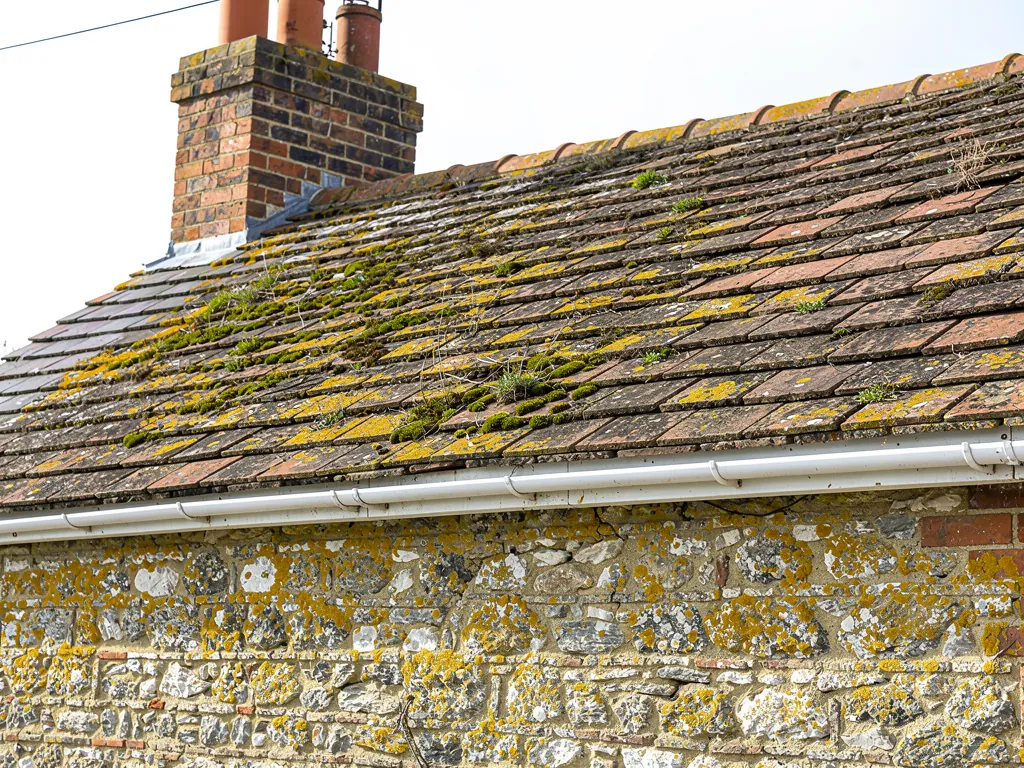
Look up at an older roof on a bright morning and you will often see flat, crusty rosettes spread across the tiles: grey-green, mustard yellow, sometimes a burnt orange. Some owners hate them. Others think they give a roof character and would rather the tiler left well alone. Both views have something in them, and neither is the whole story.
Lichen is a different thing from moss. It is not a plant at all but a partnership between a fungus and an alga, living as one organism, and it sits tight against the surface instead of standing up in a cushion. That matters because it changes what harm it can do and how it should be removed. A treatment that suits a thick mat of moss can be too rough for a lichen crust, and the reverse is true as well.
This guide covers what lichen is, why it settles on some roofs and not others, the point at which a harmless patina turns into a reason to act, and the gentle ways of clearing it. Whatever your roof is carrying, the useful thing is a close look at the tiles themselves, with photographs, before anyone reaches for a hose.
What lichen is and how it differs from moss
Lichen is a fungus and an alga living together. The fungus gives it structure and grip, and the alga makes food from daylight. The result is a slow, tough growth that needs very little: light, some moisture from the air and a surface that stays put.
On a roof you will mostly meet the crusty kind. It looks like a stain or a splash of paint at first, and only a closer look shows it has a raised, slightly textured edge. Some patches are circular and spread outwards in rings. Others are leafy and lift a little at the margins. Colour depends on the species, which is why one roof can carry grey, yellow and orange at the same time.
Moss behaves differently. It is a true plant, grows upright in soft green or brown cushions, and holds a great deal of water. You can usually pull it away by hand, and it tends to collect at the bottom of a slope, in valleys and wherever debris builds up. If you want the full picture on that one, our guide on how to remove moss from a roof goes through it.
Telling lichen from algae
Algae show as a dark film, often black or green, running down a slope in streaks and not forming a crust. Lichen has substance. Run a gloved finger across it and it resists, where algae wipe off as a film. Our separate page on black streaks on roof tiles covers the algae side.
The three often share a roof. A south-facing slope may carry lichen while the shaded north slope grows moss and a dark film, so the first job on any survey is to work out which growth is where.
Why lichen settles on some roofs and not others
Lichen is patient. It needs a surface that stays undisturbed for a long time, so it likes tiles that are not walked on, rarely scrubbed and not regularly washed by a run of water. A roof that has gone years without a clean is simply a better place to settle than one that has been brushed down.
The texture of the covering helps. A rough, porous surface gives the fungal threads something to grip, which is why concrete tiles, older clay tiles and natural stone slates all hold it well. Smooth glazed tiles are harder going. Where a tile surface has already weathered, with its original facing worn off, the pits and hollows act like a seedbed.
Light and moisture matter too. Lichen needs daylight, so it often does best on open, sunny slopes where moss struggles. It takes water from damp air as well as from rain, and a coastal place such as Bognor, with sea mist and plenty of open sky, gives it both. We would not put it more strongly than that, since lichen turns up inland too.
Age counts for a lot. Lichen grows slowly, and a large, well-established patch usually means the surface beneath has been undisturbed for a good while. A new patch is not a cause for alarm. A roof thickly covered edge to edge is telling you nothing has been done for a long time, and that is worth knowing when you decide what to do.
When lichen does little harm
Many roofers will tell you a scattering of lichen on a sound roof is largely cosmetic, and we agree. If the tiles are whole, the laps are tight, the ridge is held on and the gutters run clear, a few crusty patches are not going to bring the roof down. Plenty of old stone-slate and clay roofs carry lichen for years and are still shedding water properly.
On those roofs the growth can even be part of the look. Weathered clay and slate with soft colour on it suits a period house, and owners of older properties often prefer it to a scrubbed surface that looks too new against old brick. In a conservation area the character of an old roof can matter, and that is a reason to be careful about how much is taken off. Our page on cleaning historic roofs goes into the judgement involved.
So the question to ask is not whether lichen is present. It is whether it is doing anything. Three signs say it is not:
- The patches are small and separate, with bare tile between them.
- Water still runs off the surface and does not sit in the crust.
- Nothing is lifting, flaking or breaking under the growth.
If all three hold, leaving it alone is a reasonable decision, and a good roofer will say so. A clean you do not need is not one we will book. Keep an eye on it from the ground each season, and look again if the cover starts to spread into the valleys or across the ridge.
When lichen becomes a problem
The trouble starts when the crust stops being a thin film and becomes a layer. A thick lichen cover holds water against the tile after the rain has gone. A tile that stays damp is a tile that takes in more moisture, and on a porous covering that means more of the wet-and-dry cycle that wears the face away over the seasons.
Lichen also hides things. A thick mat across a slope can cover a cracked tile, a slipped one or a failing nail, and you will not see the fault until water arrives indoors. A survey on a heavily covered roof is partly a search for what the growth is covering, which is why we photograph the problem areas before and after any treatment.
Edges, valleys and laps
Growth in the wrong place does more than growth in the right one. A valley is the trough formed where two roof slopes join, and it carries both slopes' rainwater. Thick growth there can slow the flow and push water sideways. The same goes for the laps, where one tile overlaps the next, and for the edge of the roof where water runs into the gutter.
Lichen at the ridge, the line of capping along the top, is worth checking too, because that is where we look for loose or missing fixings. A roof with a stubborn crust on its upper course is a roof where nobody has been up close for some time.
Where a roof is carrying heavy growth and showing stained ceilings, loose tiles or damp patches in the loft, the lichen is a clue and not the cause. Treat the faults first, then deal with the surface. Our guide to whether moss is bad for a roof lays out the same reasoning for the softer growth.
How lichen is removed without damaging the tile
Because lichen grips, the usual instinct is to blast it off. That is the method most likely to hurt the roof. A high-pressure jet can strip the surface layer of a concrete tile, push water up under the laps and wash out the pointing at the ridge. We do not recommend it for lichen, and our page on pressure washing roof tiles explains the risks in more detail.
The gentler route is a biocide, a chemical wash that kills the living growth, applied to the manufacturer's instructions. It is sprayed on at low pressure and left to work. The lichen then dies back and weathers off over the following weeks, with rain doing most of the work. Stubborn patches can be softly brushed once they have loosened. The method is slower than a jet and kinder to the tile.
Soft washing is the name for low-pressure application, followed by rinsing with plenty of water and very little force. We cover it on our roof soft washing page. It suits lichen well because it treats the whole surface evenly and leaves the facing intact.
What to expect afterwards
Do not expect a spotless roof on the day. Dead lichen can remain visible as pale ghost marks for a while, and some stain may stay in the surface of porous tile. The goal is to halt regrowth and give the rain time to finish the job, not to make the roof look new.
Anything sprayed onto a roof runs down to the gutters and the ground, so planting, ponds and drains below need protecting. That is part of the job, and we cover it when we plan the visit.
Deciding whether to leave it, treat it or clean it
There are three honest answers for a roof carrying lichen, and which one applies depends on what the survey finds.
Leave it. The roof is sound, the growth is light and you like the look. Check from the ground each year and revisit if things change.
Treat it. The cover is spreading, it sits on low-pitch or shaded sections, or it is thick enough to hold water. A biocide stops the growth and the roof weathers clean without any scrubbing. This is often the right call for a roof that is otherwise in good order.
Clean it and repair what it hid. The growth is heavy, there are signs of damp or slipped tiles, or the gutters are full of debris. Here the clean is the first step of a repair visit, and the repairs are priced after we have seen what is underneath.
Whichever you choose, you get a single total on paper once we have surveyed the roof, alongside pictures of your own tiles.
Some situations call for a check before any cleaning starts. A listed building needs its owner to speak to the council first, and in a conservation area it is sensible to ask the planning team at your council what it expects. Roofs made of asbestos cement sheets should be left to a specialist, because careless cleaning can break the material up.
For a general view on whether a clean is worth it at all, see our page on whether roof cleaning is worth it. For how the whole service works, the roof cleaning and moss removal page is the place to start.
Questions
Lichen on tiles: quick questions
Is lichen on a roof a sign the tiles are about to fail?
Not by itself. Lichen shows that a surface has been left alone for a long time, and it grows on perfectly sound tiles. It becomes a worry when it is thick enough to hold water, when it sits in valleys and at the edges, or when tiles beneath it are cracked or loose. A survey with photographs tells you which of these applies.
Will lichen come back after treatment?
It can, since the spores are carried on the air and the surface stays damp and undisturbed in the same places. Regrowth is slow, though, and a treated roof that is checked now and then tends to look cleaner for longer. Cleaning off the dead crust and clearing the gutters helps the roof dry faster, which slows the return.
Can I scrape lichen off my tiles myself?
We would advise against it. Lichen grips the surface and scraping can take part of the tile face with it, and working on a roof is risky without proper access. A hose from the ground will not shift it either. If you want it cleared, ask a roofer for a survey and a written price, and stay off the roof.