
Slate in storms · 9 min read
Slate roofs in storms and winter weather
A slate roof is heavy and tightly lapped, which helps in a gale, yet storms still find the weak points. Here is what they usually take, what to do first and what comes after.
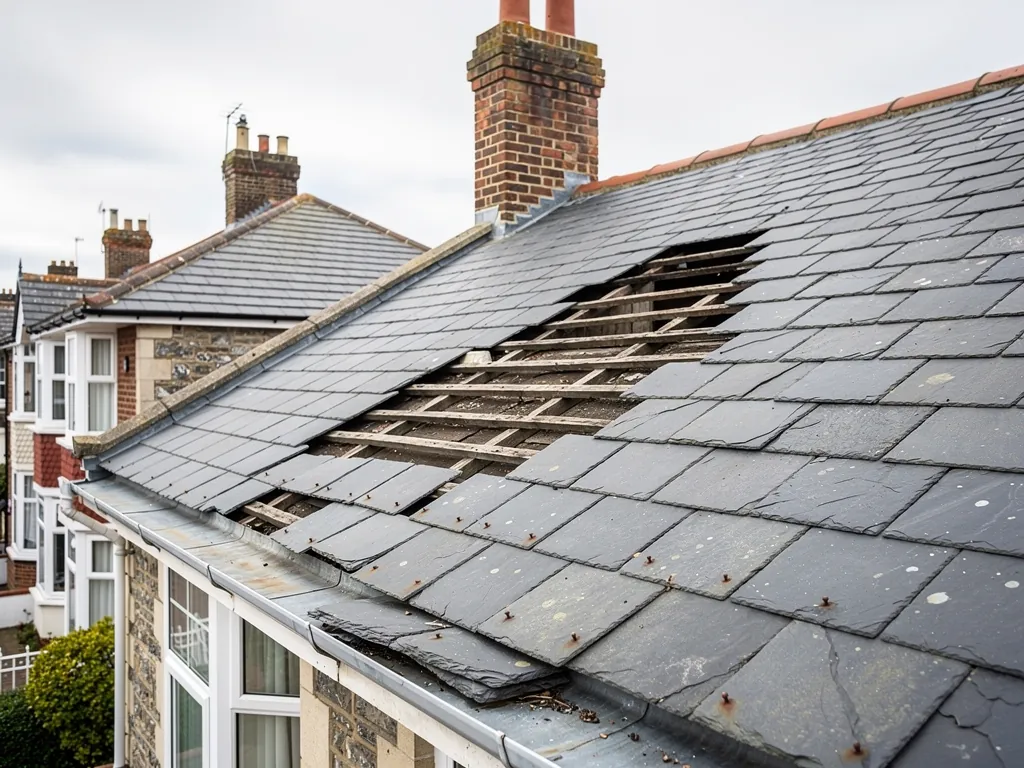
After a night of gales, the first look at a slate roof is usually from the garden. A gap in a course, a slate on the lawn, a length of lead hanging off a chimney. Sometimes there is nothing to see at all, and a brown ring spreading across a ceiling a few days later is the only clue.
Slate is a good covering for rough weather. It is heavy, it overlaps deeply and it does not absorb water. What it depends on is everything holding it: the fixings, the battens, the lead and the ridge. Storms and long wet spells go for those parts, and an old roof with ageing nails has more to lose than a recent one.
This guide is for the morning after. It covers what storms do to a slate roof on this stretch of coast, the order in which to tackle a problem, how to keep an insurer informed without promising anything, what repairs may cost and how to ready the roof for the next gale. Where a roof is leaking, making it safe comes ahead of everything else. The figures here are typical national ranges. After the survey, a written quote follows with one total.
What gales do to a slate roof
A gale does not usually strip a sound slate roof in one go. It finds the weakest fixing and works at it. Wind blowing over a roof creates suction on the lee side and on the ridge, and wind blowing against it pushes air under the edge slates. Marley's wind guidance explains that on pitches below 30 degrees the windward side may be exposed to heavy suction. Low roofs, which include many bungalows and extensions around Bognor, are the ones to watch.
The damage tends to show in a handful of places. Slates slip or break where the nails are tired. Edge slates at the verge, the sloping end of a gable, lift because the mortar that holds them has cracked. Ridge capping shifts. Lead flashings, the metal strips sealing the roof against walls and chimneys, peel back at their edges. Valleys fill with debris, and an overflowing valley sends water behind the slates.
Damage you cannot see from the garden
Some of the worst damage is hidden. A slate can crack across its width and stay in place, with the crack only visible from the loft or from a closer view. A slate can also ride up a little on its nails. Both let rain in slowly, so a stain on a ceiling after a storm may mark a leak that began long before the wind arrived.
Our guide to the signs a slate roof is failing lists what to look for, indoors and out, and tells you which signs can wait and which cannot.
The first hour: safety and a temporary cover
Safety comes ahead of repair. A slate hanging loose can hurt anyone below it, and a roof battered overnight is no place for an amateur inspection. Keep off the roof and off ladders in the wind, and keep family and passers-by clear of the edge where slates may still fall.
IStructE advice of 28 January 2025 sends owners of unsafe structures to the building control team at their local authority. For a cracked chimney or a roof section that looks unsound, that is the route: report it and keep well clear.
Stopping water coming in
Inside, the first job is to contain the water. Move furniture, put a bucket under the drip and, if it is safe, open the loft hatch and check for sagging ceiling plasterboard that may be holding water. A small pinhole in a bulging ceiling can be released into a bucket, which stops the plaster giving way, though this should be done from a safe position.
Outside, the temporary repair is a job for a roofer. A temporary covering, such as a tarpaulin fixed over the damaged area or a few slates replaced, buys time. It is not a long-term repair. Tarpaulins flap and tear in the wind if they are not fixed to the structure properly, which is one reason to leave the fixing to someone who works at height daily.
Making the roof safe is our first step, and our verdict on the roof, whether it can be mended, patched for now or needs replacing, comes once it is dry. Our guide to a storm-damaged roof covers the emergency side in more detail.
Telling your insurer, and what a policy covers
Consumer and engineering advice agree on the sequence. Which? (20 November 2025) and IStructE both stress an early call to the insurer, receipts for any emergency work and photographs of what happened. Which? also warns against binning damaged belongings that are not a hazard.
In practice that means safety, then the insurer, then pictures, then a temporary repair with the paperwork saved. What a policy will pay is between you and the insurer, and no roofer can say.
Sudden damage and ordinary ageing
Cover is aimed at sudden events, not neglect. Among its examples of ageing rather than storm damage, Which? lists rain getting in through a roof that was never looked after, and passes on regulator figures showing that 32% of storm claims made in 2024 ended in a payout. A slate roof whose nails had rusted may be judged differently from one that lost slates in a gale.
Evidence of condition therefore counts. A dated survey with photographs shows what the roof looked like before the weather arrived. If a decision seems wrong, the route is a complaint to the insurer and then the Financial Ombudsman Service, which is free to use.
Our guide to the storm damage insurance claim covers the practical steps in more detail, and the plain-English version is to keep every receipt and every photograph in one folder. Date the photographs if you can, and take wide shots as well as close ones, so the damage is clear in context. If a chimney stack, a run of lead or a ridge is involved, photograph that too, because those parts are often the costliest to put right.
Repairs after the storm and what they cost
Once the roof is dry, the repair depends on the damage. A few lost slates are replaced and the area around them checked. A lifted run of ridge is re-fixed. Lead is dressed back and, if it has torn, renewed. A scatter of damage across a slope with old nails may point to a relay, the strip-and-relay of the sound slates on new fixings, a verdict that comes after a close look.
National cost guides give a feel for the numbers. Checkatrade's repair table, last updated in June 2026, puts natural slate repairs at £150 to £220 per square metre, excluding VAT. Ridge capping and lead flashing repairs each appear in that guide at £50 to £70 per metre. Slate roofers are listed at £280 to £360 a day, and tend to work in pairs. VAT at 20 per cent goes on top where figures exclude it.
Access after a storm
A tall roof can mean scaffolding. Poles over the highway fall under section 169 of the Highways Act 1980, which takes notice to obtain. In West Sussex the county council asks for 10 working days' notice and £266 for a month. Hampshire County Council works to ten clear working days and £211.90 for the first fortnight. With that wait, an urgent job is made safe with a temporary cover first, and permanent work follows once access is in place.
Ask any roofer whether a price includes scaffolding and VAT. None of the national figures prices your roof. The written quote, with one total, comes after the survey.
Slate in a long wet winter
Not every winter problem comes from a storm. Long wet spells and cold snaps test a roof in a slower way. Slate does not soak up water the way some coverings do, so the weakness is at the junctions: the lead at walls and chimneys, the valleys and the gutters, and anywhere the underlay or batten has aged.
Gutters matter more than they look. A gutter blocked with leaves or moss overflows down the wall, and if the roof edge sits too low in it, water can back up under the bottom course of slates. A look at the gutters before winter, and again after a gale, is cheap protection.
Condensation or a leak?
A damp patch in winter is not always a leak. Warm, moist air in a loft meets cold surfaces and condenses, and the drips look like a roof fault. The pattern usually differs: condensation shows up in cold weather and in rooms with little ventilation, while a leak follows the rain. A roofer looking from the loft can tell which, and on a slate roof with no modern underlay the question is more common.
Foam sprayed under a roof deck can conceal leaks, and the RICS consumer guide warns that a leak behind some foam may go unnoticed. If your loft has foam, the roof needs closer attention after storms, not less.
Moss and lichen on slate are mostly cosmetic, but a thick mat can hold water against the slates and clog valleys, and is worth clearing carefully. Our guide to slate roof repair covers the small jobs that keep a roof dry through winter.
Getting the roof ready for the next gale
The best time to deal with a slate roof is before the storm. A short inspection in autumn, from the ground with binoculars or by a roofer on the roof, catches the faults that gales exploit. Slipped slates, loose ridge, curling lead and blocked valleys are all cheaper to fix when they are small.
Walking on slate cracks it, so leave the inspection to someone who knows how to move on a roof, using a roof ladder and working from the edges. A survey with photographs leaves you a dated record, handy if you ever have to show an insurer how the roof stood before a storm.
A checklist for autumn
- Look for slipped, cracked or missing slates from the ground.
- Check ridge capping and verge mortar for gaps.
- Look at lead flashings around chimneys and walls for lifting.
- Clear gutters, hopper heads and valleys of leaves and moss.
- Check the loft for daylight, damp patches or dripping.
If the roof has already lost slates in earlier storms, the fixings may be the underlying problem, and a small repair each time costs more in the long run than treating the cause. A survey will show whether the nails are sound or ageing. Our guide to nails or hooks explains how new fixings are chosen on a repair or relay, and the slate roofing page covers the wider service.
Roosting bats and nesting birds have their own legal protection. If you meet either in the loft or at the eaves, leave them alone and mention it when you ring a roofer.
Questions
Storm and winter queries
Should I go up and look at storm damage on my slate roof?
No. Look from the ground with binoculars, keep clear of the edge where slates may still fall, and photograph what you see. Slate is brittle and slippery when wet, and walking on it breaks more slates. A roofer can check it safely with a roof ladder.
Will my insurer pay for a storm-damaged slate roof?
Whether it pays turns on the policy wording and the cause, and no roofer can promise an outcome. Ring the insurer before arranging anything, keep the roof safe, take photographs and save receipts. Which? points out that gradual ageing is not handled like a sudden storm.
Can slipped slates wait until spring?
Rarely. A gap in a course lets rain onto the underlay and battens, and soaked timber can cost more to put right than the slate. A temporary repair can hold things until the permanent job, but the sooner a roofer sees it, the lighter the fix tends to be.