
Houses and their roofs · 9 min read
Bognor Regis houses and their roofs: Regency terraces to post-war bungalows
Bognor was laid out as a resort, then grew by estate and by bungalow. Each era left its own kind of roof, and each ages and fails in its own way.
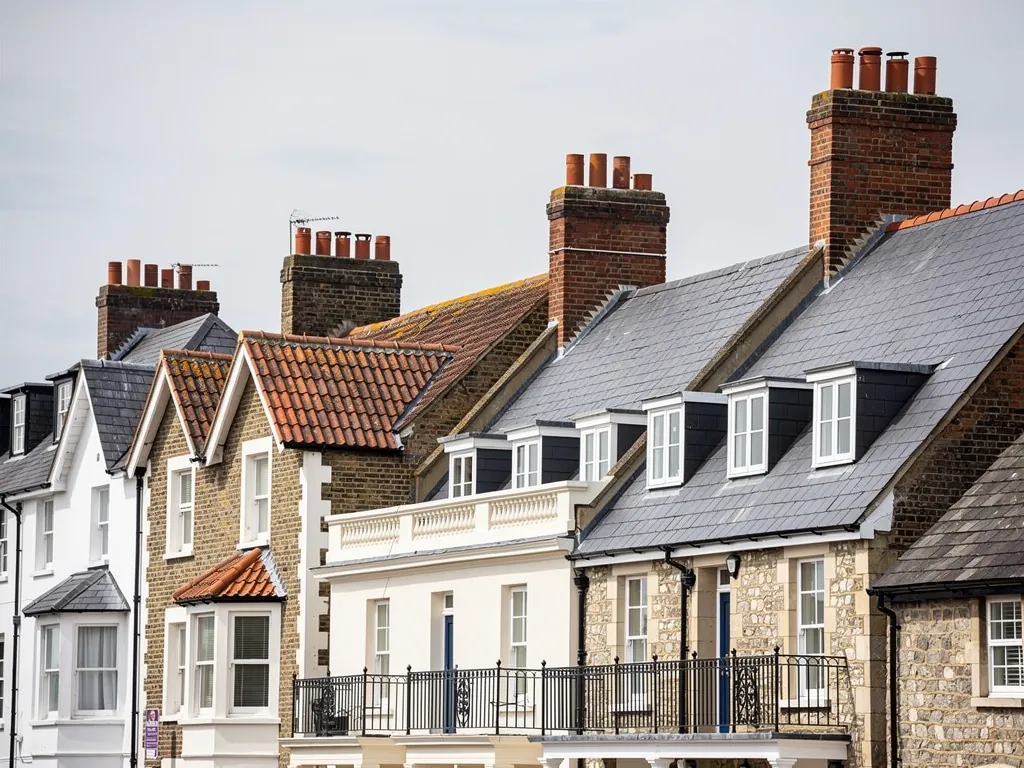
Walk from the old resort streets by Hotham Park down to the seafront and out to Aldwick or Felpham, and the roofs change every few hundred metres. Georgian brick sits beside Regency stucco. Slate gives way to plain clay tile. Further out come the interwar estates, then the bungalows, then the housing of the 1960s and 1970s. Knowing which era your house belongs to is the quickest way to understand what its roof is likely to need.
This guide takes Bognor's housing in the order it was built. For the older streets we lean on what Arun District Council recorded in its conservation area guidance and its character appraisals. For the villages, we use the Victoria County History of Sussex. We say what those sources say and no more, because plenty of individual houses have been re-roofed, extended or rebuilt since, and the roof over your head is the only evidence that counts for your house.
Under each era you will find the roof features that tend to cause trouble, the questions worth asking a roofer, and links to the guides that go deeper. Roof types on Bognor Regis houses are varied enough that no single rule covers them all.
Hotham's resort streets and the oldest roofs
Bognor began as a resort in the late 18th century, when Sir Richard Hotham laid it out as a place to attract visitors, and his plan still shapes the streets around Hotham Park. Arun's conservation area guidance, adopted in October 2000, describes the buildings fronting Upper Bognor Road as principally from that period. Numbers 45 and 47 are recorded as the oldest, built in about 1787, in stucco and brick. The same guidance mentions Myrtle Cottage, a thatched dwelling of the 18th century.
Roofs of this age are not like the roofs of a 1960s estate. They were set out one house at a time to suit the walls below, and many have been patched or re-covered several times over two centuries. The pitches, the timber sizes and the way the roof meets a party wall can all vary from one house to the next, which is why a quick look from the road tells you very little.
What to expect from an older roof
Lime-based mortars, softer bricks and old timbers all behave differently from modern materials. A repair that suits a 1980s house can do harm if it is forced onto a roof built two hundred years earlier.
Before any work, find out whether the house is listed. Check early whether the house is listed. Listed building consent covers work that alters the qualities behind the listing, and a full re-covering may well count. Small matching repairs and routine upkeep are treated more lightly, so ask your council before you order anything.
A survey of an older roof is mostly about what is behind the covering: the condition of the rafters, the battens and the junctions. Our roof inspections and surveys page explains what we look at, and the written quote follows it.
Regency terraces on The Steyne and Waterloo Square
The seafront streets are where visitors picture old Bognor. Arun's guidance dates The Steyne to the 1820s, with bays and balconies on terraced houses two and three storeys high. Waterloo Square, numbers 7 to 17, is described as Regency in style, from 1815 to 1820, and the Royal Norfolk Hotel is dated to the 1840s. Stucco is the main finish recorded, and the guidance singles out the chimneys as part of the skyline.
On a terrace, the roof is shared architecture. Chimney stacks sit on party walls, parapets and valleys run between neighbours, and the way water is carried from one house to the next matters as much as the covering on any single slope. A stain in one living room may begin at a stack, gutter or flashing that belongs to next door.
Slate, clay and the case for matching
For this area the guidance sets an aim of bringing back slate or plain clay in place of unsuitable modern coverings. If your house sits inside the boundary and you plan a different covering, speak to Arun before work starts. Our guide to roof work in Bognor Regis conservation areas sets out who to ask and when.
Lead is the other material on these roofs. Flashings where a slope meets a stack, soakers at the edge of a bay and the lining of a valley are all lead work, and good lead lasts a long time when it is dressed properly. MyJobQuote gives chimney flashing a possible life beyond 80 years. Poorly fixed lead lifts and splits sooner, which is why we look at the dressing as well as the metal itself.
For slate on terraces like these, see our guide to Victorian slate roofs. The JJ Roofing Bognor Regis homepage lists the full range of work we do.
Aldwick Road: stucco, slate and flint
Aldwick Road carries a different mix. Arun's appraisal speaks of imposing terraces from the early 1800s through the Victorian and Edwardian years, built in stucco, slate and flint, with chimneys again named as skyline features. It also makes a blunt point about roofs: original slate was often swapped for modern concrete interlocking tiles, and the council says this harms both the buildings and the street scene.
That one sentence explains a lot of roofs you will see. Swapping one covering for another is a bigger job than it looks, because the laps and fixings differ. If the new covering adds weight to old rafters, it becomes a Building Regulations question when it is roughly 15 per cent heavier or more. The Planning Portal gives that figure as a trigger for approval.
Putting slate back
Some owners now want to undo that earlier change. Going back to slate is possible, but the roof has to suit it, with well-fixed battens and an underlay chosen for the new laps. Pitch matters too. Cupa Pizarras reads BS 5534 as allowing natural slate down to a 20 degree pitch in moderate exposure, with hook fixings kept for slopes of 25 degrees and over.
The slate roofing hub explains the full range of slate work. Where the original covering cannot be saved, a good match matters as much as the material. Slate varies in colour, thickness and texture from one quarry or batch to another, and a repair set among older slates shows up from the street if the match is poor. We bring samples where we can, and tell you plainly when a patch will stand out.
Interwar estates in Aldwick, Felpham and Craigweil
Between the wars Bognor spread outward, and the housing changed with it. In Aldwick, the council's statement for the Craigweil House area follows a 1937 layout drawn up by J. Auty. The traditional materials are given as stock brick from local kilns and plain clay roof tiles. Wychwood, built from 1934, has lead-covered roofs over several entrance porches, and Silvergates, also 1934, is Grade 2 listed.
Felpham tells a related story. The Victoria County History records garden city by the sea estates of the 1920s and 1930s, among them Felpham Beach, Summerley, Roundle and Hurstwood, and council houses in the same decades. The village core is a separate conservation area, designated in February 1985, where Arun's appraisal notes red-orange clay roof tiles alongside coursed flint cobbles and clay brick.
Bungalows, chalets and what came with them
Further along the coast, the same history covers Middleton-on-Sea and Elmer, where permanent homes, weekend houses and bungalows went up side by side. Rented bungalows were selling well by around 1928. Some were built to last less long: the history records asbestos walls at Southdean and Elmer, and old railway carriages put to use at Elmer too.
None of that tells you what is on any particular roof. It does tell you that older bungalows can contain materials that need care. For a building from before 2000, the Health and Safety Executive says to assume asbestos could be present. Asbestos cement lifted off carefully and unbroken counts as non-licensed work, while breakage can make a job notifiable. We raise it at survey and leave suspect sheets alone until they have been checked.
Our chalet bungalow roofs guide takes the bungalow side further.
Post-war estates and the flat-roofed additions
The rest of Felpham filled in during the 1960s and 1970s, with houses and bungalows side by side. Bognor Regis Urban District Council bought 200 acres in 1963, and Flansham Park followed in the 1970s. At Middleton, Chichester Rural District Council had already provided homes, bungalows for older residents among them, before 1957.
Roofs from this period tend to share a family of features, though we avoid saying that any one estate has them all. Tiled pitched roofs are common, often with a shallow pitch and concrete interlocking tiles. Many houses have garages, porches or rear extensions with flat roofs, and these are usually the first part to give trouble.
Where the trouble starts on a newer house
A flat roof added to a house is a system with a short life compared with the tiles beside it. Published lifespans for felt, GRP and EPDM run from 10 to 50 years depending on the material and the quality of the work. The edges, the abutment against the house wall and the outlets are where leaks begin.
On the pitched roof, the usual causes are different. Mortar bedding on ridges and hips can crack and fall away. BS 5534 was revised in 2014 so that ridge and hip tiles need a mechanical fixing as well as mortar, and older bedding often has no other fixing. Verge cement can break up in the same way. Our ridge tile repairs page shows how we fix and refix these.
Where a flat addition is leaking, it is worth reading our guide on flat roof repair or replacement before you decide.
Matching the repair to the house
Put the eras together and a pattern appears. On older houses the work leans towards conservation: matching, lead, lime and consent. On newer ones it leans towards fixings, falls, flat roof junctions and edges.
Whatever the era, the first step is the same. We go up, record the fault in pictures and say what we would do: repair, patch or replace, with the reasoning. The smallest job that genuinely cures the problem is the one we recommend. The survey is followed by our written quote, at a single total price.
Questions worth asking before work starts
Check the status of your street and your house with the council: listed, conservation area, or neither. Ask what the covering is now, and whether it is original. Ask whether the work will change the weight the roof carries. Ask what fixings will be used on ridges, verges and hips, and what will be done at chimneys and walls. For anything bigger than a repair, ask whether the work is notifiable under the Building Regulations, and who will handle that.
The Planning Portal sets the usual cut-off for a building control application at under 25 per cent of the total building envelope and under 50 per cent of the roof. Arun, however, puts the re-covering of pitched and flat roofs on its own list of jobs needing approval. Hold both in mind, and let the council's building control team confirm which governs your job.
If you are buying an older house, our guide to roof checks when buying a house is a good place to start, and our planning permission guide covers consent.
Questions
Bognor house roof questions
Can I replace my Regency terrace's roof with modern tiles?
The answer turns on two things: any listing on the house, and whether it stands in a conservation area such as The Steyne. Arun's guidance favours restoring slate or plain clay there. Matching the existing covering rarely needs planning permission, but a change of material can, so ask Arun's planning team before ordering anything.
Is a flat-roofed garage or extension worth repairing on a 1970s house?
Often yes, if the deck is sound. In its March 2026 guide, Less gives £150 to £500 for small flat roof repairs. If the timber is soft or water stands on the roof, re-covering with proper falls usually makes more sense. We say which in the survey, with pictures.
Could an interwar bungalow roof contain asbestos?
It can. HSE advice treats anything built before 2000 as possibly containing asbestos. Intact cement sheets taken off with care are non-licensed work, but broken ones change that. Do not drill, sand or break suspect sheets, and ask for a check first.