
Buying a house · 9 min read
Buying a house: the roof checks to make before you exchange
A buyer who checks the roof before exchange can still negotiate, plan the money and walk away. This guide covers what to look at, what paperwork to ask the seller for and what typical repairs cost.
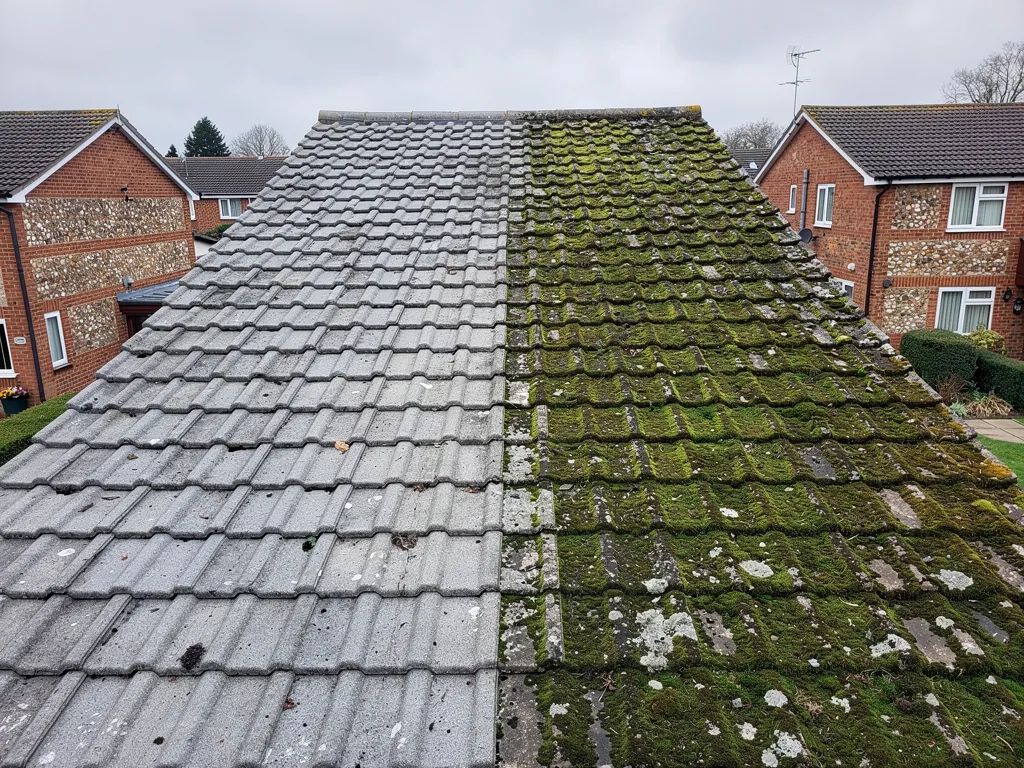
A roof is one of the few parts of a house where a small fault can turn into a large bill without much warning. It is also one of the few that a buyer rarely sees properly. You look up from the pavement on a viewing, you glance into the loft if the agent opens the hatch, and then the survey arrives with a paragraph about the roof written from the ground.
That paragraph is where this guide begins. It explains how to read the wording surveyors use, how to find out which covering sits on the house and roughly how old it is, and which parts of a house hide the trouble: flat roofs, extensions, chimneys, loft conversions and old garage roofs.
Then it turns to the paperwork that should exist, the typical UK prices that put a number on a repair, and the sequence that gives you leverage before you commit. Everything here is general guidance. A visit to the actual roof tells you more than any checklist.
Reading the survey wording on the roof
Most surveyors inspect a roof from the ground, from the loft hatch or both, sometimes with binoculars or a camera pole. They cannot walk on the roof, and the report says what could be seen rather than what is there. Words such as assumed, appears and not inspected mean the surveyor has not looked closely, which is a reason to take a second look rather than a reason to relax.
Watch for the phrases that signal work to come. Slipped or missing tiles, a sagging ridge line, patch repairs, defective flashings, cracked pointing around a chimney and signs of damp in the roof space all deserve a follow-up. A report that recommends a further inspection by a roofer is giving you a free instruction to ask for one before exchange.
Getting a roofer to look before you commit
A roofer's visit costs less than a surprise after completion. Checkatrade, in a table updated September 2026, gives £300 to £500 for a paid roof survey, plus VAT, as a typical UK range. Our visit produces survey photographs of the roof and a view on whether it wants mending, patching or renewing, with a written quote to follow, giving a single total price. Ask the seller for access and warn the agent the visit is coming.
Our guide to roof problems in a homebuyer survey goes through the common wording, and the page on roof inspections and surveys sets out what a visit covers.
The covering on the roof and the time it may have left
Ask the seller, the agent or the survey what the covering is, and when it last had work. The material gives a rough idea of the time left, always as an indication and never as a promise. Marley quotes around 60 years for concrete tiles while stressing that the figure is not a guarantee or a warranty, and CORC puts well-kept natural slate at 100 years and more. Old clay peg tiles sit outside that pattern: a building conservation article calls the 60-year figure a poor guide for them.
Flat coverings run shorter. Less gives torch-on felt 10 to 20 years, GRP 25 to 40 years and EPDM (a synthetic rubber sheet) 30 to 50 years, though GreenSpec quotes 20 to 30 years for EPDM. The ranges disagree, which is itself a message: treat the covering's age and its maintenance history as a matter for a roofer to judge on site.
What the Bognor streets tell you
Arun's conservation area guidance records slate and stucco on the Aldwick Road terraces, plain clay-tiled roofs on the interwar Craigweil estate in Aldwick, and orange or red clay tile in old Felpham, where it describes the traditional materials. Its Aldwick Road entry adds that concrete interlocking tile has taken the place of slate on some roofs. A mix of coverings on one terrace is therefore possible, and the question is how well each patch has been done.
Lead flashings can last for over 80 years, according to MyJobQuote, so old lead that is intact is no cause for worry. Our guide to when to replace a roof sets out the signs that a covering has had its time.
Flat roofs, extensions, chimneys and garages
The parts of a house that are not the main pitched roof often cause the biggest surprises. A flat-roofed extension or garage relies on one membrane, and when that fails the deck underneath can rot. Look for water that stands after rain, because BS 6229:2025 sets a minimum finished fall of 1:80, and a roof that ponds is not draining as it should. Ask when it was last covered and what with.
On a garage, an old corrugated or profiled sheet roof deserves a careful look. For anything built or refurbished before 2000, the HSE's starting point is that asbestos may be there, and it counts roofs of asbestos cement as fragile every time. Do not walk on one or let anyone else do so. Our guide asks is my garage roof asbestos, and covers the next step.
Chimneys and the lead around them
A chimney stack in poor repair is a fall hazard and a leak risk. Look for leaning, loose pots, crumbling pointing and gaps at the lead where the stack meets the slope. If a chimney breast has been taken out inside, Building Regulations approval applies, because the Planning Portal says it always will when removing chimney breasts that form part of the structure. Ask for the certificate.
Solid conservatory roofs are another to query. The Planning Portal expects a new conservatory roof to satisfy the Building Regulations for safety of the structure, energy efficiency and airflow, so a replaced one should come with paperwork. A polycarbonate roof is typically expected to last around 10 to 15 years, so an old one is a likely expense. See flat roofing for how we deal with extension roofs.
The paperwork to ask for before exchange
Your solicitor can raise questions on your behalf, and the roof is a fair subject for them. Ask for evidence of any roof work done in the seller's time: invoices, the roofer's details, dates and any guarantee. Ask for Building Regulations completion certificates for a loft conversion, a roof window, a solid conservatory roof or a removed chimney breast. A chimney breast on a party wall also needs a party wall notice.
If the house has a dormer, ask whether planning permission was needed and given. Inside a conservation area, the South Downs National Park or the harbour National Landscape, a dormer needs a full application, so a missing consent is a problem the new owner inherits. Listed buildings add a further layer, because roof alterations that change the building's character need listed building consent.
Spray foam in the loft
Spray foam applied to the underside of a roof is the one insulation product that regularly changes the conversation. The RICS consumer guide of March 2023 warns that foam installed badly may cause dampness, uncontrolled condensation included, and that it can affect a surveyor's opinion of value. Lender reporting from November 2024 found some refusing such homes outright and others judging each one individually. Tell your mortgage broker early if the survey mentions it. Our guide to spray foam and your mortgage sets out the options.
Ask also whether the roof has been re-felted, re-battened or just patched, because each leaves different evidence in the loft. Photographs from the seller's old surveys can help.
What typical repairs cost, for negotiation
Numbers turn a survey comment into a negotiation. These figures are typical UK ranges taken from national guides, not a price for any particular house. Checkatrade prices roof repairs by area, at £90 to £220 per m² for tiles and slate. Checkatrade shows ridge tile repairs at £50 to £70 per metre and lead flashing repairs at £50 to £70 per metre, all excluding VAT. A chimney lead patch costs £150 to £250 according to MyJobQuote, and replacing the lot £350 to £460 without scaffolding or £700 to £920 with it.
A full re-roof is a different scale. Checkatrade gives around £12,000 for a three-bedroom semi, says the UK average is around £8,000 and puts a flat roof at £2,800 to £7,500. Scaffolding adds to either, and Checkatrade's table shows about £875 a month for a semi on two floors. The standard rate of VAT is 20%, so check whether a price includes it.
Using a quote with the seller
A written quote from a roofer is firm evidence in a price conversation. Ours gives one total, with the survey photographs showing the faults it answers. Our prices are good and fair. Ask the seller to reduce the price, carry out the repair before completion or hold back an agreed sum until it is done, whichever your solicitor advises.
Do not assume the lowest-priced route is the right one. A patch that carries the roof through one winter may suit a short stay, while a long stay may call for the full repair now. Our verdict, set out after the survey, tells you which of the two applies. Our guide to roof repair costs gives the full table.
Timing: viewings, exchange and the first winter
The best moment to look at a roof is a wet day, when leaks and blocked gutters show up. On a viewing, look at ceilings and the tops of walls for stains, check the landing and the bedrooms under the roof, and open the loft hatch if you may. A loft with daylight showing through the covering, damp timbers or flattened insulation tells you something regardless of the survey.
Book the roofer as soon as the survey flags something, not once the legal work is nearly done. Sellers' diaries and scaffold licences take time. Access over a pavement brings a Highways Act licence into the plan, and with West Sussex County Council the notice is at least 10 working days, so a repair needing scaffold should be timed with that in mind.
After completion
Whatever the survey found, plan to look over the roof in the first autumn. Gutters, ridge tiles, flashings and any flat sections are worth checking before the gales start, and a record of the condition on the day you moved in is useful later. Keep the survey, the roofer's photographs and any invoices together with the deeds.
If you are buying near the sea, bear in mind that the house will face gales, sea weather and wet blowing in off the Channel, so a roof that has been left alone for years may need more attention than the survey implied. Our roof maintenance checklist gives a seasonal routine, and the roofing homepage lists every service we offer around Bognor Regis.
Questions
Roof questions for buyers
Should a roofer or a surveyor look at the roof?
Both do different jobs. A surveyor reports on the whole property and usually sees the roof from the ground or the loft. A roofer can read the covering, the flashings and the ridge in detail and put a price on any repair. If the survey raises a doubt, have a roofer look, ask for photographs and a written quote, and pass both to your solicitor.
Can I ask the seller to pay for roof repairs?
You can ask, and a roofer's written quote is the evidence that makes the request reasonable. Your solicitor can raise it as a price reduction, a repair before completion or a retention. Whether the seller agrees depends on the sale, so get the quote early enough to leave room to decide whether to proceed.
Will spray foam in the loft stop a mortgage?
It can complicate one, because lenders were split in late 2024: a few turned such properties down while others looked at the detail. The RICS consumer guide says to check with your mortgage provider whether its policy allows it. Tell your broker as soon as you hear it is there, and ask for the installer's paperwork.