
Roofing materials · 9 min read
Which roofing material is best for a UK home?
No covering wins on every count. This guide compares the main UK roofing materials on lifespan, minimum pitch, weight and cost, and shows how the choice follows from your roof.
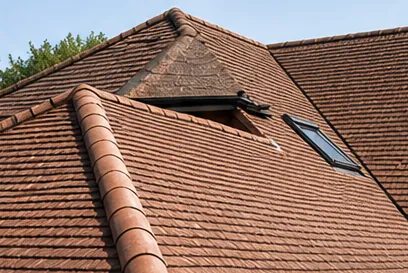
Ask which roofing material is best and you will usually be handed a favourite. A tile merchant recommends tiles, a slater recommends slate, and a flat roofer swears by whichever membrane he lays. Each of them is right about their own material and no use as a judge of the others.
A better question is which covering suits this roof. The answer is set by things you can measure. The pitch of the slopes rules some materials out. The strength of the timber frame limits how much weight it can carry. The age and character of the house, and whether it is listed or in a conservation area, narrow the field again. What is left comes down to lifespan and price.
The sections below take the main coverings one at a time, using published figures with their sources. Lifespans are typical ranges, never promises, and prices are national guide figures rather than a quote for your roof. On a survey, we look at the pitch, the structure and the neighbouring roofs, then say what we would put on yours and why.
Start with the roof you have, not the catalogue
Four checks narrow the choice before anyone opens a brochure.
Pitch
Every covering has a lowest slope it will work on. Marley publishes a lowest pitch for every tile in its range. That is 15 degrees for the Lincoln clay pantile and a few interlocking concrete tiles, 17.5 or 22.5 degrees for others, and 35 degrees for concrete plain tiles. For natural slate, BS 5534 indicates a minimum of 20 degrees on a moderate-exposure site with 500 mm slates. The figure moves with the profile, so the maker's sheet for your chosen tile is the document to trust.
Weight and the frame
A heavier covering puts more load on the timber, and the Planning Portal is specific: Building Regulations approval is needed where the weight added is 15 per cent or more. It also advises asking an engineer or surveyor about any tile markedly heavier or lighter than the one it replaces. Our guide to re-roofing and Building Regulations covers the rule.
The building
A Victorian terrace with a slate roof belongs in a different conversation from a 1970s estate house. Listed buildings and conservation areas often expect the original material or a close match. We cover that in planning permission to replace a roof.
Exposure and aftercare
Fixings matter as much as the material. Wind-driven rain and gales near the Channel put a covering's fixings under strain, and the right specification depends on the site. A covering is only as good as the way it is fixed, which is why we work to BS 5534 for tile and slate. The ridge line is part of that, and we screw or clip it rather than leave it to mortar.
Concrete tiles: the sensible default
Concrete tiles are a familiar sight on British roofs, and for good reasons. They are made in volume, so they are among the cheaper options and easy to match. They come as interlocking tiles, which lap each other and lay quickly on lower pitches, and as plain tiles that mimic old clay.
Marley expects concrete tiles to last around 60 years, while stressing it is not a warranty. Lower figures circulate too. A safe reading is that 30 to 60 years is common, with maintenance and fixings deciding which end you reach.
Where they work well
Interlocking concrete tiles suit the shallower pitches that many post-war bungalows and chalet bungalows have. Marley lists minimum pitches from 12.5 degrees for its Mendip 12.5 up to 25 degrees for its Anglia, so a profile exists for most slopes. They are heavier than slate, which is a point to check against the frame. Ask your roofer which tile weights are in the quote and whether the rafters were checked for them.
Where they fall short
Concrete tile surfaces weather, and moss takes hold on the shaded faces. In a conservation area they can look wrong against stucco and slate terraces. Arun's own guidance for the Aldwick Road conservation area regrets that modern concrete interlocking tiles have so often taken the place of slate on its seafront terraces.
Our page on clay against concrete roof tiles compares them directly, and roof tile types shows the profiles.
Clay tiles: colour that lasts
Clay is fired, not cast, and the colour runs through the whole tile. That is its appeal. A clay roof keeps its tone for decades and weathers gently, which is why it is the covering of choice on period houses across Sussex. Marley quotes a minimum life of 60 years for clay, taken from the Building Research Establishment. One conservation article adds a caution: on old peg-tile roofs, that number cannot be trusted, because age and quality differ so widely.
Plain tiles and pantiles
Plain clay tiles are small, hung on battens and laid in overlapping courses. They need a steep slope, and Marley's lowest pitches climb from 30 degrees for two of its clay plain tiles to 40 degrees for the Canterbury. Clay pantiles, with their S-shaped profile, work on lower slopes; the Marley Lincoln needs 15 degrees.
The Felpham village conservation area, designated in February 1985, describes its traditional roofing as orange and red clay tile, and the interwar Craigweil estate in Aldwick is recorded with plain clay tiled roofs. Where clay is the local material, replacing it with something else changes how the street reads, and a neighbour's roof is a useful guide to what the planners will expect.
The trade-offs
Clay costs more than concrete and takes longer to lay, because plain tiles cover little area each. Matching old handmade tiles can mean sourcing reclaimed stock. In return you get a covering that suits traditional houses and keeps its good looks as it ages. See our page on plain clay tile roofs for more.
Natural slate: the long-lived, higher-cost choice
No pitched covering here lives longer than slate. CORC puts well-maintained slate at 100 years and more, and Checkatrade reaches the same conclusion for stone slate. In practice the slate often outlives the fixings. Nails corrode and slates slip long before the stone itself fails, so a slate roof is often relaid with the sound slates reused.
Cost is the other side of the coin. Checkatrade's September 2026 slate table shows £160 to £210 per m² for natural slate, an average of £184, and £95 to £125 per m² for Spanish slate. Those figures sit above most tile prices. Slate roofers are priced at £280 to £360 per day. Read those as national figures: your own number depends on access, pitch and roof size, and it arrives as a written quote after the survey.
Fixings and pitch
Slate relies on a careful fixing schedule. Cupa Pizarras advises against hook fixings on any slope under 25 degrees.
Where slate is the right call
On Victorian and Edwardian terraces, and in conservation areas where slate is the original covering, it is often the only acceptable answer. On a house built for concrete tile, the extra cost may buy little. Reusing sound slates when relaying a slope is one way to keep the cost down, where the stock is good enough. Our slate roofing page describes how we handle it.
Flat roof coverings: felt, EPDM and GRP
Flat roofs sit in a different world, since the covering must be waterproof as a single skin and the roof must drain. The three common choices differ mainly in lifespan and how they are laid.
| Covering | Typical life as published | How it is laid |
|---|---|---|
| Torch-on felt | 10 to 20 years (Less) | Layers of bitumen felt, fused with a gas torch |
| GRP | 25 to 40 years (Less) | Fibreglass-reinforced resin, brushed on and left to set |
| EPDM | 20 to 30 years or more (GreenSpec, Less) | A rubber membrane rolled out as one sheet |
Done well, felt can reach 20 years; done badly it may fail inside a decade. EPDM suits larger, simpler roofs because one sheet means few joints. GRP gives a rigid finish with no joints that works well on smaller roofs with awkward shapes, such as dormer cheeks and extension roofs.
Falls matter more than the membrane
Whichever covering you choose, the roof must drain. BS 6229:2025 sets the minimum finished fall at 1:80. Because boards settle and rafters vary, roofers usually design around 1:40 to end up with a roof that drains. A membrane laid on a flat deck that holds water will not live out its published lifespan. Our flat roofing page goes through the options.
Lead, zinc and the specialist metals
Metal roofing is rarer on British houses but has a place. Lead and zinc suit low-pitch roofs, curved surfaces and details that tiles cannot follow.
Lead is the traditional answer for flashings, valleys, dormer cheeks and small flat roofs. MyJobQuote reckons lead flashing can outlast 80 years, while Less allows a lead flat roof 50 to 100. Lead sheet is graded by numbered codes tied to thickness. Royston Lead's brochure reserves code 3 for soakers, so code 4 is the thinnest it lists for flashings. It is heavy and expensive, so it tends to be used where it earns its place. Our page on lead roofing and leadwork covers it.
Zinc
Zinc forms a protective surface as it ages. VM Zinc, the manufacturer, states that a zinc roof can exceed 100 years, citing an environmental product declaration. HomeBuilding quotes a contractor at 60 to 100 years. The supplier has a commercial interest, so read the claim as a manufacturer's figure. Zinc is common on modern and contemporary buildings, and less so on traditional Sussex houses.
Choosing between them
On a house with a hipped tiled roof, metals will mostly feature as flashings and valleys, not as the main covering. For a flat or shallow roof where you want a long life and a clean line, they are worth a quote.
If your roof is Horsham stone or a similar stone-slate covering, the choice is tied to the existing material; see Horsham stone roofing.
Turning the comparison into a decision
Pull the threads together and the right covering usually picks itself.
- Low-pitched pitched roof, tight budget: an interlocking concrete tile with a profile rated for your pitch.
- Period house, tiles or pantiles: clay in the matching shape and colour.
- Victorian terrace, seafront conservation area: natural slate, bedded and fixed to BS 5534.
- Flat extension or garage: EPDM on a simple shape, GRP where there are awkward details.
- Valleys, flashings and small features: lead.
Cost follows from that choice and the size and access of the job. In Checkatrade's October 2026 replacement guide a typical UK roof averages around £8,000, with most between £4,000 and £19,000. Your own price comes from the survey, as one total in a written quote, and ours is good and fair. When you compare quotes, check that each includes VAT and scaffolding.
The honest sum
A cheaper covering that needs replacing 30 years sooner is not cheaper. Think of cost per year of life, and weigh in the maintenance, such as gutter clearing, moss control and the occasional fixing repair. But also weigh the house, since a covering that does not suit the building may cost you at sale.
Our guide to changing roof covering deals with swapping materials, and the roof replacement page explains the work itself.
Questions
Choosing a roof covering
Which roofing material lasts longest?
Of the common coverings, natural slate and zinc have the longest published lives, at 100 years or more, with lead flashing also reaching beyond 80 years. Tiles are usually quoted at around 60 years for clay and concrete. These are typical ranges rather than promises, and fixings, ventilation and maintenance decide what a roof actually achieves.
Can I put a different material on my roof than the one it has now?
Often, yes, subject to pitch, weight and consent. The new covering must work at your slope, the frame must carry its weight, and a listed building or conservation area may restrict the change. A big change in weight can also trigger Building Regulations approval, so we check the structure and the rules before pricing it.
Is a more expensive roofing material always better?
No. A covering that suits the pitch, the frame and the house will outperform a dearer one that does not, and fixing quality matters as much as the material. Natural slate earns its higher cost on period houses; on a modern estate house a good concrete tile may be the better value. The survey tells us which.