
Coastal weather · 9 min read
Living by the sea: how coastal weather affects your roof
A roof near the Channel takes wind, rain and salt in a different mix from one inland. This guide separates what is known about that from what is guesswork.
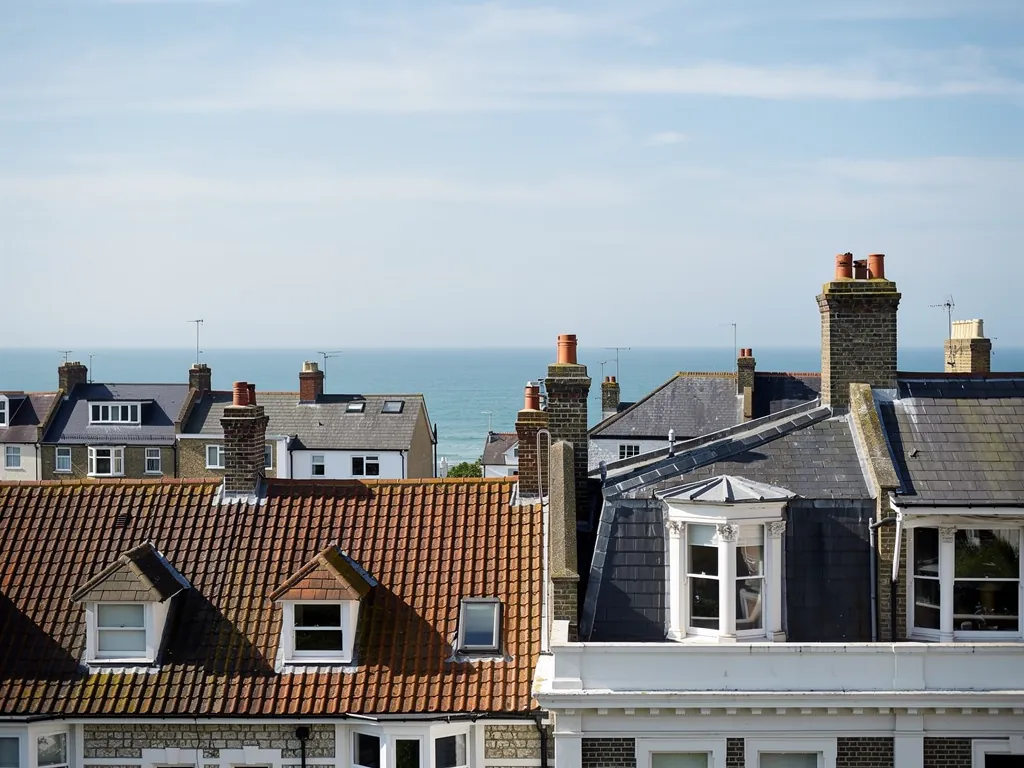
Everyone who lives within sight of the sea has a view on what it does to a roof. Some say the salt eats everything. Others say it is all exaggeration. The truth sits in between, and a lot of it depends on the individual house: its height, its pitch, what stands beside it, and how well the details were fixed in the first place.
Here we stay with what manufacturers and standards bodies publish. You will find no rainfall or wind speed figures for Bognor, because a number borrowed from somewhere else would only mislead you. Wienerberger points out that the right fixing specification depends on the roof's location, its altitude and the wind exposure of its particular spot, so the answer for your roof comes from looking at it, not from a postcode.
What we can do is walk through the weather a roof on this coast has to handle, the places where each kind of weather finds a way in, and the habits that keep a roof in good order. Coastal weather roof damage is rarely mysterious. It usually starts at one of a handful of weak points, and most of them can be checked from the ground or the loft.
Gales and the suction on a roof
When people picture wind damage they picture a tile being pushed off. In practice the bigger force is often suction. Wind passing over a roof lowers the pressure on the surface, and anything poorly held down is lifted. Marley warns that on pitches under 30 degrees the slope facing the wind can see strong suction, known as negative pressure.
That matters in Bognor because so many houses here are low. Bungalows, chalets and extensions sit under shallow roofs, and a shallow roof is exactly where suction is strongest. Fixing a roof properly is therefore about how every tile, ridge and verge is held, not just how it is laid.
What the standard asks for
BS 5534 is the British Standard behind modern slating and tiling. Marley's guidance, updated in February 2026, says that after the 2014 revision mortar's own strength could no longer be trusted to carry the ridge and hip tiles, and that anything bedded should also be mechanically fixed. Wienerberger's rule for single-lap tiles is a minimum of one mechanical fixing each. Marley adds that following BS 5534 is not a legal requirement, which is a good reason to ask a roofer which fixings they intend to use.
Dry-fixed ridge, hip and verge kits, in which screws and clips replace a mortar bed, are tested to BS 8612:2018. Our ridge tile repairs page shows the difference, and we price ridges with the fixings included.
After a gale we start with the ridge, hips and verges, the lines the wind meets first. If you see loose tiles on the ground, our guide to tiles blown off in a storm explains what to do next.
Driving rain and where it gets in
Rain that falls straight down is easy for a roof to shed, and the JJ Roofing Bognor Regis homepage shows the repairs we carry out when it does not. Rain that arrives sideways, pushed by a gale, is a different test. It is forced up under the laps between tiles, around the edges of flashings and into gaps that stay dry in ordinary weather. Marley's design procedure works with four categories of driving rain exposure, and which one applies depends on the exact site, so a roofer has to look at the roof rather than rely on the town.
What we see on survey is a short list of repeat offenders. Flashings, the strips of lead sealing the joint where the roof meets a wall or a chimney, are the first. Pitched slopes that end against a gable wall, valleys where two slopes meet and chimney stacks come next. Older roofs add one more: underlay that has perished or torn behind the tiles.
Leaks that only show in certain weather
A leak that appears only in a strong blow from one direction usually means water is being driven past a lap or a flashing that holds up well otherwise. That makes it hard to find. A mark on the ceiling can appear several metres from the entry point, because water runs along timbers and felt before it drips.
A day with a hose and a second person indoors can help, but a systematic look in the loft with a torch after rain is the better start. We cover this in our guide to roof leaks that only appear in wind and the one on flashings that leak in rain.
Chimneys deserve a mention too. The joint between a stack and the roof is lead, and the top of the stack is mortar and flaunching. Both take driving rain directly. Our chimney repairs page explains how we deal with them.
Salt in the air and on the surfaces
Salt is the part of coastal weather that attracts the most folklore. One manufacturer that does publish guidance is one zinc manufacturer, whose advice is specific to zinc. It sorts sites by distance from the coast, with the closest band running up to 1 km, a second band from 1 to 3 km and low influence from 3 to 20 km. It also notes that salt builds up on surfaces rain does not rinse, such as protected facades and soffits, and advises washing zinc with clean water at least twice a year.
That advice concerns zinc only. It does carry a practical idea for any coastal house, which is that the parts of a building that rain does not reach stay dirty. Soffits under the eaves, fascia undersides and the area behind a gutter are examples. A wash with clean water costs little and shows you the condition of the board at the same time.
Checks and fixings near the sea
A roof close to the sea deserves checks that are a little more regular, and fixings should be chosen for the job and the site rather than by habit. Ask your roofer what they plan to use and why.
Gutters and downpipes are worth a look too. They carry water away from walls, and a blocked outlet near the sea causes the same damp problems as one inland. Our guttering, soffits and fascias hub covers cleaning, replacement and repair, and our roof maintenance checklist gives you a routine to follow.
Moss and algae grow where roofs stay damp. Our roof cleaning and moss removal page explains the choices.
Flat roofs: sun, standing water and edges
Flat roofs on garages, porches and extensions take the weather differently from pitched ones. They have no slope to shed rain quickly, so water has more time to find a flaw, and there is nothing to hide the covering from the sky. The sort of damage we see is slow rather than dramatic: a blister in felt, a split along a seam, a trim that has lifted at an edge.
Standing water is a warning sign. BS 6229:2025 replaced the 2018 edition in December 2025 and retains 1:80 as the minimum finished fall. Roofers usually design for about 1:40 so that the roof as built still sheds water. Water still lying on a flat roof well after the rain has gone shows that it is not draining as it should, and each dry spell leaves a film of dirt that holds more moisture.
Edges are where gales bite
The wind passing over a flat roof lifts at the perimeter first. That is why edge trims and drip details matter so much. A membrane that is well stuck down in the middle can still peel from the edge if the trim is poorly fixed. We finish edges neatly and fix them properly, so the roof looks right from the street and holds up in a blow.
Lifespans give a sense of timing. The March 2026 edition of Less's guide gives torch-on felt 10 to 20 years, GRP 25 to 40 and EPDM 30 to 50, while GreenSpec puts EPDM at 20 to 30 years. Treat these as typical spans, since they swing with how well the roof was laid.
Our guides on flat roof falls and drainage and flat roof storm damage go into more depth.
Frost, then thaw
Cold snaps are the other piece of coastal weather that catches roofs out. Water soaks into porous tiles and slates, freezes, expands and can flake the surface from the face. Our guide on frost damage to roof tiles explains what the damage looks like.
The things to look for are simple. Flakes of tile in the gutter, new patches of lighter colour on a slope and tiles that have lifted or cracked after a freeze are all worth a closer look. If you can see debris in the gutters after cold weather, it is a reason to check, not a reason to panic.
Looking from the ground and the loft
You do not need to climb a ladder. A pair of binoculars from the garden shows slipped tiles, missing mortar and gaps at the ridge. Inside, a torch in the loft after rain shows daylight, damp patches on timbers and wet insulation. Take pictures and note the date. They help your roofer, and they help your insurer if you later need to make a claim.
Never walk on a tiled or slate roof to check it. It is easy to break tiles and easier still to fall. Our guide on walking on roof tiles explains why.
We would sooner you called us about a worry than ignored it. A short visit to look at a roof, followed by a plain verdict, costs less than the damage a small fault can cause when it is left through another winter. If the verdict is that nothing needs doing, that is what you will hear.
Ventilation matters too, because condensation can look like a leak. A roof that is warm and damp inside will show wet timbers and stained ceilings even when the covering is sound. Our guide on telling a roof leak from condensation helps you tell them apart.
After a storm: what to do and in what order
When a gale has done damage, the order of events matters more than speed. Safety comes first. If there is a danger to people, keep clear of the area below, and if a structure looks dangerous you can tell the building control team at your council. IStructE gives that advice in its guidance for storm damage, dated 28 January 2025.
Next, get in touch with your insurer promptly. If you book emergency repairs yourself, Which? advises telling your insurer and saving every receipt. Take photos of the damage before anything gets moved, and do not bin damaged belongings unless they are hazardous.
Wear and tear is not storm damage
Insurers separate sudden storm damage from gradual decline. Which? offers a neglected roof letting rain in as a wear and tear example, and quotes Financial Conduct Authority data in which 32 per cent of storm claims made in 2024 ended in a payout. The decision on any claim rests with your insurer. What we do is write down what we find, with photographs, so that you have the evidence to hand.
Unhappy with a decision? Start with a complaint to the insurer; if that fails, the Financial Ombudsman Service is the following step, and using it is free.
A temporary repair, such as a tarpaulin or a patch, keeps water out until the proper repair can be done. Leaks and storm damage jump our queue, and on a leaking roof we begin by making it safe. Our pages on storm damaged roofs, checking your roof after a storm and roof insurance claims go through each step.
Questions
Coastal roof questions
Does sea air shorten the life of roof tiles?
Tile lifespan depends on the material and the fixing far more than on a single number for sea air. What manufacturers do say is that exposure is specific to the site, and that surfaces rain does not reach collect salt deposits. A regular look at the roof, gutters and soffits is the sensible response.
How often should a seaside roof be checked?
Glance over the roof from the ground every spring and autumn, and after any bad storm, is a sensible habit. Check for slipped tiles, loose ridge tiles, stained ceilings and blocked gutters. If you find anything, a photograph and a call is better than a guess. Our maintenance checklist gives the full list.
Is wind damage to a roof covered by home insurance?
Sudden damage from a storm is the kind of event policies are designed for, but cover depends on your policy. Which? notes that wear and tear is treated differently. Read your policy, ring your insurer, have the roof made safe, and file the photographs and receipts from any temporary repair.