
Horsham stone explained · 9 min read
What is Horsham stone roofing?
Horsham stone is a flaggy Wealden sandstone split into thick slabs and laid as a roof covering. This guide covers the material, the laying, where it survives and what makes it different.
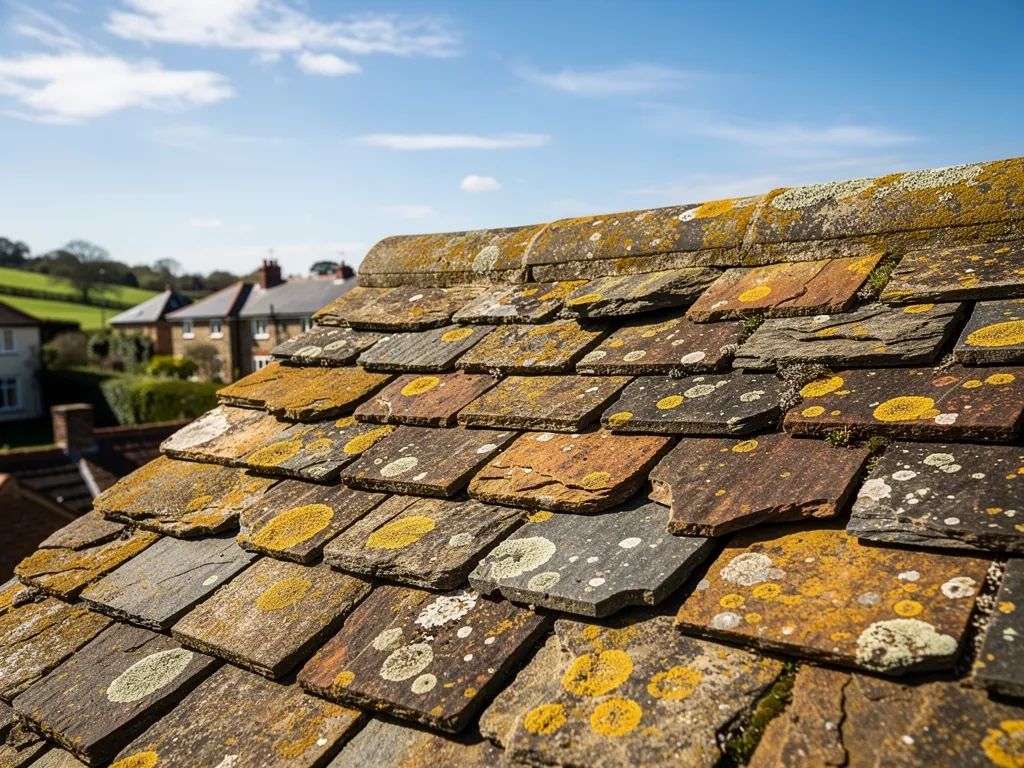
Stand in a Sussex lane with an old farmhouse, barn or church across the way and you may notice a roof that looks nothing like the neat rows of modern tile. The slopes are heavy and slightly uneven, the colours run from honey to rust to grey-green, and the stone shrinks in size as it climbs. That is very likely Horsham stone, and this guide explains the term.
The name is used loosely. Some people mean the sandstone itself, some mean the slabs cut from it, which go by Horsham slabs or stone slates, and some mean any heavy stone covering in the Weald. Here it means the sandstone slabs, split from the rock and hung in graded courses. It is a covering with its own habits, its own weak points and its own pattern of cost, so a roof like this deserves a survey before anybody talks about work.
Read on for the stone, the way it is laid, where it turns up, how long it lasts and what to ask a roofer before one climbs onto it. Our Horsham stone roofing page sets out the work we carry out on these roofs.
A flaggy sandstone from the Weald
Horsham stone is a sandstone, and a particular kind of one. Horsham District Council's Slinfold Conservation Area Appraisal (September 2020) describes it as a calcareous, flaggy sandstone, taken from the Weald Clay country and used for roofing and for floors. Flaggy means it splits naturally along flat bedding planes, so a quarryman could open a block into thick slabs without sawing it. The slabs keep the texture of the rock: rough on the face, irregular at the edges and never quite flat.
The council's appraisal for Horsham's town centre traces the roofing back to stone dug near the town itself, and treats the roofs as a distinctive local tradition. That explains the name. The stone did not arrive from a distant quarry, which is part of why it sits so naturally in the landscape around Horsham, Slinfold and the villages of the Weald.
Colour, thickness and texture
Colour varies from slab to slab. You will see warm honey and brown, rusty orange, and cooler grey and green where lichen has settled. Weathering softens all of it. The thickness is what sets the stone apart from slate in the hand: a Horsham slab is a chunky piece of rock, where a slate is a thin leaf. Because every slab differs, a stone roof reads as a patchwork rather than a pattern, and the eye follows the way the rows shrink up the slope.
Stone slates, slabs and Horsham stone are, in practice, three names for the same material. If a surveyor or conservation officer uses any of them, they mean this covering. If you are weighing the two up, the Horsham stone against slate comparison is in our wider stone roofing guides.
It helps to know what you are looking at before you speak to anyone about it, because the vocabulary on these roofs is half the battle. Once you can name the slabs, the courses and the details around them, a survey report or a quote becomes much easier to follow.
How the slabs are laid
A roof covering goes on in courses, which are horizontal rows. On a stone roof those rows get smaller as they rise. The largest, heaviest slabs sit at the eaves, the lower edge where rain leaves the roof, and each row above uses slightly lighter stone until the smallest slabs finish at the ridge, the apex line along the top of the roof. Big stone low down copes with the water gathering as it runs off. Small stone higher up spares the upper structure from carrying more weight than it needs to.
Every slab hangs from a batten, a narrow timber strip nailed over the rafters, and every row laps the one beneath so that water is shed rather than admitted. Our page on diminishing courses follows a single slope from the eaves to the top in more detail.
Fixings, hips and valleys
Traditionally a slab was secured with a peg, or later a nail, driven through a hole drilled near its upper end. The weak link in that arrangement is rarely the rock. It is the peg, the nail or the timber behind it, which is why a stone roof can seem sound from the lane and still be dripping in the loft.
The other parts of the roof need the same care. A hip is the sloping line at an external corner, where the angle of the roof points outward. A valley is the opposite: a re-entrant angle where two slopes drain into one channel. Both have to be dressed carefully, or water will find a gap. Lead is often used in valleys and beside chimneys, and on older roofs a swept valley, where the stone itself curves round the angle, can still be found. Each of these details has its own guide on our site, linked from the Horsham stone roofing page.
Where Horsham stone roofs survive
These roofs turn up across the Weald and along the foot of the Downs, and the councils' own appraisals record many of them. Horsham's town centre still has some hipped and half-hipped roofs in the stone, among clay tile and pantile, and the Victoria County History describes the parish church of St Mary as roofed in it. Over at Kirdford, the village appraisal picks out its Grade I parish church, dedicated to St John the Baptist, for a Horsham stone slate roof.
Houses show a pattern as well. The Billingshurst and Storrington appraisals both explain that in the early days, thatch was normal and the grander buildings were covered in Horsham stone, with plain clay tile taking over from the middle of the seventeenth century. Henfield's appraisal says the older roofs there are mostly peg tile with stone slate a rarer sight, while the History's account of Steyning lists tile, slate, thatch and Horsham slabs together. Mid Sussex District Council's East Grinstead appraisal counts the stone among the materials of that town centre.
Near our patch
We work as far as Horsham, Pulborough, Petworth and Midhurst, and a stone roof may sit on an old farm building, a church or a cottage in any of them. Closer to the coast they are rarer, but a listed barn or a farmhouse on the Downs fringe may carry one. If you are not sure what you have, send a photograph of each slope and we will tell you what it looks like. A phone picture from an upstairs window is usually plenty to start the conversation.
How long a stone roof lasts
Checkatrade's slate cost guide notes that stone slate, kept in good order, can run beyond a hundred years. That is a national figure for the material and no promise about any one roof, yet it explains why so many of these roofs are old. The stone itself is slow to wear. Most of the trouble on an ageing stone roof comes from what holds the stone up.
The usual order of failure is fixings first, then battens, then individual slabs, then the details around chimneys and valleys. A peg gives way and a slab slips. A batten softens and a whole row sags. Lead beside a chimney lifts and water finds a way in next to the stack. The rock in the middle of a slope often stays sound while all that happens around it, which is why replacing a whole roof because of a few failed fixings seldom makes sense.
Frost, moss and mortar
Water trapped in the stone does damage when the weather turns cold, so flaking at the lower edge of a slab is worth looking at. Moss holds damp against the surface and can clog the gaps between slabs and the valleys, so gentle removal helps. Mortar at the ridge and along the verge, which is the sloped edge finishing a gable wall, is the part most likely to crumble, and it is replaced far more often than the stone.
Age gives you no reason to strip a roof. A sound stone covering that is leaking at a few details is a candidate for repair, and our guide on whether to repair, re-lay or replace a Horsham stone roof works through the choices. Regular checks from the ground, plus a look from inside the loft after heavy rain, will show up trouble early, when a fix is still modest.
Why a stone roof is a specialist job
Stone is heavier than slate or tile, graded rather than uniform, and fixed by older methods. A roofer who lays concrete tiles all week does not automatically know how to sort a pile of slabs into courses, or how to tell a slab with a hairline crack from one that is merely stained. The first skill on a stone roof is a careful eye. The second is patience, because the work cannot be hurried without the courses going wrong.
Even the standards read differently here. The BSI record for BS 5534:2014+A2:2018, the code for slating and tiling, warns that its recommendations may be a poor fit for some old roofs, above all those built with traditional or reclaimed materials. A stone roof is exactly that case, so the right fixing is a judgement made on the roof itself and not a figure lifted from a table.
Questions to ask before any work
Ask whether the roofer has worked on stone before and whether they will show you photographs. Ask how many of your existing slabs they expect to reuse, and where any replacements will come from. Ask what they plan to do about the battens and whether you will see the timbers from inside the loft. Ask about consent too: a stone roof is often on an old building, and the building may be listed or stand in a conservation area. Our guide to re-roofing a stone roof in a conservation area covers what to check with the council.
A survey comes first. We look at the timbers from the loft, then at every slope, photograph the faults and give you a plain verdict. After that you get a written quote, set out as one total.
Questions
Horsham stone roof queries
Is Horsham stone the same thing as slate?
No. Slate is a fine-grained rock that splits into thin, even sheets. Horsham stone is a flaggy sandstone that splits into thick, uneven slabs, laid in courses that shrink towards the ridge. Because the slabs are heavier and fixed differently, a repair that suits slate may not suit stone. The two are sometimes grouped as natural roofing, but they behave differently once they are on the roof.
Can I tell from the ground whether my roof is Horsham stone?
Often you can. Look for thick, uneven slabs in warm browns, rusts or greys, with larger stone low on the slope and smaller stone near the ridge. A close photograph from a safe spot, such as an upstairs window or the lane, helps a good deal. Send us the picture and we will say what it looks like. Keep your feet on the ground and let the camera do the climbing.
Is a stone roof always a listed building roof?
No. Plenty of stone roofs sit on unlisted houses and farm buildings, though many are on older properties in conservation areas or ones that carry a listing. Whether yours is listed or in a conservation area is a matter of record with your local council, and it decides what permission the work needs. Check that before anybody starts on site.