
Inspections for insurance claims · 9 min read
Roof inspections for insurance claims
A roofer's inspection can supply the evidence an insurer asks for: what is damaged, how it looks, and what putting it right involves. Here is where it fits and what it cannot do.
When water comes through a ceiling after a gale, the roof suddenly matters in two ways. It has to be made safe, and it may have to be explained to someone else. An insurer who has never seen your roof will want to know what happened, what it looks like now and what it will take to repair. A roofer's inspection is one way of answering those questions with something better than a phone description.
It is worth being clear about what an inspection is not. It is not the claim, and it does not decide the claim. Your policy wording and your insurer do that. What an inspection gives you is a record: dated photographs, a description of each fault in plain language and a view on what the roof needs. Done well, it saves arguments. Done badly, or too late, it can leave you with an argument you cannot settle.
This guide sets out the order of events, what a roofer can and cannot tell from a roof, what the findings should contain, and what to do if the answer from the insurer is not the one you hoped for. It sits alongside our guides on roof insurance claims and storm damage claims, which cover the claim itself.
Where an inspection fits in a claim
A claim has three parts: the event, the evidence and the decision. You supply the first, a roofer can help with the second, and only the insurer does the third. Keeping those apart stops you expecting more from an inspection than it can give.
The policy is the starting point. Home insurance is written to pay for sudden events, and Which? uses rain getting in through a badly kept roof as its example of a fault an insurer may call wear and tear. It also cites Financial Conduct Authority data showing that 32% of storm-related claims in 2024 ended in a payout. That share is across storm claims of every kind, so it says nothing about yours, but it is a reason to build the evidence carefully.
What the inspection adds
An insurer may send its own assessor, ask for photographs, or rely on a repair quote. A roofer's inspection helps with the last two. It shows the damage as someone with a trade eye sees it, it separates the fault that needs fixing from the ones that do not, and it gives a basis for the repair cost.
It will not tell you whether the insurer will pay. Only the insurer can say that, once it has read your policy and seen the damage. What an inspection can do is give an accurate picture of the roof, and whatever follows is a matter for you and the insurer alone. Before you book anyone, call the insurer, because it may have a view on who should look and when.
Before anyone goes up: the order of events
Safety comes first. Keep people out of any room under a damaged roof, and do not climb up for a better look. Wet slates and tiles in a high wind are treacherous, and no roof is worth a fall. If something looks structurally unsafe, the Institution of Structural Engineers says you can report it to the building control team at your council.
Next, tell the insurer. Which? says to ring early, and most insurers keep an emergency number for exactly this. Ask what the insurer wants done before any permanent work, and whether it will send someone out. If you must arrange an emergency repair yourself, tell the insurer and keep the receipts, as Which? says they form part of the claim.
Photographs before anything moves
Take pictures from the ground, from inside the loft if it is safe, and of any ceiling staining. The Institution of Structural Engineers describes photographs of the affected areas as vital evidence. Keep any fallen tiles, a bent length of gutter or a dislodged pot, because they show how the damage happened.
Make safe, then inspect
A leaking roof gets made safe before anything else. A temporary cover keeps the weather out while the fuller inspection and the repair are planned, and it should have its own receipt. Our guide on making a roof safe sets out what that involves. With the water stopped, the inspection can then be done calmly, and the pictures show the roof itself instead of an emergency in progress.
Reading the damage: sudden or gradual
The question an insurer cares about most is whether the damage came from a particular event. A roofer cannot give a legal answer to that, but the roof usually shows a pattern, and the inspection records it.
Sudden damage tends to be local and fresh. A run of tiles missing along the windward edge, a ridge lifted in one piece, a chimney pot on the lawn or a length of fencing from next door lodged in the gutter all point to a single event. Broken edges look clean and bright where the material has only just snapped.
Gradual failure looks different. Tiles that have slid down one by one, slate edges that are crumbling, moss packed into joints, flashings that have lifted over many seasons and ceiling stains that have grown in rings all point to a roof that has been losing the fight for a while. Slate nails, for instance, can give out slowly, and the slates drop when a gale finally pulls on them.
When it is both
Many roofs show both. A gale may have taken a ridge that was already poorly bedded, or a leak that started in a storm may have found timber that was already damp. A fair inspection says so. It describes what appears recent, what appears long-standing, and what could be either, without forcing the evidence into a tidy story. That is more useful to an assessor than a report that claims too much, and it protects you if the insurer later asks questions.
Our guide to the roof inspection after a storm covers the checklist a roofer follows on the day.
What the written findings should contain
The report is the part that travels. It will be read by someone who was not there, perhaps weeks later, so it needs to stand on its own. A useful set of findings has these elements:
- the date of the inspection and the address
- how the roof was reached, and what could not be seen
- numbered photographs, each tied to a named slope or feature
- a plain description of every fault, in the order it was found
- a note of which faults look recent and which look long-standing
- the work needed and how urgent it is
Each photograph should show enough surroundings for a stranger to place it, then a close view of the fault. The description should say what is there, not guess at what caused it, unless the cause is obvious. Opinions about cause are fine when they are labelled as opinions.
The verdict and the quote
We add a plain verdict, whether that is a repair, a patch or a new roof, and the reasons for it. If work is needed, the quote follows in writing with one total price, and it covers only the work needed to cure the fault. That is often what an assessor most wants to read, because it separates the damage from the improvements a householder might like to make while the scaffold is up.
Be careful about one thing. Hold off on signing up to a full re-roof until the insurer has been able to see the damage. Any roofer worth using will separate the pressing jobs from the ones that can wait. Our roof condition report guide shows what a full written report contains when a claim is not the only reason for having one.
Temporary cover, scaffold and who pays
Costs come up in two places: the inspection and the access it needs. Checkatrade's table, updated September 2026, gives about £260 as the typical UK price of a roof inspection, plus VAT. Ask the insurer, before you book, whether it will meet some of that, whether it wants its own assessor to attend the same visit and whether it has a preferred route for evidence. Our guide to the cost of a roof inspection explains what moves the figure.
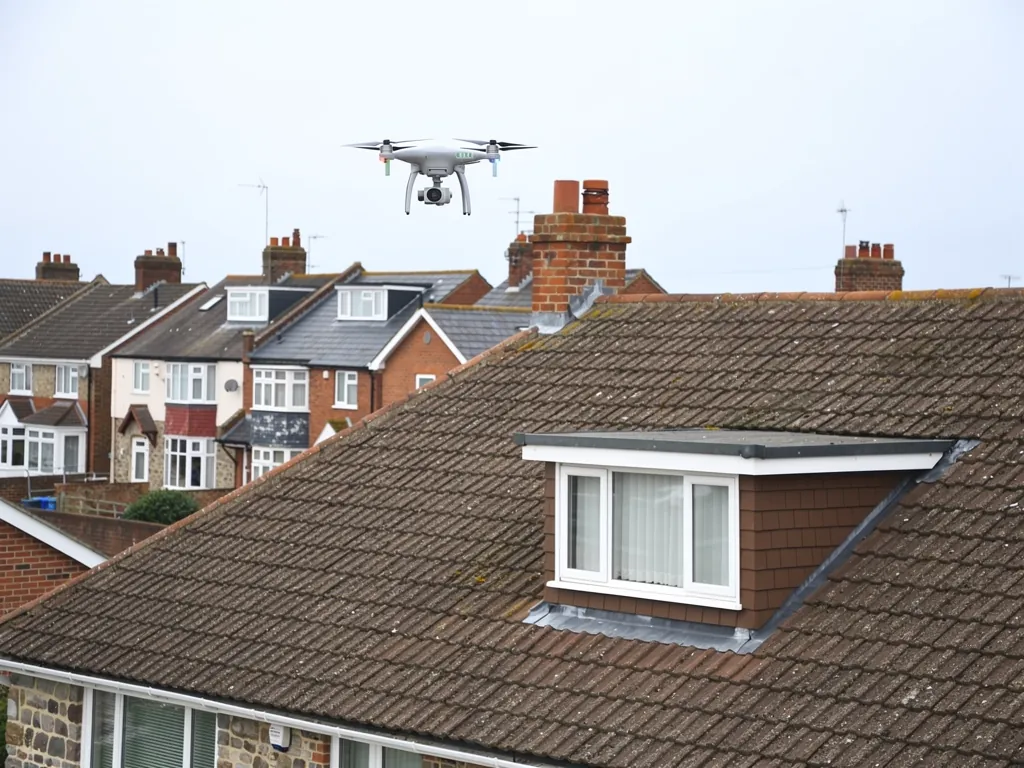
Access can matter more than the inspection itself. Checkatrade's scaffolding table (October 2026) lists about £875 for a month's hire on a two-storey semi and £1,200 on a detached house. If the roof can be checked by drone or from a tower, there may be no need for scaffold at all, and that is worth saying to the insurer.
Temporary repairs and receipts
Among the things to report to the insurer, the Institution of Structural Engineers names urgent repairs, such as a temporary covering fitted to keep the rain out. Keep the receipt and the photographs of the cover in place. A tarpaulin battened down, or a weather-tight panel over exposed boards, is a temporary repair and is described as one.
VAT and the paperwork
Standard-rate VAT is 20 per cent. Before a quote or receipt goes to the insurer, look for two things on it: VAT in or out, and scaffolding in or out. A total that leaves either unclear invites queries, and queries slow a claim down. Ask the roofer to make both plain on the page.
When the insurer's answer disappoints
Sometimes the answer is not what you hoped. The insurer may call the damage wear and tear, may pay for part of the work or may decline. That is a decision about the policy. An inspection cannot overturn it, but it can help you question it if the evidence supports you.
Start by asking the insurer for the decision in writing, with the reasons. Read the wording it relies on, and compare its description of the damage with your own photographs and the roofer's findings. If the two disagree, say exactly where. A calm letter that points to numbered photographs gets further than a general protest, and it gives whoever reads it next a short route through your case.
Escalating a complaint
Which? advises complaining to the insurer first and, if you are still unhappy, taking the complaint to the Financial Ombudsman Service, which is free to use. The ombudsman looks at both sides, so the more orderly your evidence, the easier that job is.
You may also decide a second opinion is worth having, from a roofer who did not do the first inspection. It costs something, but it can settle whether the disagreement is about the roof or about the policy.
Meanwhile the roof still has to be dealt with. A leak does not wait for a complaint to finish, so make the roof safe, keep the receipts and keep the photographs. When you are ready, our roof inspections and surveys page explains how we work, and the home insurance and roof repair guide covers the repair side.
Questions
Roof inspections and insurers
Do I need a roofer's report before I contact my insurer?
No. Contact the insurer first, make the roof safe and take your own photographs. Insurers often say who should inspect and which evidence they will accept, so ask early. A roofer's inspection then follows that guidance and answers the questions the insurer really has.
Can a roofer say whether a storm caused the damage?
A roofer can describe what looks recent and what looks long-standing, and give an opinion on cause. The decision on whether the policy covers it is the insurer's. A fair report separates what was seen from what is inferred, and says when the roof shows signs of both.
Can a leak be stopped before the insurer has been out?
A leak that is still running cannot usually wait for a visit. Tell the insurer as soon as you can, take photographs, then have the roof made safe. Which? advises that if you arrange emergency repairs yourself, you tell the insurer about them and keep every receipt.